CUSTOM AI AGENT DEVELOPMENT
AI agents for real tasks.With clear boundaries.
YAS builds custom AI agents that research, classify, prepare, route, and assist—inside defined tools, permissions, review rules, and business workflows.
Where an AI agent is genuinely useful
Research across sources
Collect and compare information while retaining sources, assumptions, and evidence for review.
Operator assistance
Prepare a decision, response, or next action while keeping the accountable operator in control.
High-volume classification
Sort requests, documents, leads, products, or content through explicit categories and confidence rules.
Multi-step tool use
Let an agent perform bounded actions across approved systems with permissions, logs, and stop conditions.
Agent capabilities we implement
- Research agents with retained citations
- Support and sales copilot workflows
- Document extraction and classification agents
- Content operations and publishing assistants
- Internal knowledge and retrieval systems
- Tool-using agents with approval gates and audit trails
What turnkey implementation includes
Start with one process. We agree the scope and acceptance criteria before expanding the system—not just a demo or a set of prompts.
A defined first release
The workflow, supported users, existing tools, required access and exclusions. We compare configuration, conventional automation and AI where each fits.
Connected and tested software
Agreed integrations, validation, review steps and recovery paths. Normal cases, missing data and failures are tested against the agreed criteria before launch.
Launch and team handover
Deployment, operating instructions and agreed access to the implementation. We define who monitors it, handles exceptions and owns changes after launch.
How a production agent is built
- 01
Define the job
We specify the task, allowed inputs, expected output, tools, permissions, and the human who owns the result.
- 02
Build evaluation cases
Representative success, ambiguity, and failure examples become the acceptance standard before autonomy expands.
- 03
Add tools and guardrails
The agent receives only the integrations it needs, with structured outputs, limits, logs, and escalation paths.
- 04
Observe real operation
We measure accuracy, exceptions, time saved, and operator corrections instead of judging a polished demo.
YAS / AUTOMATION IN PRACTICE
Three workflows. Real public products.
Email, documents and content: see how an input becomes a usable result, where a person stays involved and how to scope a similar system for your business.
These are breakdowns of YAS-owned products based on their public workflows, not client case studies or measured ROI claims.
01 / Own YAS product
LaycanMatch
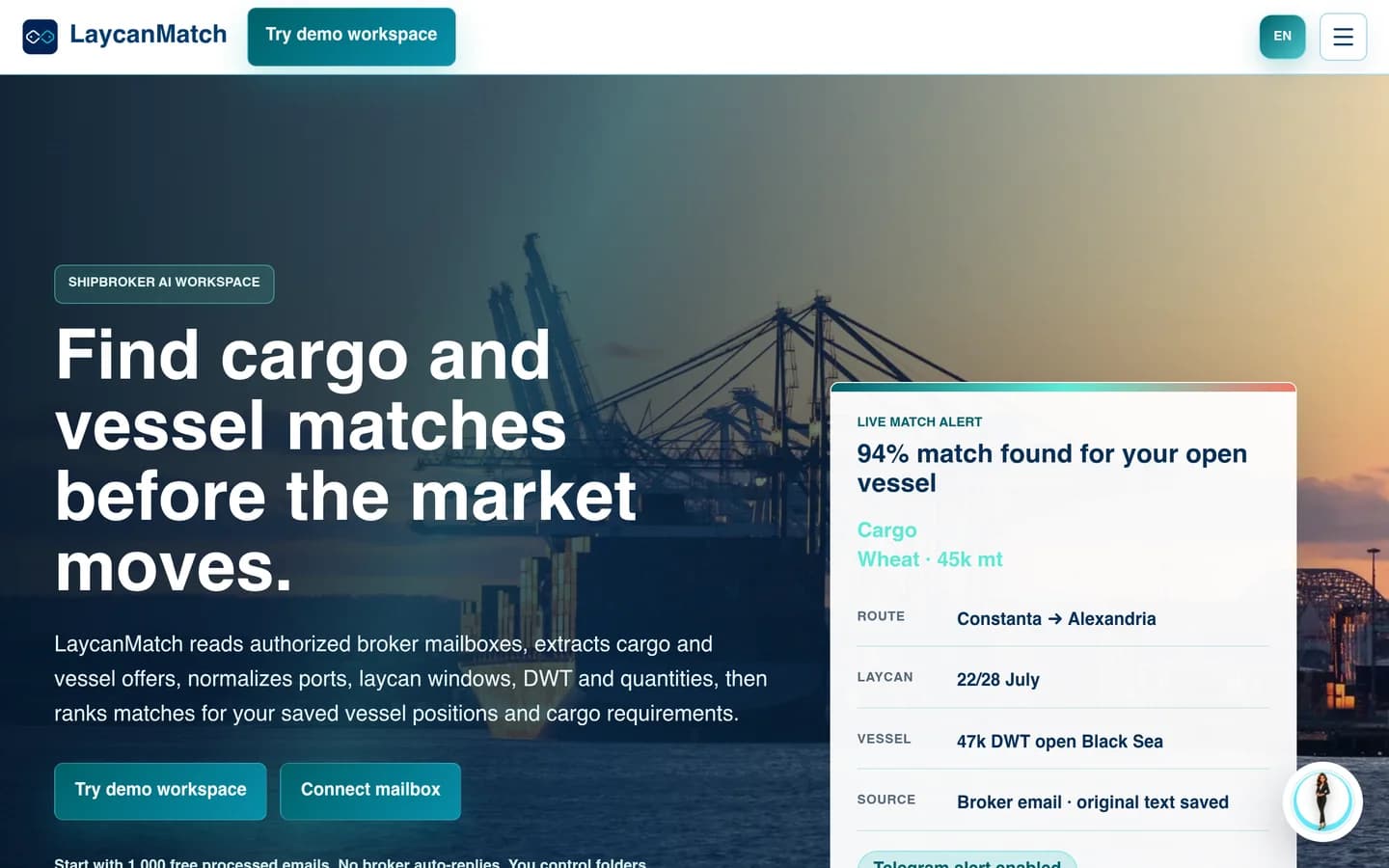
From inbox traffic to a reviewable shortlist
When the useful information is scattered across emails, the first task is to turn messages into records people can work with.
Input
Selected broker emails and circulars.
Automation
Extract cargo and vessel fields; rank possible matches.
Human review
Check uncertain fields against the source email.
Output
Searchable offers and a shortlist for the broker.
The boundary: A match is a candidate, not a commercial decision. Negotiation and fixture approval stay outside this workflow.
02 / Own YAS product
InvoKsef
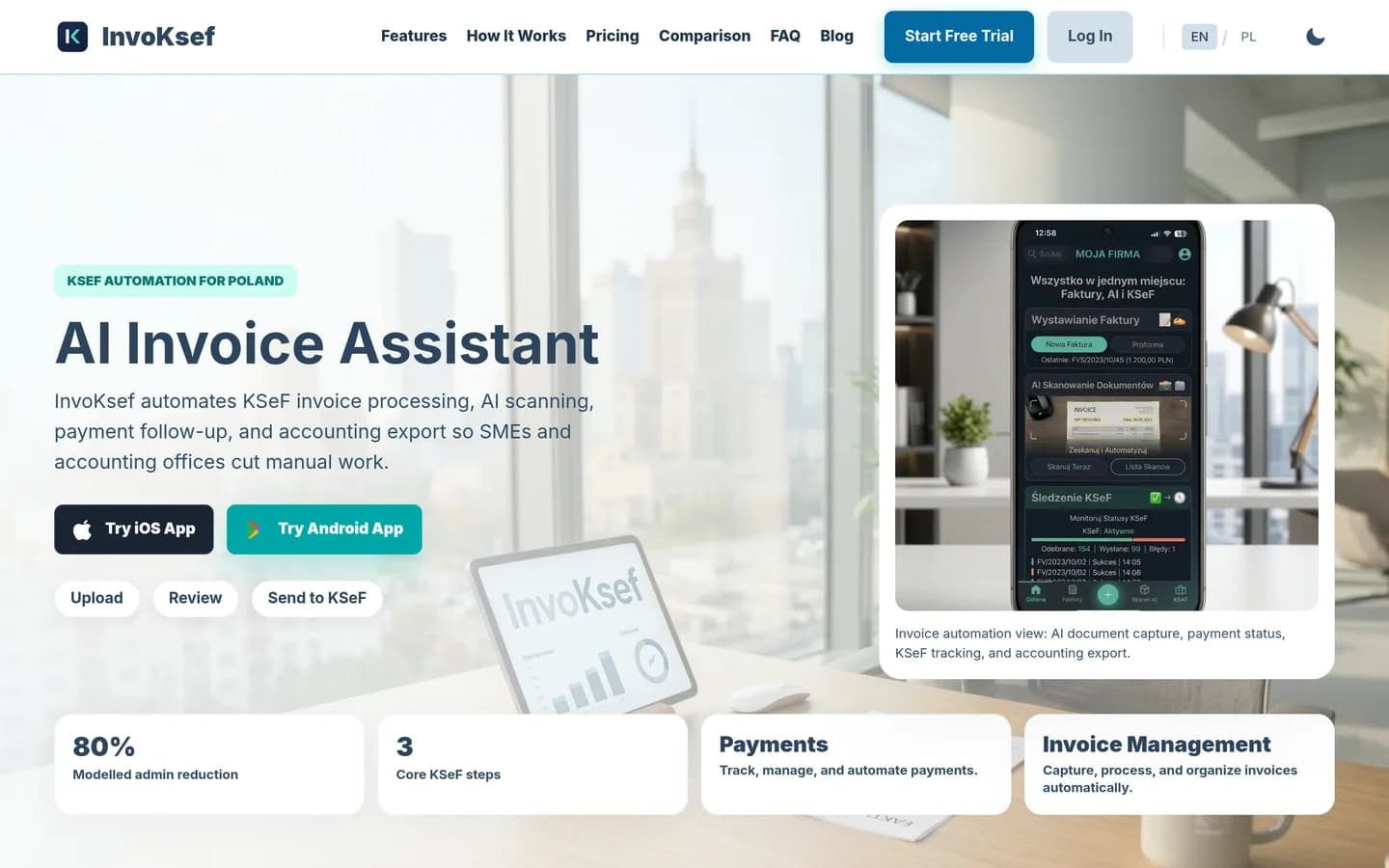
From a document to reviewed invoice data
Document automation needs more than text extraction: someone must catch missing details before the next system relies on them.
Input
Invoice PDFs, photos or created invoices.
Automation
Extract invoice fields for review.
Human review
Review extracted values before sending.
Output
Invoice records, KSeF status and accounting export.
The boundary: Extraction is not an accounting decision or a compliance guarantee. Company-specific rules and permissions need separate validation.
03 / Own YAS product
My UGC Studio

From a product photo to a reviewed creative
A repeatable content process needs a clear brief, reusable inputs and a quality check — not just a generate button.
Input
A product photo and a chosen creative direction.
Automation
Generate product imagery or UGC-style video variants.
Human review
Check product appearance, labels and brand fit.
Output
Creative assets for a listing or campaign.
The boundary: An AI-generated asset is not a real customer testimonial. Output still needs review; it does not prove a sales uplift.
Model-independent architecture
A useful agent should not depend on one model brand. We select models by task quality, latency, privacy, and cost, then place them behind a controlled application layer with retrieval, tools, evaluation, and human approval where needed.
FAQ
What is the difference between an AI agent and a chatbot?
A chatbot mainly exchanges messages. An agent can work toward a bounded goal using approved information and tools, while following explicit permissions and stop conditions.
Can an agent connect to our CRM or internal software?
Yes, when the system offers a safe API or another controlled integration surface. Access is limited to the actions required by the workflow.
How do you test an AI agent?
We use representative evaluation cases, inspect tool calls and evidence, track failures and human corrections, and verify the complete workflow rather than a single model response.
What should I send to start?
Describe one manual process, the tools involved and the result you want. A few sentences are enough for an initial discussion. No credentials, customer records or detailed specification are required. YAS reviews the request and clarifies the scope before proposing an implementation.
How are implementation and running costs agreed?
The proposal depends on scope, integrations, access and acceptance requirements. It separates implementation from recurring model, hosting and third-party costs. We agree these responsibilities before work starts; a short inquiry alone cannot establish a reliable fixed price.
What happens after launch?
The handover defines operating responsibilities, documentation and agreed implementation access. Ongoing monitoring, support and future changes need an explicit agreement; unlimited support is not implied by a turnkey build.