
Recent job postings across customer support and sales functions show a recurring operational pattern: individual team members are explicitly tasked with maintaining record hygiene and logging interaction notes across multi-system environments. This repeated responsibility raises an architectural product-design question about how engineering teams can construct robust synchronization layers that reduce administrative friction while maintaining strict data governance.
What Job Postings Reveal About Multi-Tool Data Maintenance
In modern revenue and support operations, job descriptions frequently define explicit responsibilities for keeping records synchronized across disparate platforms. In a public job ad for a Support Operations role at Stripe, the posting states the expectation to "Maintain data hygiene, consistency, and accuracy across our support stack, including Pylon, Slack, HubSpot, and other systems." This explicit requirement demonstrates that operational staff are tasked with cross-system data consistency across multiple named platforms.
Similarly, sales development advertisements place direct emphasis on pipeline maintenance. In a posting for an Inbound Sales Development Representative at Ramp, the job ad specifies that the hire must "Maintain accurate and detailed activity, notes, and pipeline data in Salesforce". In another instance, Gusto's posting for Early Career Sales Talent calls for candidates to "Maintain accurate notes and pipeline details in Salesforce to ensure excellent follow-through."
These listings establish as fact that companies assign record-keeping duties directly to operational and customer-facing staff. However, the presence of these advertised tasks does not prove that underlying software is missing, broken, or inefficient. It simply confirms that maintaining pipeline integrity and cross-platform alignment remains an active human responsibility within these operational structures.
- Stripe posting specifies cross-system hygiene across Pylon, Slack, HubSpot, and auxiliary tools.
- Ramp posting assigns detailed activity, notes, and pipeline logging within Salesforce.
- Gusto posting requires updating notes and pipeline details to support account follow-through.
The Recurring Operational Pattern Across GTM and Support Stacks
When analyzing these role requirements together, a consistent structural pattern emerges: organizations rely on individual operators to act as the primary reconciliation layer between communication channels and centralized databases. In support environments, this involves validating customer identifiers and ticket context across chat and CRM tools. In sales functions, it involves transcribing prospect interactions and advancing deal stages.
A fair inference from this pattern is that cross-system communication naturally introduces state fragmentation. When customer conversations occur in chat tools, video conferences, or email clients, the resulting metadata does not automatically align with commercial pipeline records unless specialized infrastructure bridges the gap. When teams evaluate their own workflows, understanding how data flows between capture points and primary systems becomes the critical first step in system design.
When building an initial internal reconciliation prototype, understanding how to scope an MVP without waste prevents scope creep. how to scope an MVP without waste.
Evaluating Evidence: How to Establish if Friction is Systematic
A job advertisement indicates what a team asks an individual to do, but it cannot measure how much organizational time is consumed or whether data degradation occurs. Before technical teams propose engineering solutions, they must establish rigorous empirical baselines within their own operating environment.
To determine whether multi-tool logging warrants custom software development, an organization must audit its own telemetry. Engineering leaders should inspect field update histories, measure the frequency of cross-system data mismatches, and identify where customer interaction context is lost between support threads and account records. When organizations decide whether to build or buy software, analyzing real operational bottlenecks prevents over-engineering basic integrations.
Before embarking on internal tooling projects, evaluating workflow automation cost ensures clear return on engineering investment. evaluating workflow automation cost.
Proposed Architecture: A Minimal Conditional Data Sync Engine
If an operational audit reveals systematic data drift and high operator overhead, software teams can design an event-driven synchronization engine. A proposed system could ingest raw communication events from communication platforms, process structured state changes through deterministic validation pipelines, and stage proposed updates for primary systems.
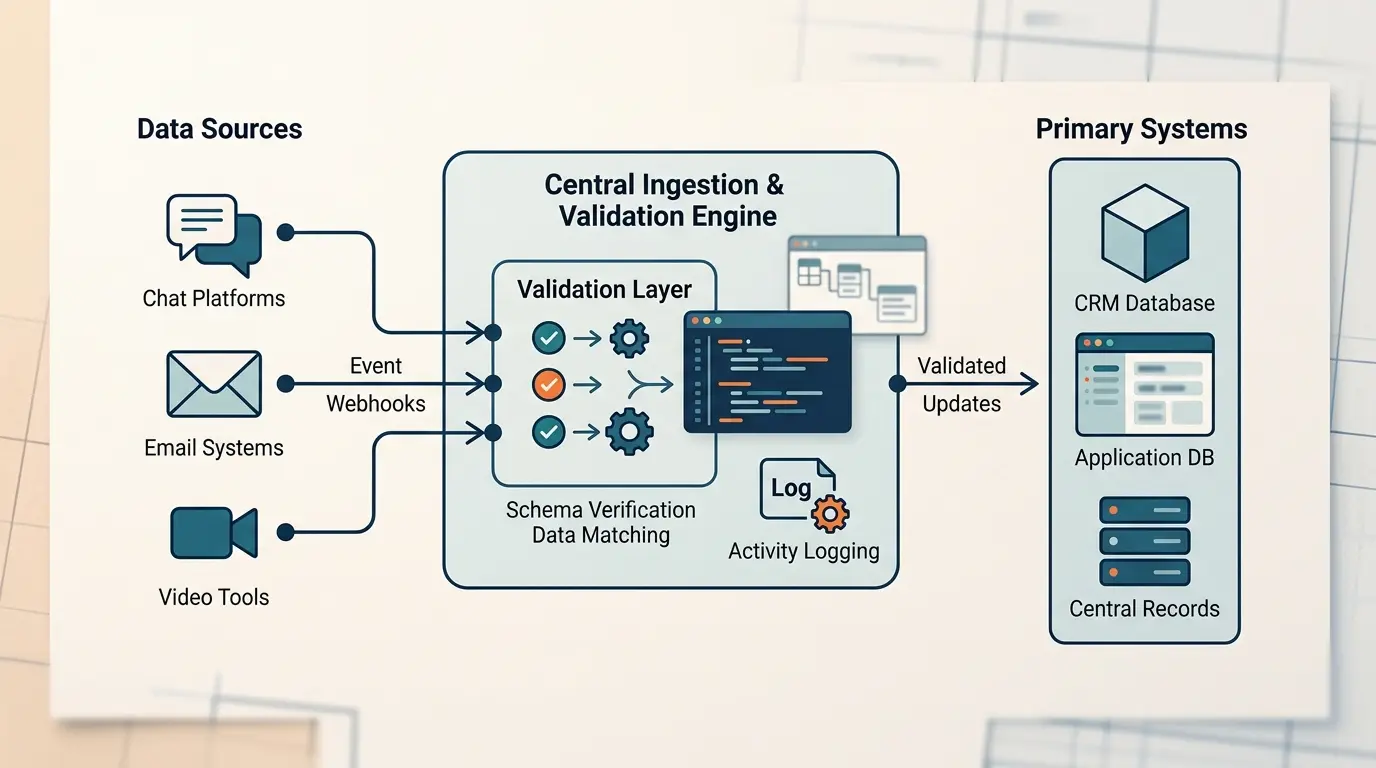
The architecture would need to operate conditionally based on verified data sources. Rather than allowing unvalidated bulk writes to a core CRM, the synchronization engine should parse inbound webhooks, normalize payload schemas, cross-reference account keys against existing relational models, and compute diffs before updating any target repository.
By treating CRM hygiene as a formal data integration problem rather than an informal administrative task, engineering teams can build reliable pipelines that isolate data transformations and preserve data integrity across enterprise stacks.
For teams addressing complex data synchronization challenges, custom software development provides full architectural control. custom software development.
Deterministic Validation Preceding Generative Transformation
A resilient internal integration pipeline must enforce strict deterministic rules before introducing any language models or automated text summarization. Generative components should never determine primary entity relationships, foreign keys, or commercial lifecycle states on their own.
In a well-architected pipeline, incoming communication metadata is first parsed against strict deterministic criteria: verifying domain matches, confirming active deal identifiers, checking timestamp sequences, and validating schema constraints. Only after the system deterministically binds an event to a verified account record should an AI summarization module be invoked to condense conversation logs into structured notes.
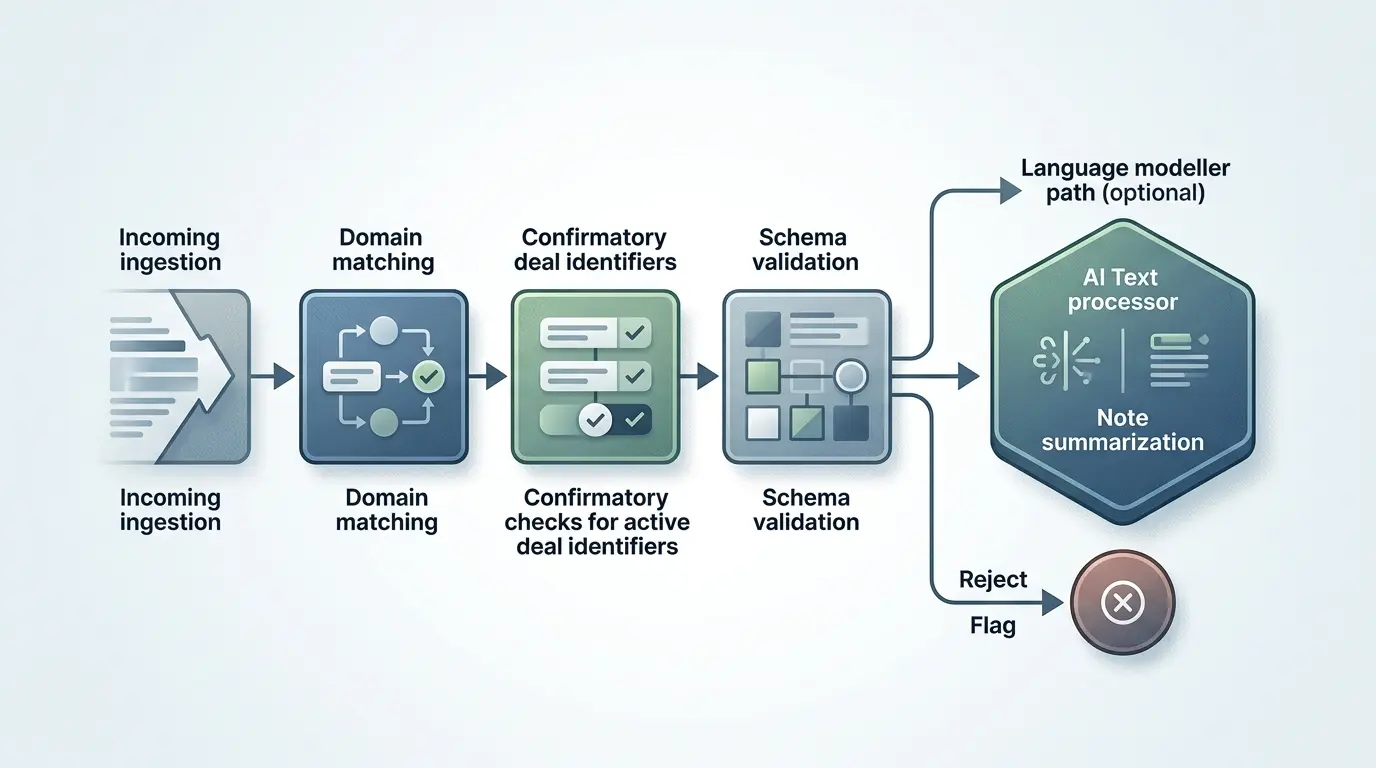
This separation of concerns ensures that programmatic invariants remain rigid while contextual intelligence is constrained to qualitative synthesis, mitigating the risk of phantom record creation or corrupted deal stages.
Exception Handling, Conflict Isolation, and Auditability
Data reconciliation frequently encounters edge cases, such as multiple contacts sharing a domain, ambiguous ownership transfers, or contradictory lifecycle states across platforms. A robust design must never attempt silent auto-resolution when foreign keys conflict.
When an anomaly is detected, the engine must isolate the transaction in a dedicated exception queue and write a structured error log. The target systems should retain their prior valid states while the disputed update is flagged for review. Furthermore, every automated payload staging must include an immutable audit log detailing source timestamps, raw payloads, deterministic transformation steps, and target record diffs.
Maintaining thorough traceability ensures that operational managers and compliance teams can inspect data lineage whenever discrepancies arise across the revenue or support stack.
Designing the Human Decision Gate
Automating data ingestion does not mean eliminating human judgment from commercial and operational workflows. Critical lifecycle transitions, high-value account updates, and ambiguous record reconciliations require an explicit human decision gate.
A proposed internal system could surface pending CRM updates within the operator's primary workspace through concise approval interfaces. Rather than requiring staff to manually transcribe call notes and adjust dropdown fields across several tabs, the interface presents pre-compiled entity matches and drafted notes for a single-click confirmation or inline edit.
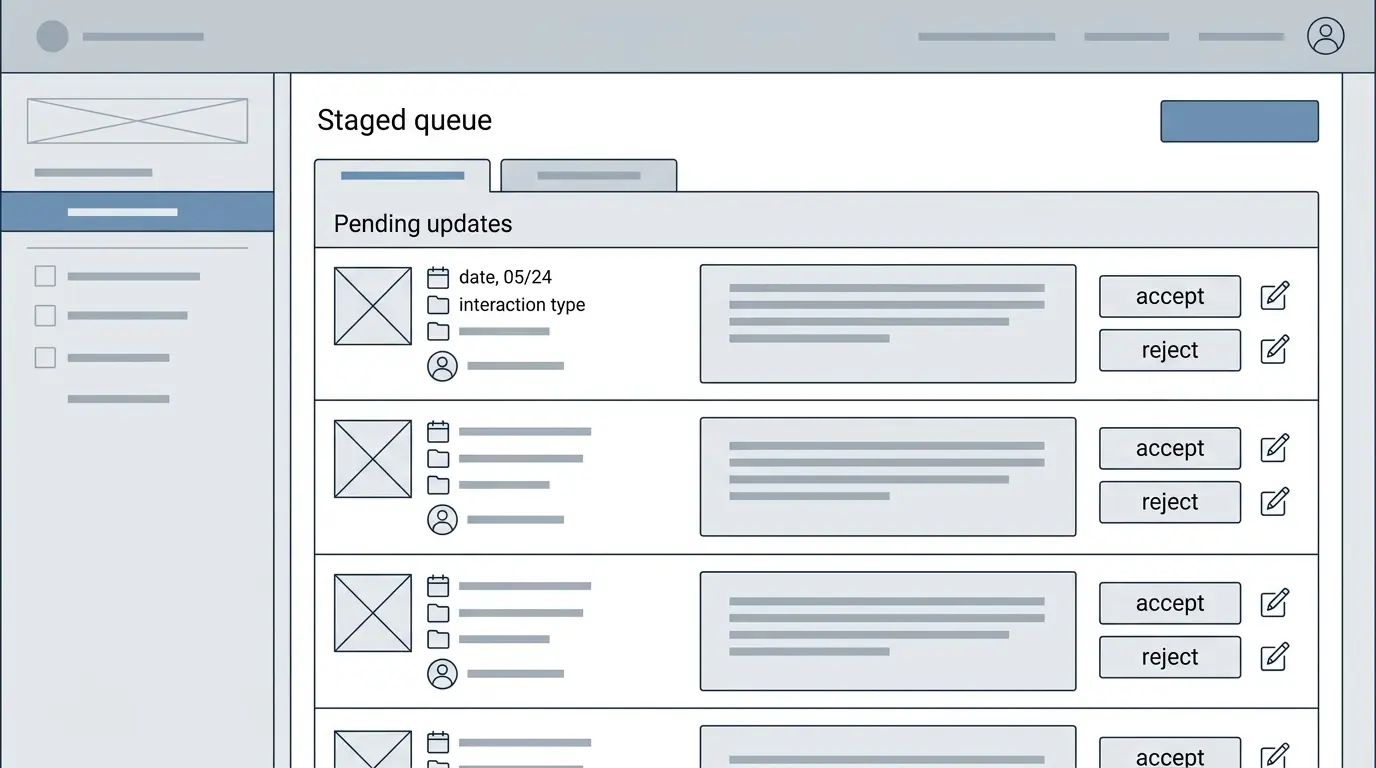
This human-in-the-loop design maintains data ownership with the domain expert while drastically simplifying the mechanical burden of multi-field pipeline administration.
Assessing Implementation Viability Within Your Stack
Organizations considering whether to build custom reconciliation systems must evaluate the complexity of their unique data dependencies. When off-the-shelf connectors fail to accommodate bespoke business logic or custom entity relationships, custom engineering offers full control over data flow and validation rules.
Technical leaders must balance development scope against operational complexity. By starting with a minimal, audit-backed pipeline focused on the most fragile cross-system touchpoints, teams can deliver high-leverage data hygiene without introducing unnecessary architectural overhead.
When evaluating whether standard connectors suffice, comparing custom software to off-the-shelf SaaS helps identify architectural trade-offs. comparing custom software to off-the-shelf SaaS.
| Company | Role | Exact Advertised Task | Bounded Interpretation | Source and Access Date |
|---|---|---|---|---|
| Stripe | Support Operations, Privy | Maintain data hygiene, consistency, and accuracy across our support stack, including Pylon, Slack, HubSpot, and other systems. | The job ad assigns cross-system data consistency maintenance across multiple support and CRM platforms directly to the support operations role. | https://stripe.com/jobs/search?gh_jid=8162819 (Verified August 27, 2026) |
| Ramp | Sales Development Representative | Inbound | Maintain accurate and detailed activity, notes, and pipeline data in Salesforce | The job ad requires the inbound sales representative to keep activity logs, notes, and pipeline records accurate in Salesforce. | https://jobs.ashbyhq.com/ramp/f98771d6-e685-4b91-a466-71789c238e33 (Verified August 21, 2026) |
| Gusto | Future Opportunities: Early Career Sales Talent | Maintain accurate notes and pipeline details in Salesforce to ensure excellent follow-through. | The job ad specifies that sales talent must record accurate interaction notes and pipeline updates in Salesforce to support deal follow-through. | https://job-boards.greenhouse.io/gusto/jobs/8001931 (Verified August 14, 2026) |
Diagnostic Checklist: Auditing Multi-System CRM Hygiene
- Audit existing communication and CRM tools to document all locations where customer interaction data is created.
- Measure field-level discrepancy rates between chat systems, support trackers, and primary CRM databases.
- Map existing API endpoints and webhook availability for all tools in the operational stack to establish integration boundaries.
- Identify common entity matching conflicts, such as duplicate contact emails or overlapping company domain names.
- Document the exact business rules required to validate stage transitions, ownership assignments, and mandatory field requirements.
- Evaluate whether off-the-shelf synchronization tools support the required custom entity schemas and deterministic validation steps.
- Design a staged approval interface to test operator review speed and accuracy before writing updates directly to production databases.
- Establish structured logging and immutable audit trails to track every field change and manual override.
Maintaining clean CRM data across fragmented communication channels is fundamentally an architectural integration problem, not an individual operational shortcoming.
FAQ
Do these job postings prove that the cited companies lack internal automation tools?
No. A job advertisement describes assigned responsibilities for an individual hire. It does not provide evidence about an organization's internal tooling, automated workflows, tech stack maturity, or operational software investments.
Why is CRM hygiene frequently assigned to frontline operational staff?
Frontline staff directly participate in customer conversations and support interactions, placing them in the immediate position to interpret conversation context, deal progress, and account status.
What is the primary risk of using generative AI directly for CRM synchronization?
Unconstrained language models can hallucinate entity associations, misapply foreign keys, or generate inaccurate pipeline metadata if deterministic schema validation and entity resolution are not enforced beforehand.
When should an organization build a custom synchronization engine instead of buying standard SaaS connectors?
A custom synchronization engine is warranted when business logic, entity relationships, validation constraints, and multi-system exception workflows exceed the configuration capabilities of standard off-the-shelf tools.
How does a human decision gate protect CRM integrity in automated pipelines?
A human decision gate allows domain specialists to quickly verify drafted field updates and summaries before changes are committed, ensuring high data accuracy while reducing manual typing.
What metrics should engineering teams monitor to evaluate cross-system data quality?
Teams should monitor data discrepancy rates across systems, unresolved identity conflicts in exception queues, time elapsed between interaction events and record updates, and manual override frequencies.