
Choosing between custom software and off-the-shelf SaaS depends on whether your core business processes require a unique competitive advantage. Off-the-shelf software provides immediate, cost-effective utility for standard business functions. Conversely, custom software is necessary when your workflows are highly proprietary, require deep integrations, or demand complete ownership of the underlying technology to scale effectively without recurring subscription fees.

Understanding the Core Trade-Offs
When evaluating software options, operators face a fundamental choice: adopt a pre-built Software as a Service (SaaS) application or invest in developing a proprietary custom software solution. This decision impacts not only the initial budget but also the long-term operational flexibility, technical debt, and competitive positioning of the enterprise. SaaS platforms are designed as multi-tenant systems, meaning a single codebase serves a broad user base. This model allows SaaS providers to distribute infrastructure and development costs across thousands of customers, offering relatively low entry costs and rapid deployment. However, because these platforms are engineered to address the common needs of a wide market, they inherently require users to conform to standardized workflows.
Custom software, by contrast, is built to align precisely with the specific operational requirements of a single organization. Instead of adapting business processes to match the limitations of an external platform, the software is engineered around the existing or desired workflows of the company. This approach requires a dedicated development lifecycle, including requirements gathering, architecture design, frontend and backend engineering, and ongoing quality assurance. While this path demands a more significant commitment of capital and management attention, it can yield an owned and controlled asset when the contract, code handover, infrastructure access, and intellectual-property terms explicitly provide that ownership. For founders and operators, the core strategic question is whether the software in question supports a standard administrative function or a core, value-generating process that defines the business's competitive advantage.
In modern product development, particularly within specialized ecosystems like e-commerce, this trade-off is highly pronounced. A merchant operating on Shopify might utilize standard off-the-shelf applications for basic utilities like email notifications. However, when the business model relies on proprietary subscription logic, complex multi-warehouse routing, or specialized AI-driven personalization, standard applications may fall short. In such scenarios, custom-engineered solutions or native-first Shopify applications can provide the precise functionality required to execute the business strategy.
Workflow Fit and the Cost of Workarounds
The operational efficiency of any organization is influenced by how well its software tools support daily tasks. Off-the-shelf SaaS products are built with opinionated workflows designed for market averages. When internal processes do not align with these pre-defined pathways, employees must either alter their methods or implement manual workarounds. These workarounds often involve exporting data to spreadsheets, manual copy-pasting, and maintaining offline records to track information that the SaaS tool cannot accommodate.
While a single workaround may seem minor, the cumulative effect of multiple manual interventions across a team can be substantial. Manual data transfer increases the likelihood of human error, leading to data discrepancies and operational friction. As the business scales, the labor hours dedicated to maintaining these workarounds grow, which can offset the initial cost savings of the SaaS subscription. Operators must analyze their workflows to identify where standard software forces inefficient practices.
Custom software mitigates these issues by automating the exact steps of an established workflow. By building software that mirrors the physical or logical operations of the business, organizations can eliminate redundant steps and reduce the need for manual intervention. For instance, in complex logistics or order fulfillment, a custom application can automatically route tasks based on real-time inventory levels and carrier availability without requiring staff to manually cross-reference multiple dashboards. This level of process alignment ensures that the software serves as an accelerator for growth rather than an operational bottleneck.

Integration Complexity and Data Ownership
Modern business operations rarely rely on a single software application. Instead, they utilize an ecosystem of tools for customer relationship management, enterprise resource planning, financial accounting, and marketing automation. The value of these systems is maximized when data flows freely and accurately between them. While many SaaS vendors provide pre-built integrations or connectors, these integrations are often designed for basic use cases. They may not support custom fields, real-time synchronization, or complex data transformations required by more sophisticated operations.
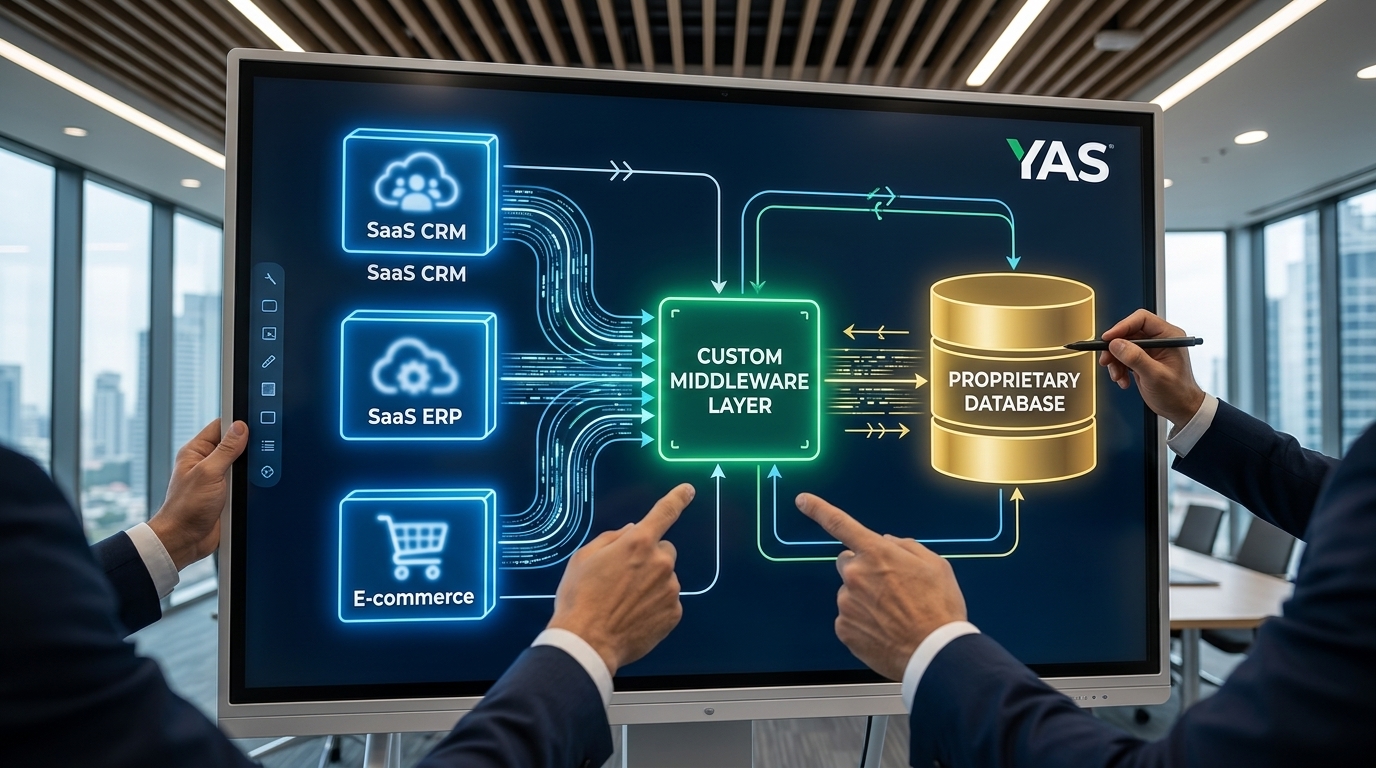
When pre-built integrations are insufficient, businesses must develop custom middleware or rely on third-party automation platforms to bridge the gaps. This can introduce additional layers of complexity and potential points of failure. If one SaaS provider updates its API, the integration may break, requiring immediate developer intervention to restore functionality. With custom software, the integration architecture is designed holistically. Developers can establish direct, robust connections between databases using custom APIs, ensuring that data is transformed and synchronized according to precise business rules without relying on restrictive third-party connectors.
Data ownership and security represent another critical dimension. When utilizing off-the-shelf SaaS, an organization's data is typically stored on infrastructure managed by the vendor. While SaaS providers maintain security standards, the customer has limited control over data storage formats, backup schedules, and access logs. For businesses operating in regulated industries or those leveraging proprietary data as a competitive asset, this lack of direct control can pose compliance and strategic risks. Custom software allows the organization to define its own data architecture and hosting environment to ensure data sovereignty.
Analyzing Total Cost of Ownership
A comprehensive financial comparison between SaaS and custom software requires analyzing the Total Cost of Ownership (TCO) over a multi-year horizon. SaaS is often marketed as a low-cost alternative because the initial setup fees are minimal compared to the capital required for custom development. However, SaaS pricing models are typically structured around recurring subscription fees, which scale based on the number of user seats, volume of data processed, or specific feature tiers. As an organization grows its team and expands its operations, these recurring monthly or annual costs can escalate significantly.
In contrast, custom software requires a substantial upfront capital expenditure for the initial design, engineering, and deployment phases. Once the application is built and deployed, however, the ongoing licensing fees are eliminated. The operational costs shift to hosting infrastructure, basic security maintenance, and occasional updates to accommodate new operating systems or API changes. For businesses with large user bases or high transaction volumes, the cost curve of custom software can eventually intersect and fall below the cumulative cost of SaaS subscriptions.
To accurately evaluate TCO, operators should calculate the projected costs over a multi-year period. This calculation must include not only the direct software fees and development costs but also the indirect costs associated with system maintenance, employee training, and potential downtime. Additionally, custom software should be viewed as an intellectual property asset that adds value to the company's balance sheet, whereas SaaS subscriptions are purely operational expenses that do not generate equity for the business.
Implementation Risk and Time to Market
Time to market is one of the most compelling advantages of off-the-shelf SaaS. Because the software is already developed, tested, and hosted, an organization can often deploy a SaaS solution within a short timeframe. This rapid deployment is highly advantageous when a business needs to address an immediate operational need, validate a new market hypothesis, or launch a standard service quickly. The risk associated with SaaS implementation is relatively low, as the product's capabilities can be evaluated during a trial period before a long-term commitment is made.
Custom software development involves a longer timeline from initial scoping to final deployment. This extended timeline introduces project management risks, including scope creep, technical roadblocks, and potential delays. If the development process is not managed rigorously, the project can exceed its budget and miss critical market windows. To manage these risks, experienced product studios advocate for an iterative development approach, focusing on building a Minimum Viable Product (MVP) that addresses the most critical business needs first, followed by incremental feature releases based on user feedback.
Furthermore, custom development requires active participation from the business's stakeholders to ensure the final product aligns with operational realities. This demands time and attention from internal teams who must define requirements, review designs, and participate in user acceptance testing. Organizations must honestly assess their internal capacity to support a development project before embarking on a custom build, as inadequate stakeholder involvement is a primary cause of project delays and misalignment.
Limitations and Suitability
Neither SaaS nor custom software is a universal solution; each has distinct boundaries of suitability. Off-the-shelf SaaS is highly effective for non-differentiating business functions—activities that are necessary to run the business but do not contribute to its unique value proposition. Examples include standard payroll processing, general ledger accounting, office productivity suites, and basic email hosting. Attempting to build custom software for these standard functions is generally an inefficient use of capital, as it replicates existing market solutions without providing any competitive advantage.
Conversely, custom software is highly suitable for the core engines of a business—the proprietary systems that define how the company delivers value to its customers. This includes custom logistics algorithms, specialized customer portals, proprietary data analysis tools, and unique e-commerce checkout experiences. If a business relies on a standard SaaS tool for these core operations, it is limited to the same capabilities as its competitors, making differentiation difficult. However, custom software carries the limitation of requiring ongoing technical stewardship. If an organization does not have a reliable plan for long-term maintenance, security patching, and platform updates, the custom asset can degrade over time and become a source of technical debt.
Before making a decision, founders must evaluate their organization's technical maturity and long-term operational budget. A custom software build is not a one-time expense; it requires a commitment to continuous improvement and maintenance. If the business lacks the resources or the partnership of a dedicated engineering studio to manage this lifecycle, adopting a SaaS solution—even if it requires altering some workflows—may be the more stable and less risky path in the short term.
The Hybrid Approach and Automation
The choice between custom software and off-the-shelf SaaS does not have to be a binary one. In many cases, the most effective strategy for growing enterprises is a hybrid approach that leverages the strengths of both models. By utilizing standard SaaS platforms for commodity tasks and building custom software or automation layers for proprietary workflows, businesses can optimize both their development spend and operational efficiency. This approach minimizes upfront development costs while preserving the ability to innovate where it matters most.
For example, a business might utilize a major SaaS platform like Shopify to handle its core e-commerce storefront, shopping cart, and payment processing. This ensures high reliability, security compliance, and access to a broad ecosystem of standard tools. However, to manage a highly specialized fulfillment process or a proprietary customer loyalty program, the business might develop a custom application that connects to Shopify via its APIs. This hybrid model allows the merchant to benefit from Shopify's robust infrastructure while maintaining complete control over the unique aspects of their customer experience and back-office operations.
AI automation represents another area where the hybrid model excels. Instead of building a complete artificial intelligence platform from scratch, businesses can integrate existing AI APIs into their custom workflows or middleware. This allows operators to automate complex data analysis, customer support routing, or content generation tasks without the immense cost of training proprietary models. By combining standard SaaS components with custom-engineered integration layers, organizations can create highly agile, scalable systems that adapt quickly to changing market demands.
Making the Strategic Decision
To determine the optimal path, founders and operators must conduct a structured evaluation of their business goals, technical requirements, and financial constraints. The decision framework should begin with a thorough audit of existing workflows to identify which processes are truly proprietary and which are standard. If a process is standard, the default recommendation is to purchase a SaaS solution. If the process is proprietary and directly impacts customer satisfaction or operational margins, custom development should be seriously considered.
Additionally, organizations must assess their capital allocation strategy. While custom software can deliver a higher return on investment over the long term by eliminating subscription fees and driving operational efficiency, it requires immediate capital that might otherwise be spent on marketing, inventory, or hiring. A clear understanding of the company's financial runway and growth projections is essential to ensure that a custom development project does not jeopardize short-term liquidity.
Ultimately, the decision should be guided by a commitment to building a scalable, resilient technical architecture. Partnering with an experienced product and engineering studio can provide the objective analysis needed to weigh these options. A professional studio can help scope the project, estimate development and maintenance costs, and identify opportunities for hybrid architectures or automation that deliver the desired functionality with minimal risk. By making a deliberate, data-driven choice, operators can ensure their technology stack serves as a powerful foundation for long-term business success.
| Criterion | Off-the-Shelf SaaS | Custom Software | Decision Trigger |
|---|---|---|---|
| Upfront Cost | Low setup fees | High initial investment | Capital availability |
| Time to Market | Rapid deployment | Longer development cycle | Urgency of solution |
| Customization | Configurable within platform limits | High flexibility | Process uniqueness |
| Maintenance | Vendor-managed updates | Requires dedicated maintenance | Technical capability |
| Data Control | Stored on vendor infrastructure | Complete ownership options | Compliance and security requirements |
Steps to Evaluate Your Software
- Document your current workflow step by step without assuming any software solution.
- Identify which parts of your process provide a direct competitive advantage to your business.
- Research existing SaaS tools to see if they cover your standard requirements.
- Calculate the long-term subscription costs of SaaS against the estimated build cost of custom software.
- Assess your team's internal capacity to manage software development or partner with an external studio.
- Run a risk analysis on vendor lock-in, data security, and future API dependency limitations.
Do not build custom software for processes that do not differentiate your business. Save your development capital for the proprietary workflows that your competitors cannot easily replicate.
FAQ
How do I know if my business needs custom software?
If your core operational workflows are unique and cannot be supported by existing SaaS tools without significant workarounds, custom software may be necessary.
Is custom software more expensive than SaaS?
Custom software generally requires higher upfront development costs, while SaaS costs can accumulate over time through recurring subscription fees as user seats or transaction volumes scale.
What are the main risks of relying on off-the-shelf SaaS?
Potential risks include dependency on the vendor's roadmap, potential subscription cost increases, limitations in customization, and constraints on data portability.
Can you combine custom software with off-the-shelf SaaS?
Yes, businesses frequently implement a hybrid model, using custom integrations or middleware to connect standard SaaS applications with proprietary databases or workflows.
How long does it take to build a custom software solution?
The timeline for building a custom software solution varies depending on the complexity, scope, and technical requirements of the project.
Who owns the code when custom software is developed?
Ownership of the intellectual property and source code depends on the specific agreement established with your development partner, though custom development typically aims to provide the client with full ownership.