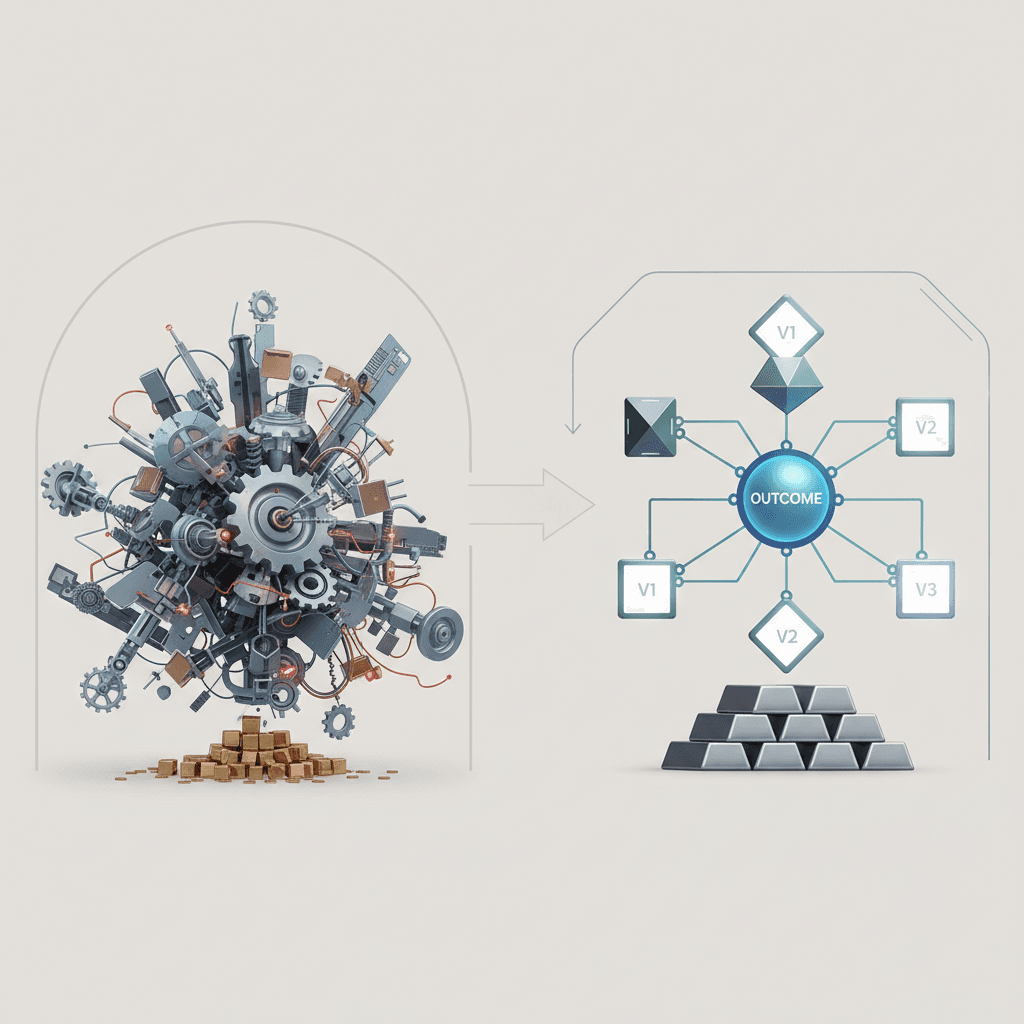
To scope an MVP without wasting budget, you must isolate your core value proposition, define a single user flow, and eliminate non-essential features before writing code. By establishing strict technical boundaries, utilizing existing software integrations, and planning for post-launch maintenance early, founders can avoid over-engineering, control initial development costs, and validate their product idea with real users efficiently.
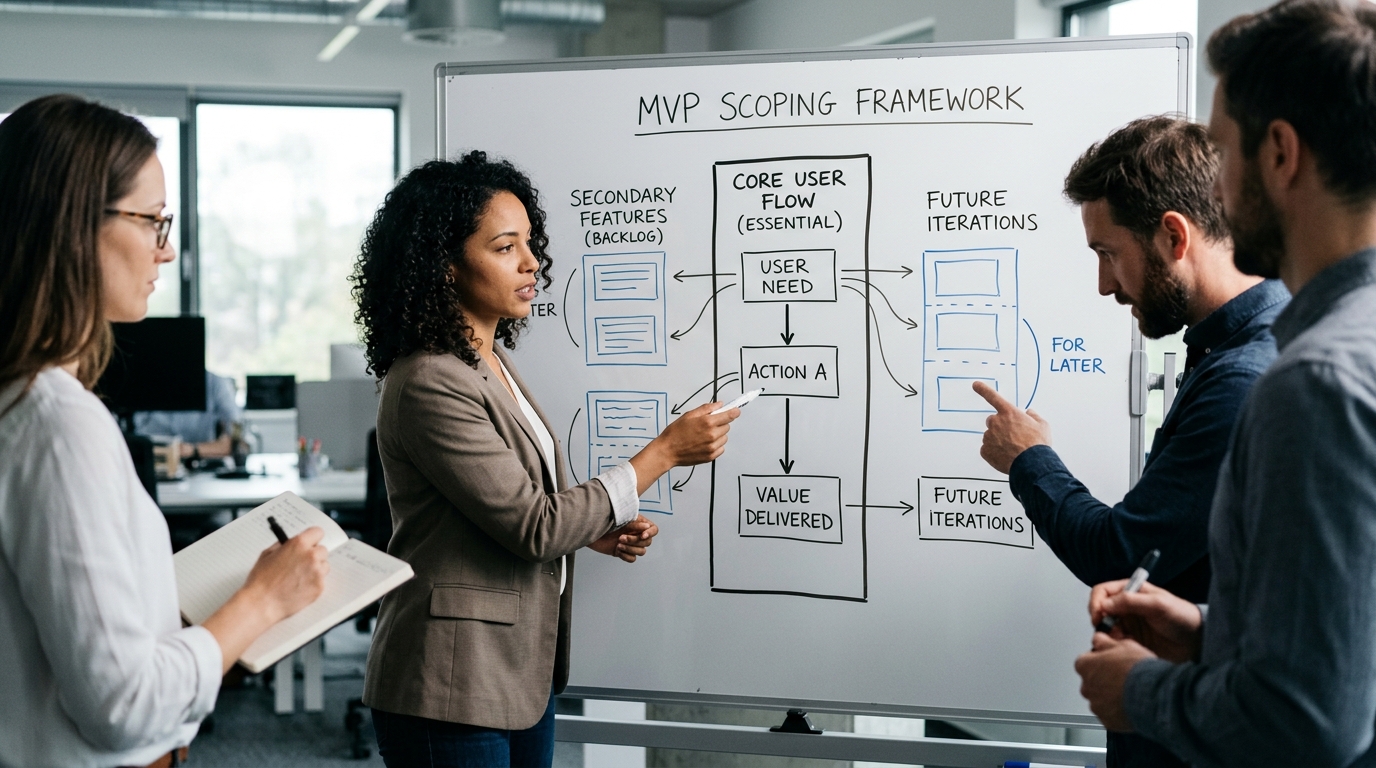
The Core Philosophy of Waste-Free MVP Scoping
Scoping a Minimum Viable Product is an exercise in disciplined subtraction rather than addition. Many founders approach the product development lifecycle by listing every feature they hope to build over the next several years, attempting to pack as much value as possible into the initial release. This approach frequently leads to bloated budgets, delayed launch dates, and a product that attempts to solve too many problems at once. Instead, successful scoping requires isolating the single, core value proposition that addresses your target audience's primary pain point.
To achieve this, operators must map out the absolute shortest path a user can take to experience that core value. Any feature, button, or integration that does not directly contribute to completing this primary user flow must be set aside for future iterations. By focusing on a narrow, well-defined scope, you minimize early technical debt, reduce development time, and preserve precious capital for post-launch adjustments based on real user feedback. This disciplined approach is particularly crucial for founders navigating competitive markets where speed to feedback is a primary differentiator.
Furthermore, waste-free scoping requires a shift in mindset from building a final, polished product to building a functional learning vehicle. Every line of code written for an unvalidated feature represents a financial risk. By treating the MVP as a structured experiment, founders can validate assumptions with minimal exposure, ensuring that subsequent development phases are guided by actual user behavior rather than speculative requirements. When engineering resources are spent on secondary features, they are diverted from refining the core value proposition, creating an opportunity cost that can be highly detrimental to early-stage ventures.
MVP Development Complexity and Resource Planning
The resources required to develop an MVP can vary widely depending on technical complexity, integration requirements, and the development partner you select. For a low-complexity, automation-focused MVP that connects existing tools to validate a workflow, resource requirements are typically minimal. This type of build relies heavily on cloud functions and third-party APIs to demonstrate value quickly without building a massive custom infrastructure from scratch. This is an excellent path for validating basic business logic before committing to custom development.
For a medium-complexity product, such as a native Shopify application or a standard software-as-a-service (SaaS) platform with custom user authentication and database management, resource requirements increase to a moderate level. These builds require a structured database design and a tailored user interface to ensure the core utility is functional and reliable. High-complexity MVPs that require custom AI automation integrations, real-time data processing, or complex mobile applications demand significant resource allocation.
Understanding these relative complexity tiers helps founders set realistic financial and operational expectations before engaging with engineering studios. Rather than focusing on fixed, arbitrary price tags, founders should evaluate the complexity of their desired features and prioritize development tasks that offer the highest validation value per unit of effort. This strategic alignment of scope and resources is essential for maintaining capital efficiency throughout the initial build phase.

What a Complete MVP Development Proposal Should Include
A comprehensive MVP development proposal must go beyond a simple price estimate and a list of features. It should provide a detailed breakdown of the project architecture, the proposed technology stack, and a clear timeline organized around specific milestones. A transparent proposal outlines the exact user stories that will be built, ensuring that both the development team and the founder have a shared, unambiguous understanding of what is included in the initial release.
Additionally, the proposal should detail the design phase, the integration plan for third-party services, and the delivery process. It must specify how quality assurance will be handled and what level of post-launch support is included in the initial agreement. By demanding this level of detail, founders can avoid unexpected out-of-scope charges and ensure that the engineering team has a realistic plan for executing the project within the agreed parameters.
A well-structured proposal also serves as a risk management tool. It should clearly define the boundaries of the MVP, explicitly listing features that are excluded from the initial build. This level of clarity helps prevent scope creep during the active development phase, keeping the project aligned with the founder's strategic timeline and resource constraints. Elaborating on user stories provides a non-technical way to define software behavior, allowing founders to verify whether the proposed scope matches their vision.
Scope, Product, Design, Architecture, Integration, and Delivery Factors
Several key variables can change the resource requirements of an MVP during the scoping phase. In terms of design, opting for highly customized user interfaces and unique animations will typically require more development hours than utilizing established UI kits or platform-native design frameworks. For instance, in native-first Shopify development, leveraging native components may streamline the design and implementation process when the native components fit the validated requirements compared to building entirely custom, non-standard interfaces.
The choice of technical architecture also plays a major role. Attempting to build a highly scalable, multi-tenant cloud infrastructure from day one is far more resource-intensive than setting up a simple, monolithic backend that can be refactored later as demand grows. Founders must balance the desire for long-term scalability with the immediate need for market validation, often opting for simpler architectures that can be deployed quickly.
Third-party integrations are another common driver of complexity. Simple integrations with well-documented APIs are relatively straightforward, but connecting to legacy systems or complex enterprise resource planning (ERP) platforms can add weeks of development effort. Integrating AI capabilities can also range from simple API calls to existing models to training custom models. For an MVP, founders should typically favor existing AI APIs and prompt engineering over custom training, as the latter introduces massive data collection and computational resource requirements that can quickly exhaust an early-stage budget.

Post-Launch Considerations: Infrastructure, Monitoring, Support, and Iteration
Launching your MVP is not the end of your financial commitment; it is the beginning of an operational phase that requires careful budget planning. Founders must account for ongoing infrastructure costs, which include cloud hosting, database management, and content delivery networks. While these costs may start small, they can scale as your user base grows, making efficient database design and resource allocation critical from the start.
Beyond hosting, you must account for application monitoring, error tracking, and ongoing technical support. Technical issues will inevitably arise once real users begin interacting with the system under real-world conditions, requiring developer time to diagnose and resolve. Setting up basic error logging allows the development team to identify and fix critical bugs before they impact a large portion of the user base, preserving user trust during the critical early days of a product launch.
Furthermore, an MVP is designed to be iterated upon based on user feedback. Founders must reserve a portion of their overall budget to implement changes and refinements after the initial launch. Failing to plan for these post-launch iterations can leave a company with a validated concept but no resources remaining to build the next, improved version of the product. These post-launch costs are variable and depend heavily on user adoption and system complexity.
Limitations and Suitability of Lean MVP Scoping
While the MVP approach is highly effective for validating consumer software, SaaS products, and e-commerce tools, it has distinct limitations that founders must recognize. An MVP is not suitable for industries with extremely high regulatory hurdles or safety-critical requirements, where partial functionality is not legally or operationally permissible. In these sectors, products must meet exhaustive compliance standards before they can be tested by actual users in a live environment, making a bare-minimum release impractical.
Additionally, an MVP is not an excuse for releasing a non-functional or poorly designed product. If the core utility of the software is obscured by critical bugs or an unusable interface, you will fail to gather meaningful data on user demand. A seamless user experience is not guaranteed, but the product must be stable enough to deliver its primary value proposition reliably. Launching a dysfunctional product will only result in wasted budget and skewed feedback, as users will reject the software due to technical failures rather than a lack of interest in the core concept.
Finally, an MVP's primary goal is to generate data. If the feedback loop is broken—either because the product does not collect usage analytics or because the founders do not have a structured process for reviewing user feedback—the entire MVP development effort is wasted. Scoping must therefore include planning for how feedback will be collected and analyzed, ensuring that the team can make data-driven decisions for future product iterations.
How YAS Approves and Refines MVP Scopes
At YAS, we approach MVP development with a product-first mindset, helping founders strip away unnecessary complexity to focus on what truly matters. Our team works closely with you to analyze your business objectives, evaluate technical feasibility, and design a lean architecture that aligns with your operational goals. By leveraging native-first Shopify development, AI automation, and custom development only where it adds proprietary value, we help you launch efficiently.
We believe that a successful MVP is built on transparency, clear communication, and a shared commitment to avoiding waste. Our scoping process is designed to identify potential technical risk factors early, allowing you to make informed decisions about feature prioritization before any code is written. This collaborative founder advisory approach ensures that your budget is directed toward building a solid foundation that can scale as your business grows, providing a practical path from initial concept to market validation.
As a product and engineering studio, YAS does not just write code; we act as strategic partners. We help founders navigate the trade-offs between custom development and native platform features, particularly within the Shopify ecosystem, ensuring that every technical decision supports a clear business objective. This comprehensive approach minimizes waste and maximizes the learning value of your initial product launch.
| MVP Complexity | Resource Allocation Level | Core Focus | Technical Approach |
|---|---|---|---|
| Low Complexity | Minimal | Single core workflow, basic data handling | Leveraging existing APIs and simple automation |
| Medium Complexity | Moderate | Custom database, user authentication, core utility | Native-first platform development or tailored web application |
| High Complexity | Significant | Complex data processing, AI automation integrations | Custom backend architecture and specialized APIs |
| Enterprise Integration | Extensive | Legacy system synchronization, high compliance alignment | Custom security layers and robust enterprise integrations |
Five Steps to Strip Waste from Your MVP Scope
- Identify the single primary action a user must take to receive value.
- Map the absolute shortest path to complete that action, ignoring non-essential edge cases.
- Evaluate if custom-built features can be replaced with existing software integrations or native platform features.
- Set a strict, compressed timeline to force prioritization and prevent scope expansion.
- Establish manual processes behind the scenes to test workflows before building complex automated backend systems.
An MVP is not a half-built product; it is a fully realized answer to a very narrow question. Waste occurs when you try to answer multiple questions at once.
FAQ
What is the average MVP development cost?
Development costs are highly variable and depend on the product's complexity. A low-complexity MVP utilizing workflow automation requires minimal resource allocation, whereas custom web applications or native Shopify applications require moderate to significant resources depending on the feature set.
How do I know if my MVP scope is too large?
If your planned release includes secondary features like advanced notification preferences, multiple payment gateways, or deep analytics dashboards, your scope is likely too broad. Focus strictly on the single flow that solves the user's primary problem.
Should I build a custom MVP or use off-the-shelf SaaS tools?
Whenever possible, use off-the-shelf SaaS tools, native platform capabilities, or workflow automations to validate your concept. Custom software should only be developed for the proprietary core of your product that cannot be replicated with existing platforms.
What is often missing from an MVP development proposal?
Many proposals omit detailed post-launch support terms, hosting cost projections, and a granular breakdown of user stories. Ensure these elements are clearly documented before signing to avoid unexpected out-of-scope charges.
How much should I budget for post-launch MVP costs?
You should expect to budget a planned portion of your initial development cost annually for hosting, monitoring, support, and minor iterations. These costs are variable and depend heavily on user adoption.
Can I use workflow automation to build an MVP?
Yes, workflow automation tools can serve as the entire backend for an MVP, allowing you to validate business logic and user demand with minimal upfront coding.
Decision scenarios
Illustrative scenarios for applying the framework, not completed client projects or measured results.
Scenario 1: Booking product: test whether a user can find a suitable slot, request it and receive a confirmed outcome before adding loyalty programs or complex recommendations.
Scenario 2: Internal portal: deliver one request-to-resolution workflow with permissions and an exception owner before combining several departments into one system.
Scenario 3: AI-assisted product: test the smallest useful input-to-reviewed-output path. Define unacceptable outputs and human review before expanding to autonomous actions.