
Public job postings across major technology companies explicitly assign sales representatives the responsibility of maintaining accurate customer records, logging outreach activities, and updating pipeline stages in CRM systems. This recurring operational duty establishes a clear product-design question: how can revenue teams structure custom internal workflows to capture structured communication data deterministically while reserving human judgment for essential customer qualifications?
What the Job Postings Literally Assign
A review of verified job advertisements across software and financial technology organisations reveals an explicit operational expectation: sales representatives must maintain their own CRM records. The specific responsibilities range from synchronising individual touchpoints to preserving overall pipeline accuracy.
In a job advertisement for a Sales Development Representative, AUNZ, Stripe states that the hire must 'Effectively manage customer outreach, consistently meeting and exceeding Service Level Agreements (SLAs), meticulously updating activity and contact information within the Customer Relationship Management system (Salesforce) to support weekly reporting efforts'. Similarly, Ramp advertises for an Inbound Sales Development Representative who must 'Maintain accurate and detailed activity, notes, and pipeline data in Salesforce'.
A recruitment posting from Gusto for early career sales talent specifies that candidates must 'Maintain accurate notes and pipeline details in Salesforce to ensure excellent follow-through.' Across each case, the advertisement explicitly documents that maintaining record accuracy, logging activity, and updating pipeline data in Salesforce is a core component of the representative's operational role.
The Recurring Operational Responsibility Across Sales Roles
When examining these job listings side by side, a clear pattern emerges. The published responsibilities focus on three distinct actions: recording communication events, revising contact metadata, and updating stage classifications. These records serve internal operational needs, including weekly performance reporting, follow-up management, and pipeline tracking.
It is a fair inference that managing this volume of transactional record updates creates continuous operational overhead for customer-facing teams. However, a job posting duty proves neither the absence nor the presence of internal automation software. An organisation may already employ partial synchronisation tooling or require representatives to perform validation manually to ensure stringent reporting integrity.
The recurrence of this duty across distinct market leaders highlights that CRM hygiene remains a critical human responsibility unless structured systems are intentionally engineered to manage the data ingestion path.
Investigating Operational Scope: Evidence of Internal Friction
Before concluding that an internal product opportunity exists, an organisation must collect rigorous internal operational evidence. Relying on generalised assumptions about sales friction is insufficient to justify custom engineering investment.
A sound internal investigation inspects whether the task creates latency in pipeline reporting or introduces discrepancies into account ownership. If customer-facing representatives must switch contexts between email clients, telephony tools, and CRM interfaces to enter matching data, the workflow introduces operational fragmentation.
Evaluating this pattern requires measuring concrete metrics within the business: the average time elapsed between an outreach interaction and the CRM log entry, the proportion of pipeline records with incomplete required fields, and the volume of manual reconciliation hours logged by revenue operations teams.
Before engineering internal tooling, operations leaders must establish accurate baselines by measuring workflow automation costs and manual labor overhead. measuring workflow automation costs.
Smallest Conditional Internal Product Architecture
If an organisation establishes that manual record maintenance creates verified operational drag, it can consider building a lightweight, conditional internal product. Rather than deploying massive third-party platforms, a purpose-built ingestion pipeline can capture outbound and inbound interactions at the transport layer.
A proposed system architecture would ingest raw communication events directly from mail transfer agents, calendar servers, and telephony webhooks. An ingestion worker extracts message headers, timestamps, participant email addresses, and interaction channels.
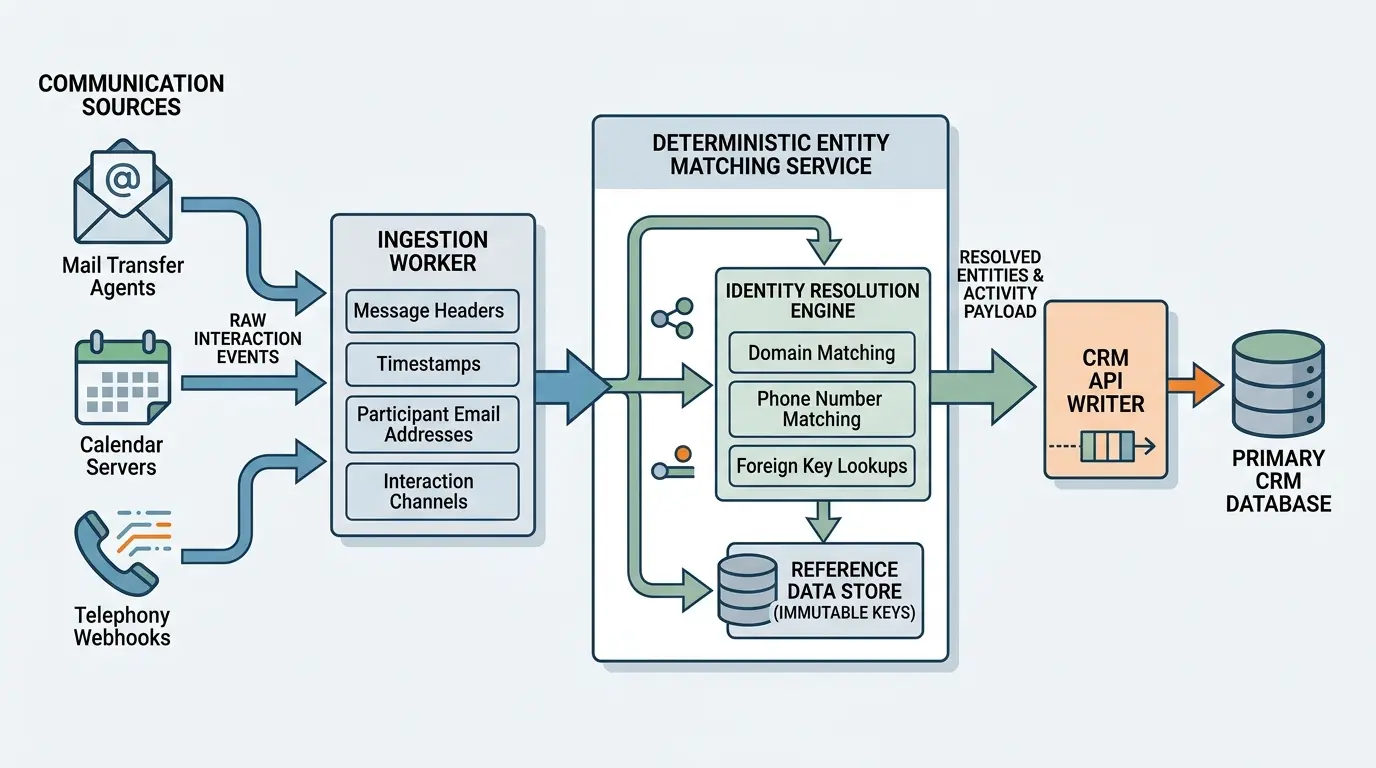
By passing this payload through a deterministic entity matching engine, the internal service identifies the corresponding account and contact identifiers within the primary CRM. If the record exists, the service queues a structured activity creation call, reducing the representative's task to simple context confirmation.
Organizations seeking to solve complex pipeline hygiene issues often turn to custom software development to tailor integrations directly to their internal schemas. custom software development.
Prioritising Deterministic Steps Before Generative Processing
Software design for pipeline hygiene must enforce strict deterministic rules before introducing machine intelligence. Generative models should never be responsible for primary entity matching, stage transitions, or timestamp logging.
The deterministic layer handles identity resolution through immutable keys such as corporate domain names, verified telephone numbers, and existing CRM account foreign keys. If an incoming email originates from a domain tied uniquely to a single customer record, the system links the event deterministically without probabilistic inference.
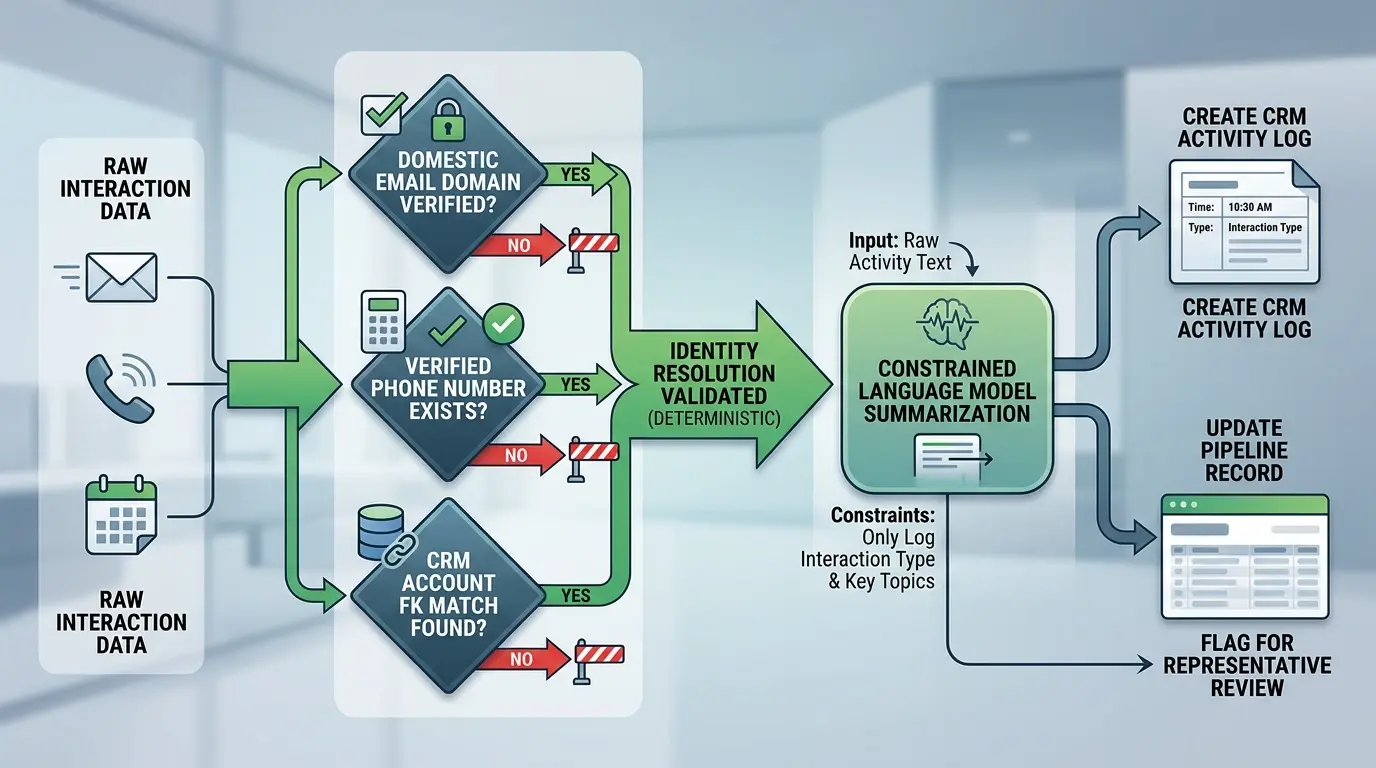
Only after identity is confirmed deterministically should a language model be applied to unstructured interaction text. When utilised, the model operates under strict schema constraints to generate concise bulleted call summaries, detect mentioned follow-up dates, or flag requested changes to contact titles. This separation ensures that structured database tables remain completely protected from generative hallucination.
- Deterministic domain and email validation against existing CRM accounts
- Strict timestamp and communication metadata extraction at the ingestion boundary
- Deterministic evaluation of required stage progression fields
- Constrained extraction of notes, action items, and title changes via structured schema definitions
Exception Routing, Data Integrity, and Audit Trails
A dependable workflow system must anticipate edge cases where automated record matching fails. If an inbound email contains multiple ambiguous company matches or originates from an unrecognised personal domain, the system must not guess.
In a robust custom product design, unresolved events are diverted to an exception queue rather than committed directly to the CRM database. The exception routing service notifies the assigned account owner or revenue operations analyst with a diff-style view highlighting the ambiguous fields.
Furthermore, every automated update must write to an immutable internal audit log. The audit log records the raw event payload, the matching rule applied, the model prompt version if text processing occurred, and the timestamp of the CRM write operation. This ensures total traceability for compliance and revenue forecasting audits.
The Human Validation Gate in Pipeline Governance
Full automation of CRM state transitions introduces substantial risk to forecast reliability. While activity timestamps and basic contact changes can be synchronised automatically, pipeline stage progression requires contextual human judgment.
A proposed internal product design incorporates an explicit human-in-the-loop validation gate. When an interaction suggests an opportunity stage advancement, the system stages a proposed update in a lightweight staging interface rather than writing directly to production CRM records.
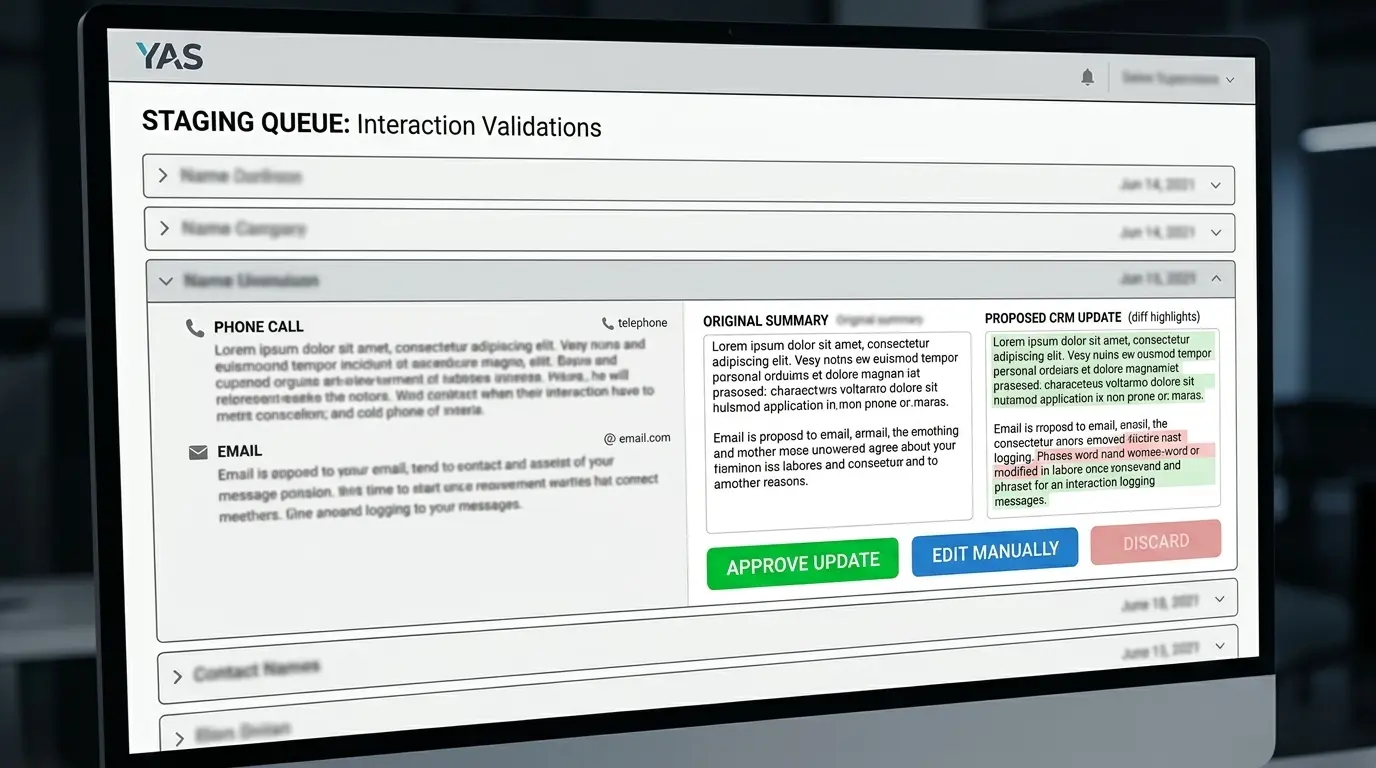
The sales representative reviews the drafted interaction summary, adjusts stage classifications based on qualitative nuance, and approves the update with a single click. This approach transforms the representative from a manual data-entry operator into a supervisory editor, preserving human agency over deal governance while eliminating repetitive typing.
Designing high-reliability internal operational workflows requires product-level thinking, making choosing a product development company over a software agency a critical strategic decision. choosing a product development company over a software agency.
Assessing the Opportunity in Your Own Organisation
Determining whether to build dedicated CRM synchronization workflows requires careful operational self-assessment. Leadership must evaluate whether off-the-shelf software sufficiently solves their data governance requirements or if custom business logic is required.
Teams should calculate their internal discrepancy rates and measure how much time representatives dedicate to non-selling data administration. When commercial connectors cannot handle complex proprietary data models, custom workflow engineering provides a resilient path forward.
By structuring clear ingestion pipelines, deterministic validation rules, and human supervisory checkpoints, businesses can achieve dependable pipeline hygiene while supporting representative productivity.
When assessing integration capabilities, teams face the architectural trade-off of evaluating custom software versus off-the-shelf SaaS solutions. evaluating custom software versus off-the-shelf SaaS.
| Company | Advertised Role | Exact Advertised Task | Bounded Interpretation | Source / Access Date |
|---|---|---|---|---|
| Stripe | Sales Development Representative, AUNZ | Effectively manage customer outreach, consistently meeting and exceeding Service Level Agreements (SLAs), meticulously updating activity and contact information within the Customer Relationship Management system (Salesforce) to support weekly reporting efforts | The role requires maintaining contact information and logging outreach activity in Salesforce to facilitate weekly reporting cycles. | 2026-08-18 |
| Ramp | Sales Development Representative | Inbound | Maintain accurate and detailed activity, notes, and pipeline data in Salesforce | The posting assigns the ongoing responsibility of maintaining detailed notes, activity records, and pipeline stage data in Salesforce. | 2026-08-21 |
| Gusto | Future Opportunities: Early Career Sales Talent | Maintain accurate notes and pipeline details in Salesforce to ensure excellent follow-through. | The role includes responsibility for recording conversation notes and tracking opportunity pipeline details in Salesforce to support follow-up. | 2026-08-14 |
Diagnostic Steps to Assess CRM Data Ingestion Friction
- Audit all communication endpoints (email, calendar, dialer) used by customer-facing representatives to identify raw interaction sources.
- Measure the operational time lag between an outreach event occurring and the corresponding record appearing in the CRM.
- Examine existing CRM database error logs, duplicate contact rates, and empty field percentages across active pipeline records.
- Map the deterministic criteria required to match an inbound message or meeting participant to an existing CRM account.
- Identify which CRM fields strictly require human qualitative judgment (e.g., deal sentiment, qualification status) versus deterministic metadata (e.g., date, attendees, channel).
- Quantify the administrative hours spent by revenue operations personnel performing manual data cleansing and weekly report reconciliation.
- Evaluate whether existing off-the-shelf CRM connectors satisfy custom schema requirements or introduce data sync conflicts.
- Draft technical specifications for a supervisory approval interface allowing representatives to confirm staged updates in bulk.
Job advertisements reveal that CRM record hygiene remains an explicit, human-operated duty across high-growth sales teams, highlighting a critical architectural opportunity for deterministic data ingestion.
FAQ
Do these job advertisements prove that the cited companies lack CRM automation?
No. A job advertisement proves only that the company assigns specific operational responsibilities to the advertised role. It does not provide evidence regarding the company's internal software architecture, existing integrations, or the extent of automation already deployed.
Why shouldn't pipeline stage updates be fully automated with AI?
Deal progression involves nuanced business context, buyer intent evaluation, and risk assessment that cannot be reliably inferred from communication metadata alone. Using deterministic capture for metadata while maintaining a human approval gate for stage changes protects pipeline forecasting integrity.
What is the difference between deterministic sync and generative text processing in this architecture?
Deterministic synchronization maps structured attributes such as email addresses, timestamps, and domain names using exact mathematical matching rules. Generative processing is conditionally applied only to unstructured conversation text to extract concise summaries and action items.
When should an organization build custom sync software instead of using standard CRM plugins?
An organization should consider custom internal workflow software when off-the-shelf connectors cannot support complex custom CRM schemas, proprietary communication platforms, strict security compliance boundaries, or specialized validation logic.
How does an audit log protect CRM data integrity?
An immutable audit log records the raw inbound event payload, the matching rules applied, the exact timestamp, and the committing user or process. If bad data or misattribution occurs, operations teams can trace the exact origin and revert changes systematically.