
Recent job listings across fintech and human resources assign specialists to triage, prioritize, and route incoming requests across distinct operational boundaries.
What the Job Postings State About Inbound Triage
Public hiring listings across technology and platform organizations frequently define specific operational ownership over request intake, categorization, and routing. These listings demonstrate how growing organizations manage inbound volume from varying user cohorts, ranging from external developers to internal employees.
For example, a job posting by Stripe for a Support Operations role within Privy describes the responsibility to "Own triage and routing for inbound support tickets from both Privy developers and end users of Privy applications, ensuring issues are assigned, tracked, and resolved promptly and efficiently across the Developer Success team." The listing explicitly links intake ownership with downstream assignment across a technical success function.
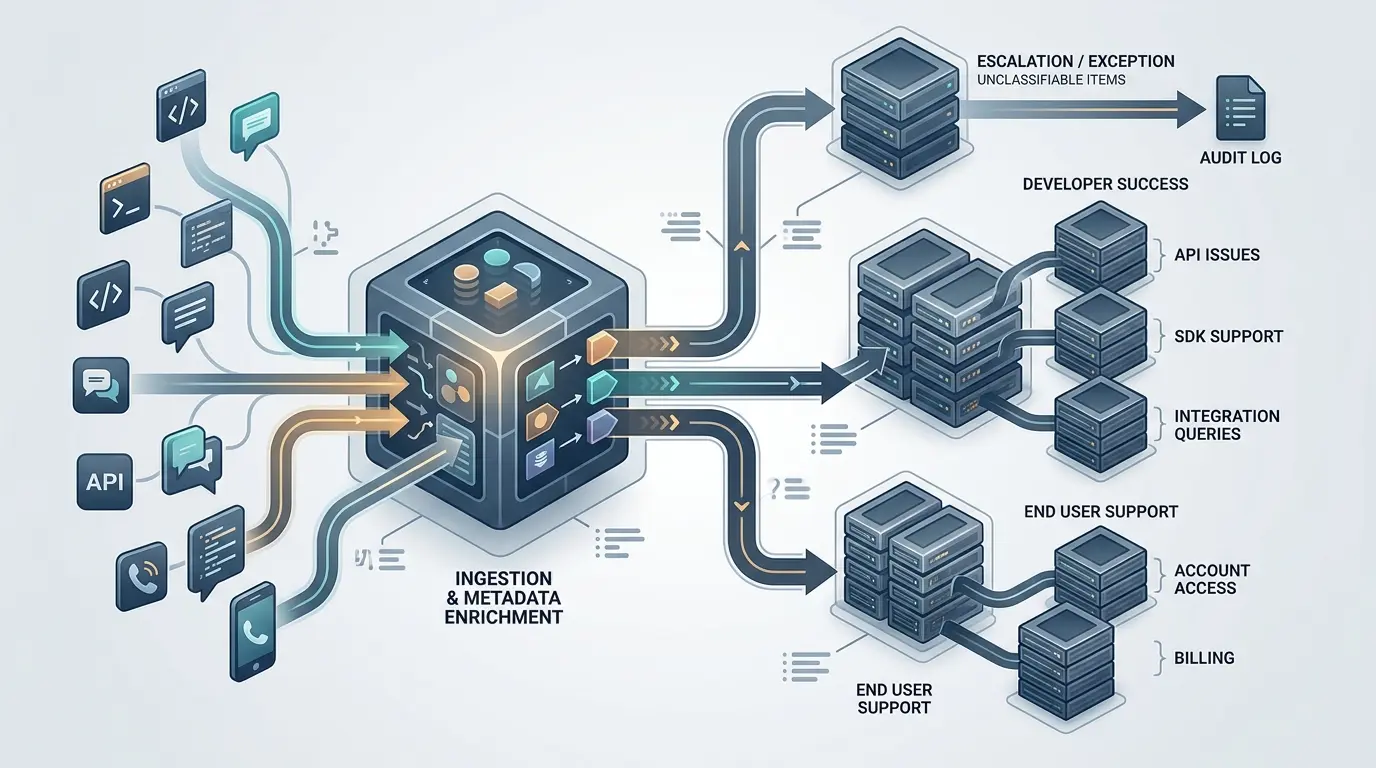
Similarly, a posting by Gusto for a People Process Transformation Lead specifies the duty to "Lead the HR Service Center responsible for Tier 0/1 Gustie (employee) and People Empowerer (manager) support." At Ramp, an advertisement for an Associate Manager in Premier Support specifies oversight of "Quality, responsiveness, and SLA delivery across the accounts your team supports - plus the day-to-day mechanics that get you there: triage by account risk, load balancing, coverage, and on-call rotation."
- Stripe: Direct ownership of ticket triage and routing for developers and end users.
- Gusto: Leadership of service center intake for introductory tiers of employee and manager requests.
- Ramp: Execution of risk-based triage, load balancing, and schedule coverage for account requests.
Partnering with experienced product engineers ensures that teams scope an MVP without waste while building internal tools. scope an MVP without waste.
The Recurring Operational Responsibility Across Inbound Channels
When examined together, these job postings establish a clear operational pattern: businesses designate human roles to assess incoming requests, evaluate context such as account risk or user tier, and direct work to appropriate destinations. A fair inference from these responsibilities is that cross-functional triage remains a critical coordination layer between requesters and specialized service teams.
However, the presence of these advertised tasks does not prove that an organization lacks internal tooling, nor does it quantify ticket volume, latency, or operational cost. An ad specifying triage duties simply shows that the enterprise values explicit human accountability over how incoming work items are received, categorized, and distributed.
When internal teams face high operational overhead, calculating the workflow automation cost and defining precise system requirements prevents over-engineering. workflow automation cost.
Establishing Evidence of Triage Patterns Within an Organization
To determine whether an internal triage process requires structural redesign, an engineering team must look beyond job descriptions and audit actual operational artifacts. Relying on assumptions about manual friction can lead to misallocated engineering effort.
An evidence-based evaluation begins by recording where requests originate, how often ticket routing tags are manually modified, and how frequently items are reassigned between departments. If an audit shows that incoming items undergo multiple re-routing hops before reaching the correct resolver, that data establishes a concrete operational pattern that software can address.
Conditional Product Design: Ingestion and Metadata Enrichment
If an organization determines that incoming requests require systematic pre-processing, a proposed software system could ingest unstructured items from source queues and enrich them with structural metadata prior to assignment.
In this proposed architecture, if relevant customer records and operational calendars exist, the system would extract requester identity, match the requester to account risk tiers, and query on-call schedules. By assembling this diagnostic context at the moment of intake, downstream handlers receive fully contextualized records rather than unparsed raw text.
Building such mechanisms as tailored internal platforms allows organizations to preserve domain-specific routing rules rather than retrofitting generic interfaces. Exploring how to build custom workflow software can clarify whether bespoke intake architecture offers distinct operational control over off-the-shelf options.
Comparing the trade-offs of custom software versus off-the-shelf SaaS involves evaluating whether commercial platforms support the company's unique data schemas. custom software versus off-the-shelf SaaS.
Deterministic Rules Before Model-Driven Classification
A resilient intake architecture establishes deterministic validation steps before passing unstructured data to generative classification models. Deterministic steps ensure high-confidence constraints are enforced without probabilistic variance.
For instance, if a ticket contains an exact enterprise identifier, deterministic rules can instantly apply contractually mandated service level flags and verify active account coverage. Only when rule-based filters determine that the request category or sentiment is ambiguous would an AI classification step evaluate the semantic content of the message.
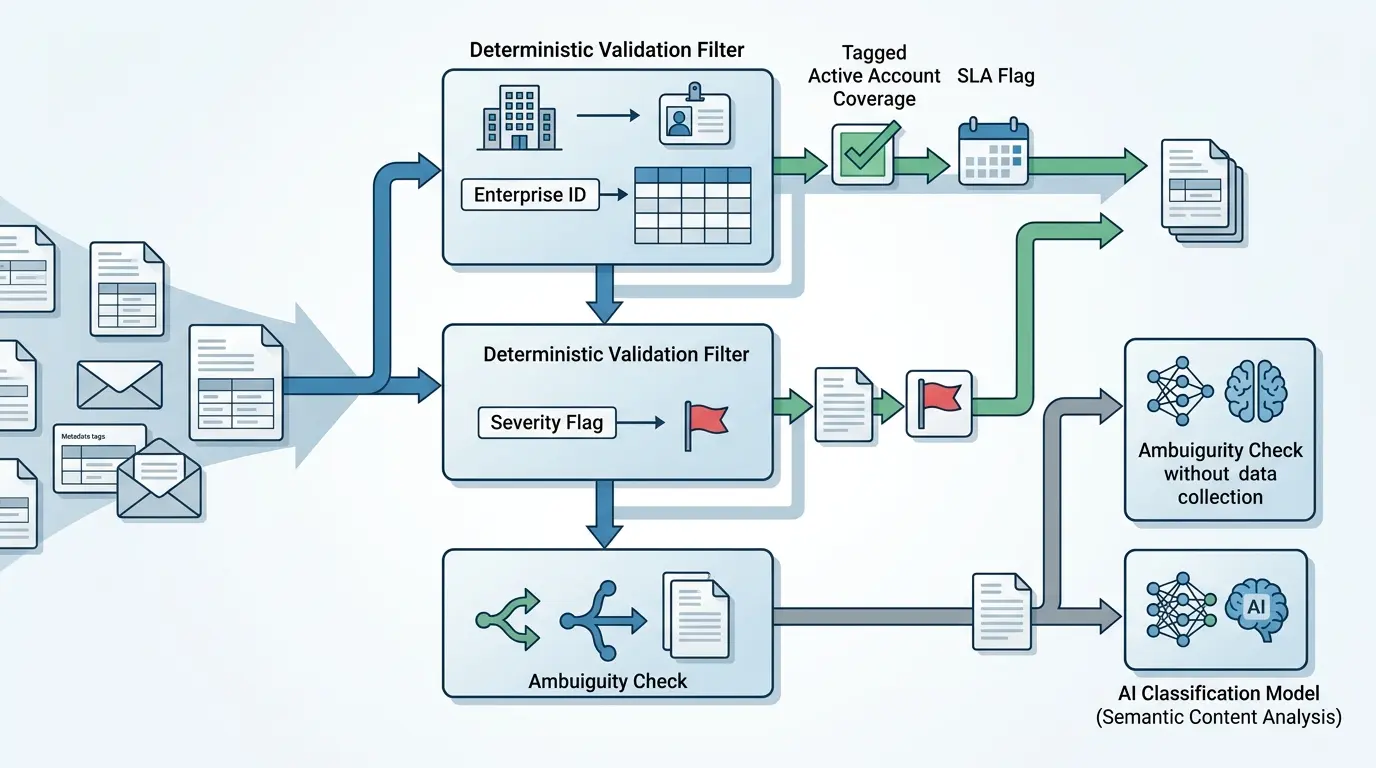
Designing this division of labor ensures predictable handling. Teams evaluating the differences between n8n automation and custom workflow software often find that maintaining strict deterministic validation requires granular software boundaries that generic automation visualizers may struggle to govern.
Partnering with a dedicated product development company rather than a generic software development agency can help teams scope an MVP without waste. product development company vs software development agency.
Routing Exceptions, Audit Logs, and Queue Governance
Any automated dispatch design must anticipate edge cases, including unclassified technical queries, emergency outages, or missing customer profiles. A robust system routes unresolved exceptions to an explicit triage queue rather than failing silently.
Furthermore, every automated classification, score assignment, and routing decision should be written to an immutable audit log. This record allows operations leaders to inspect why a ticket was routed to a specific engineering or support tier, providing the empirical foundation required to calibrate routing accuracy over time.
The Human Decision Gate for High-Risk Escalations
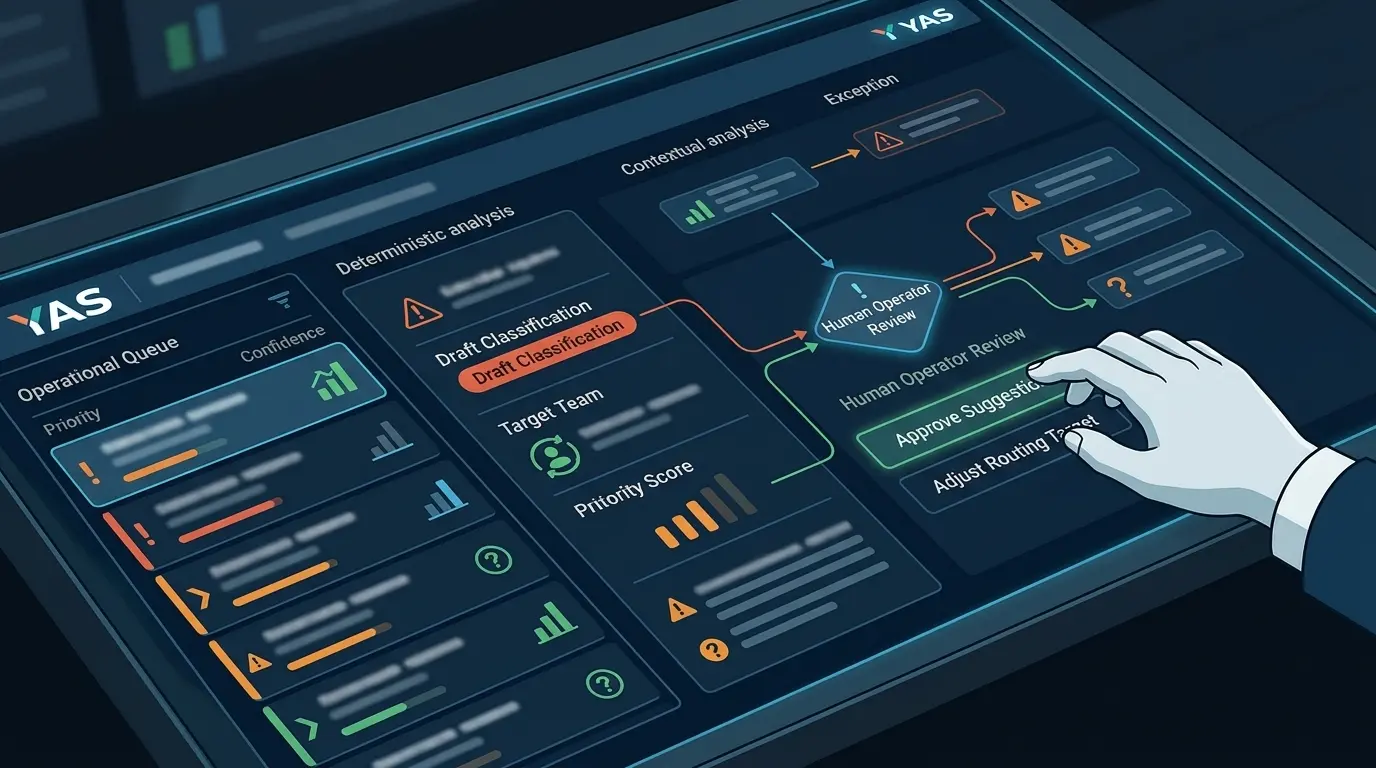
Automated routing engines should not eliminate human decision-making; rather, they should position human specialists at critical decision gates. High-risk requests, such as enterprise platform blockers or sensitive employee relations inquiries, require qualitative review before final routing.
In a proposed human-in-the-loop workflow, the system suggests a priority score, draft classification, and target team based on deterministic and contextual analysis. The human operator reviews the proposed state, approves or adjusts the routing target with a single action, and handles complex exceptions that fall outside predefined criteria.
Assessing the Opportunity for Custom Internal Workflow Systems
Organizations seeking to optimize inbound operations must systematically measure whether custom intake software is warranted. Comparing the trade-offs of custom software versus off-the-shelf SaaS involves evaluating whether commercial platforms support the company's unique data schemas and routing complexity.
When internal teams face high operational overhead, calculating the workflow automation cost and defining precise system requirements prevents over-engineering. Partnering with a dedicated product development company rather than a generic software development agency can help teams scope an MVP without waste, ensuring that engineering investments directly address validated operational bottlenecks.
Exploring how to build custom workflow software can clarify whether bespoke intake architecture offers distinct operational control over off-the-shelf options. custom workflow software.
| Company | Role | Exact Advertised Task | Bounded Interpretation | Source Date |
|---|---|---|---|---|
| Stripe | Support Operations, Privy | Own triage and routing for inbound support tickets from both Privy developers and end users of Privy applications, ensuring issues are assigned, tracked, and resolved promptly and efficiently across the Developer Success team. | The advertisement establishes that the role is responsible for the assignment and routing mechanics of developer and user support requests. | 2026-08-27 |
| Gusto | People Process Transformation Lead | Lead the HR Service Center responsible for Tier 0/1 Gustie (employee) and People Empowerer (manager) support. | The advertisement defines operational leadership over foundational support queues for employees and managers. | 2026-08-24 |
| Ramp | Associate Manager, Premier Support (Customer Experience) | Quality, responsiveness, and SLA delivery across the accounts your team supports - plus the day-to-day mechanics that get you there: triage by account risk, load balancing, coverage, and on-call rotation. | The advertisement identifies triage by account risk and coverage load balancing as core day-to-day operational responsibilities. | 2026-08-11 |
Diagnostic Checklist for Auditing Inbound Triage and Routing
- Log every inbound communication channel to record where unstructured requests currently enter the organization.
- Measure the number of manual reassignment events that occur per ticket before reaching a final resolving specialist.
- Map existing deterministic routing criteria, including account enterprise status, contract terms, and on-call calendars.
- Evaluate whether ticket metadata is populated manually by frontline agents or enriched automatically during ingestion.
- Audit exception handling paths to identify where ambiguous or unclassified requests currently accumulate.
- Identify regulatory, privacy, or security constraints that require human-in-the-loop validation before dispatch.
- Calculate the volume of routine Tier 0 and Tier 1 requests that follow strictly predictable resolution pathways.
Job advertisements across technology leaders demonstrate that inbound request triage and operational load balancing remain essential human-governed coordination functions.
FAQ
Does an ad listing triage duties prove a company lacks automated tooling?
No. A job advertisement only specifies the responsibilities assigned to a role. It does not provide evidence regarding the presence, absence, or sophistication of existing internal software.
What is the primary role of deterministic rules in an automated triage system?
Deterministic rules execute known, predictable constraints such as account risk tiers, SLA deadlines, and on-call assignments without introducing probabilistic errors.
Why is a human decision gate necessary in support routing architectures?
Human review gates ensure that ambiguous, sensitive, or high-risk requests are evaluated by specialists before critical operational actions or escalations occur.
How should an organization decide between custom triage software and commercial SaaS?
Organizations evaluate whether commercial tools accommodate their specific data models, security requirements, and routing complexity, or whether custom software is necessary to integrate deeply with proprietary systems.
What metrics indicate that an internal triage workflow may require redesign?
Key indicators include high rates of ticket reassignment across departments, delayed routing times, and frequent operational escalations caused by misclassified requests.