
Job postings across enterprise software and fintech teams show recurring responsibilities for evaluating inbound leads and routing vetted opportunities. This analysis explores how those operational patterns define custom intake engines.
What the Job Postings Literally State
Recent job postings across high-growth technology companies describe discrete evaluation steps for incoming commercial prospects. In an advertisement for an Inbound Sales Development Representative, Ramp states the responsibility to "Leverage BANT and ICP criteria to assess deal quality and route opportunities appropriately". This establishes that incoming interest is measured against predefined frameworks before sales assignment occurs.
Similarly, Stripe's posting for a Sales Development Representative specifies the mandate to "Follow up with Marketing generated leads to qualify as sales opportunities. Move solid leads through the funnel connecting them to a salesperson, and arranging meetings". The text explicitly pairs lead qualification with downstream meeting coordination and account distribution.
The pattern is not limited to direct customer sales. Notion's advertisement for a Regional Partner Manager in the DACH region details the responsibility to "Identify and qualify inbound partnership opportunities, and proactively surface new partner relationships that can expand Notion's reach in DACH". Across these distinct roles, inbound submissions require systematic evaluation against commercial criteria.
The Recurring Operational Responsibility
When examined together, these listings demonstrate a shared workflow pattern: ingesting marketing-generated or partner-submitted interest, screening data attributes against qualification models, and routing accepted candidates to dedicated internal teams. This structural repetition highlights a core business function centered on triage and boundary-based dispatching.
A job advertisement describes assigned duties, but it does not disclose the internal tooling, database configuration, or degree of existing automation at the company. Consequently, the presence of these tasks in a listing indicates human involvement in the qualification gate without proving whether the underlying infrastructure is manual, semi-automated, or powered by bespoke software.
Evaluate collaboration models through our comparison of delivery partners. product development company vs software development agency.
Evidence Required to Establish Internal Recurrence
To determine whether this intake process represents a candidate for custom internal software within an organization, technical leaders must gather specific operational evidence. Evaluating workflow efficiency requires measuring the volume of inbound submissions, the number of distinct qualification criteria applied, and the structural consistency of incoming data payloads.
Engineering teams must audit whether evaluation criteria rely on structured parameters such as company size and geography, or unstructured intent signals found in open-ended text. Understanding the ratio of deterministic checks to subjective evaluations determines whether the intake layer should be handled via database-driven rules, custom software services, or human-in-the-loop review queues.
Smallest Conditional Internal Product Design
If an organization identifies high-volume qualification bottlenecks, a proposed custom intake engine could serve as a dedicated orchestration layer. Rather than relying on disparate point-to-point scripts, the design would centralize submission ingestion, schema validation, and dispatch state machines in a single service.
In a proposed architecture, inbound submissions would enter an intake gateway that normalizes payload structures and verifies applicant identifiers. If company enrichment endpoints exist, the system could retrieve firmographic attributes before applying evaluation rubrics, ensuring that sales and partnership teams receive pre-structured dossier records.
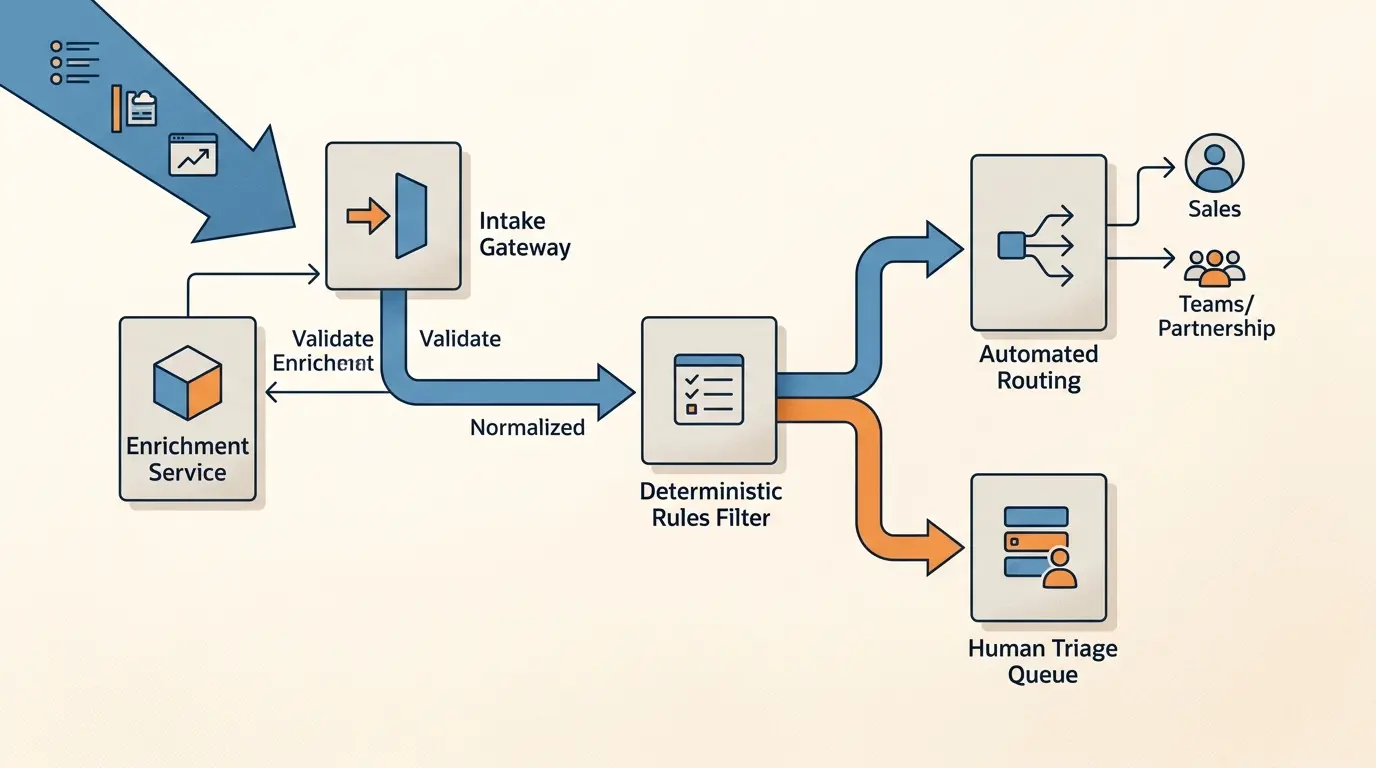
Organizations evaluating these architectural pathways often compare pre-built tools against tailored systems. custom software vs off-the-shelf SaaS.
Deterministic Steps Before Generative Models
A robust inbound processing system prioritizes deterministic validation prior to executing any probabilistic or machine learning models. The initial stage must evaluate strict boundary conditions: domain validation, geographical territory mapping, deduplication against existing CRM accounts, and exclusion list matching.
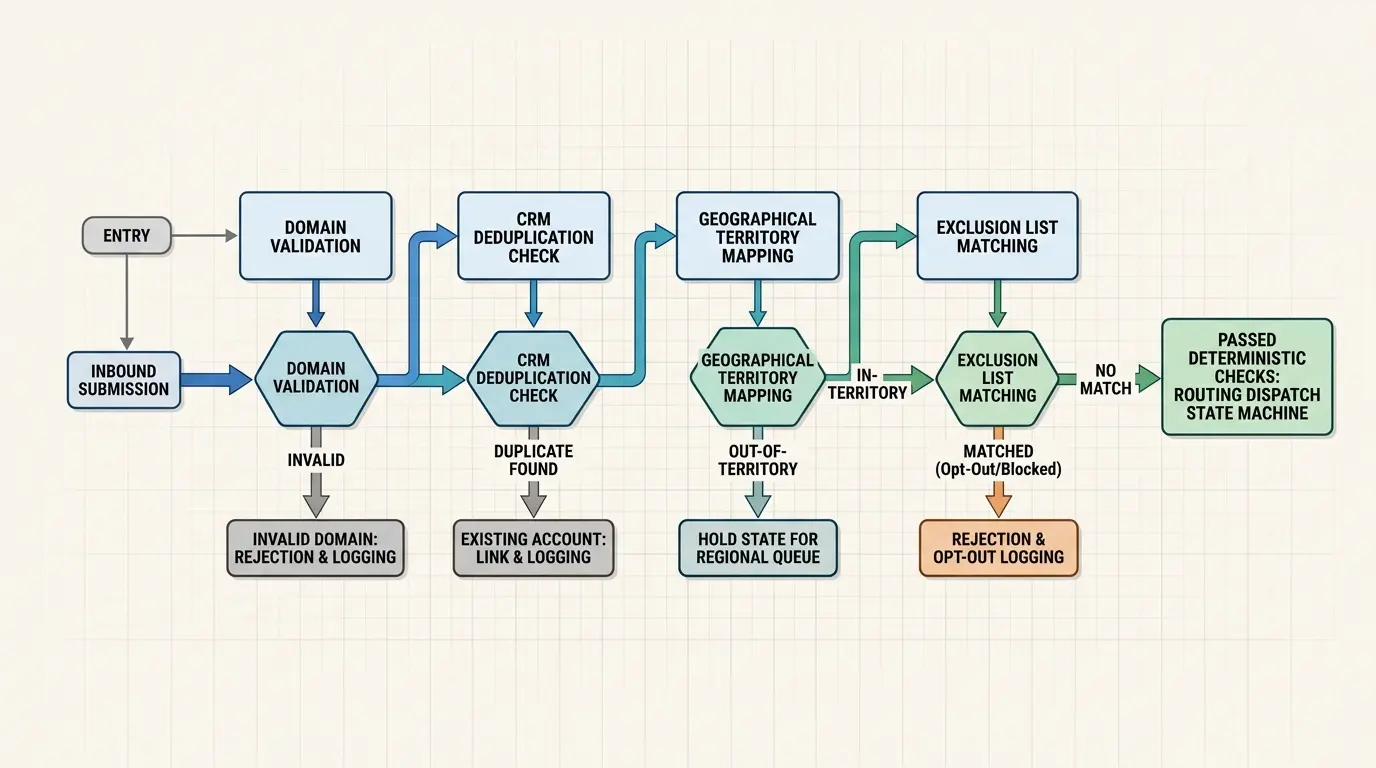
Applying deterministic logic first protects downstream compute resources and ensures reproducible routing decisions. If an incoming record fails basic eligibility criteria, such as geographic availability, the system immediately branches to an automated status transition or a dedicated partner holding state without invoking language models.
Read our breakdown on why resilient architectures separate deterministic business logic from transient integration scripts. n8n automation vs custom workflow software.
Exception Routes and Operational Auditability
Every automated triage engine requires explicit exception routing to manage ambiguous payloads, malformed data, or conflicting account ownership. When an inbound submission provides incomplete information or matches multiple sales territories, the system must divert the record into an unassigned triage queue with clear contextual flags.
Auditability requires recording every evaluation step in an immutable event log. The system design should capture the raw intake payload, the enrichment data snapshot, the specific rules evaluated, and the final routing assignment timestamp. This structured trace allows engineering and revenue operations teams to audit decisions and refine qualification logic over time.
Maintaining rigorous event logging is essential when planning software investments. workflow automation cost.
The Human Decision Gate
Automated qualification engines should assist rather than replace professional human judgment. The role of custom intake software is to perform mechanical ingestion, validation, and dossier assembly, presenting structured records to human specialists for final determination on non-standard accounts.
In this hybrid model, sales representatives and partner managers retain authority over strategic account acceptance, high-touch meeting scheduling, and exception overrides. The software provides contextual summaries and rule evaluation outputs, enabling operators to make faster, higher-confidence decisions while maintaining full governance over commercial relationships.
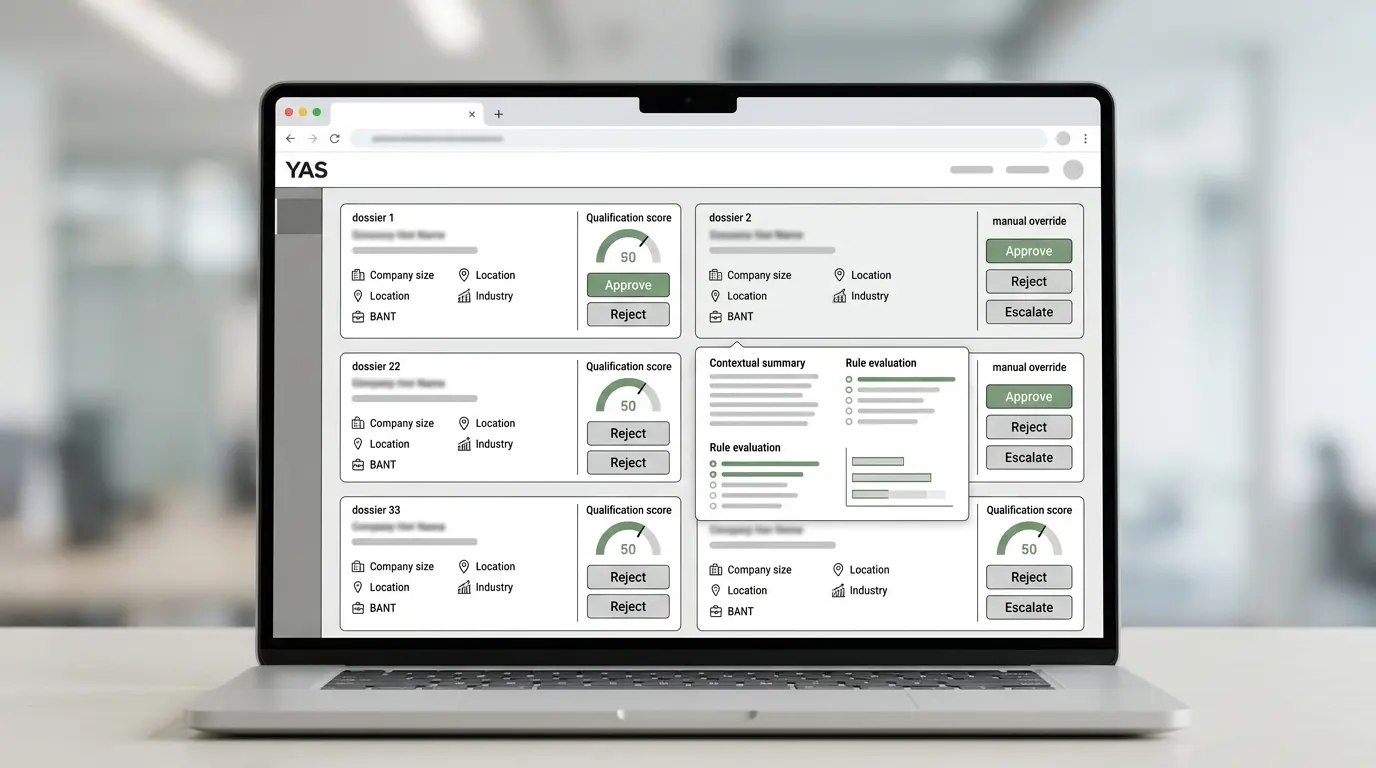
Properly scoping this interface boundary ensures development efforts focus on core friction points. scope an MVP without waste.
Assessing the Opportunity in Your Own Operation
Organizations seeking to optimize their inbound triage workflows must evaluate whether building dedicated internal tooling aligns with their engineering roadmap. Teams should assess whether their operational bottlenecks stem from disparate data sources, inconsistent routing logic, or manual data enrichment steps.
Explore how YAS builds custom software on our dedicated engineering page. build.
| Company | Advertised Role | Exact Advertised Task | Bounded Interpretation | Source and Access Date |
|---|---|---|---|---|
| Ramp | Sales Development Representative | Inbound | Leverage BANT and ICP criteria to assess deal quality and route opportunities appropriately | Task requires applying structured qualification frameworks and assigning deals across internal sales paths. | https://jobs.ashbyhq.com/ramp/f98771d6-e685-4b91-a466-71789c238e33 (Accessed August 21, 2026) |
| Stripe | Sales Development Representative (French Fluency) | Follow up with Marketing generated leads to qualify as sales opportunities. Move solid leads through the funnel connecting them to a salesperson, and arranging meetings | Task combines lead follow-up, qualification against sales opportunity criteria, meeting scheduling, and sales rep hand-off. | https://stripe.com/jobs/search?gh_jid=8139535 (Accessed August 27, 2026) |
| Notion | Regional Partner Manager, DACH | Identify and qualify inbound partnership opportunities, and proactively surface new partner relationships that can expand Notion's reach in DACH | Task involves assessing inbound partner applications against regional strategic criteria and identifying expansion opportunities. | https://jobs.ashbyhq.com/notion/6ba79c2f-1f18-49b6-acaa-53100e105556 (Accessed May 28, 2026) |
Diagnostic Checks for Inbound Triage Workflows
- Log every inbound capture channel to record all incoming payload structures and field completeness rates.
- Map all current qualification rules to identify which criteria are purely deterministic versus those requiring human evaluation.
- Audit existing CRM and directory routing tables to determine whether territory assignment logic is centrally defined or fragmented across tools.
- Measure the elapsed time between initial inbound submission and the first qualification or routing action.
- Track the frequency of manual routing overrides to identify ambiguous boundary conditions in current qualification rubrics.
- Assess data enrichment dependencies to quantify how often human operators must manually research external firmographic attributes.
- Verify whether audit trails currently capture the exact historical criteria and data snapshots used for qualification decisions.
Job listings describe operational mandates but not backend architectures. System designers must separate stated business responsibilities from the underlying software patterns required to support them.
FAQ
Do these job postings prove that the cited companies lack automated routing software?
No. The job postings describe responsibilities assigned to specific roles. An advertisement does not document backend technical architectures, internal software suites, or the level of existing automation within the hiring organization.
What is the primary difference between deterministic rules and machine learning in lead triage?
Deterministic rules evaluate structured, predictable conditions such as geography, domain uniqueness, and numerical thresholds. Machine learning models, if used, are typically reserved for parsing unstructured text or extracting intent signals from open-ended prospect responses.
Why should companies maintain a human decision gate in qualification workflows?
Human decision gates ensure that edge cases, high-value enterprise prospects, and strategic partnership nuances receive human scrutiny, while automated systems handle pre-validation and dossier enrichment.
When should an organization consider building custom inbound qualification software?
Custom software is typically considered when off-the-shelf tools cannot support complex routing logic, multi-source data enrichment requirements, strict regulatory auditability, or deeply integrated internal state machines.
How do exception routing queues protect commercial workflows?
Exception queues catch malformed, conflicting, or unclassifiable submissions, preventing leads from being lost or misassigned while providing an operational buffer for manual review.