
Job postings across technology organizations show a shared assignment: technical specialists must capture product changes and customer resolutions, translate them into user-facing copy, and distribute knowledge across self-service repositories. While these descriptions demonstrate clear role expectations, they raise an important operational design question: how can businesses build deterministic software boundaries around knowledge capture to support human-led technical authoring?
What Public Job Postings State About Knowledge Management
In modern technical organizations, the creation of support content and release updates is routinely structured as an explicit team responsibility. Public job advertisements provide primary documentation of how organizations allocate these duties across technical support, operations, and product marketing functions.
In a job posting for a Marketing Programs Specialist, Symmetry at Gusto, the advertisement assigns the role to: "Distribute release notes and product updates to our developer persona across the channels developers actually use (in-product, email, docs, changelog, community). Use AI to translate engineering-written notes into developer-friendly communications and draft channel-specific variants." The listing explicitly couples the receipt of engineering updates with multi-channel translation and AI drafting.
At Notion, a job ad for an Enterprise Technical Support Engineer includes the responsibility to: "Collaborate on the creation and maintenance of both internal knowledge and customer-facing documentation, enhancing self-service support options for customers". Similarly, Stripe describes a role for Product Support, Bridge with the responsibility to: "Create and refine documentation to empower users to resolve issues through self-service, reducing dependency on support teams."
These listings demonstrate that documenting technical resolutions and packaging software changes are core operational requirements across enterprise environments.
- Gusto explicitly lists channel distribution across in-product, email, docs, changelog, and community channels.
- Notion defines documentation as a shared responsibility spanning both internal knowledge bases and external self-service guides.
- Stripe frames documentation creation as a mechanism intended to empower self-service and reduce inbound support dependencies.
The Recurring Operational Pattern Across Technical Support and Marketing
Analyzing these listings reveals a common operational pattern: organizations assign practitioners the duty of synthesizing complex technical details into structured documentation. Whether originating from customer-facing troubleshooting interactions or raw engineering changelogs, information must be captured, reshaped for specific audiences, and published across internal or external repositories.
A fair inference is that this pattern bridges multiple operational disciplines. In customer support, specialists identify recurring incident patterns and document resolutions. In developer marketing and product operations, specialists translate engineering release artifacts into external communications. In both cases, the practitioner serves as a translation layer between raw technical records and accessible reference materials.
However, job advertisements do not define the specific internal toolchains, database structures, or end-to-end operational software supporting these staff members. An explicit job assignment confirms that an organization values the outcome, but it does not prove whether the surrounding software environment is highly automated, partially supported by scripts, or largely manual.
Establishing Internal Evidence for Knowledge Flow Opportunities
When an organization evaluates its own documentation pipeline, relying on broad assumptions about documentation lag is insufficient. Instead, technical leaders need an evidence-led method to determine how knowledge moves from technical events into published guides.
To establish whether knowledge capture is an operational bottleneck, an enterprise must audit concrete process metrics across its support and product lifecycles. This involves measuring the elapsed time between an engineering release and its corresponding public changelog publication, as well as tracking how frequently resolved incident threads result in updated knowledge base articles.
Evaluating these operational workflows also requires assessing whether existing software platforms integrate effectively. When assessing tools, organizations often compare <a href="/blog/n8n-automation-vs-custom-workflow-software/">n8n automation vs custom workflow software</a> to understand how different integration approaches handle structured knowledge extraction.
Understanding the drivers of workflow automation cost helps technical leaders assess whether developing custom software delivers long-term economic value. workflow automation cost.
A Conditional Architecture for Knowledge Capture and Synthesis
If an organization identifies measurable latency in knowledge capture, a proposed internal software system could provide an automated pipeline to support authors. Such a system would not replace human authors but would assist in gathering source inputs and generating structured initial drafts.
In a hypothetical architecture, the platform would ingest source records from support resolution tickets or engineering changelogs through deterministic connectors. If structured issue records exist, the platform can parse resolution summaries, categorize recurring technical tags, and assemble a contextual bundle for drafting.
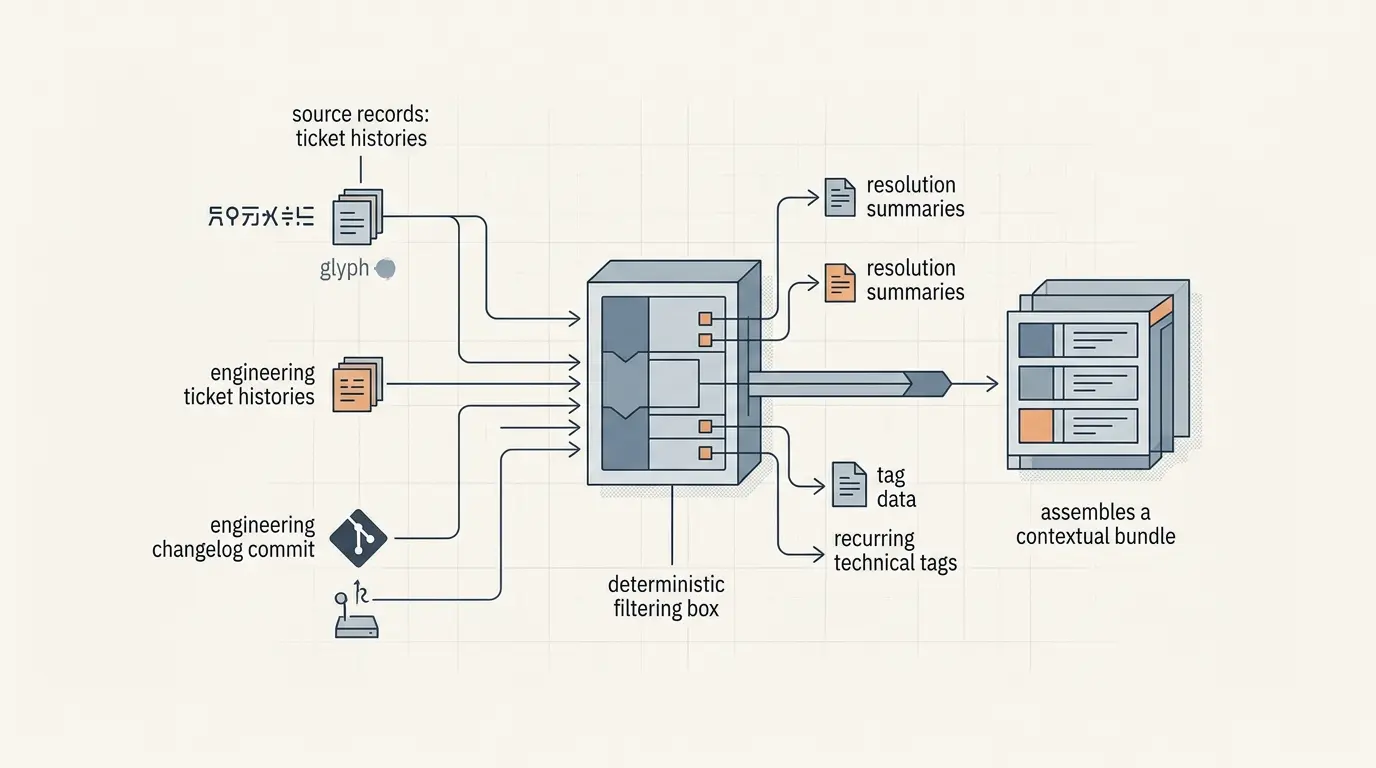
When scoping such an internal tool, teams must evaluate the scope of their minimum viable architecture. Understanding how to <a href="/blog/scope-an-mvp-without-waste/">scope an MVP without waste</a> prevents over-engineering data ingestion pipelines while ensuring that the core drafting mechanics deliver tangible operational value.
Teams building internal documentation tools must understand how to scope an MVP without waste to deliver core authoring functionality efficiently. scope an MVP without waste.
Deterministic Data Hygiene Before Generative Processing
A critical vulnerability in automated knowledge synthesis is the ingestion of unstructured or sensitive operational data. A robust system architecture requires strict deterministic filtering before any language models process the text.
The proposed ingestion layer must enforce deterministic validation rules. These include automated redaction of customer identifying information, verification that ticket resolutions are marked as officially validated by technical staff, and schema validation against predefined documentation taxonomies.
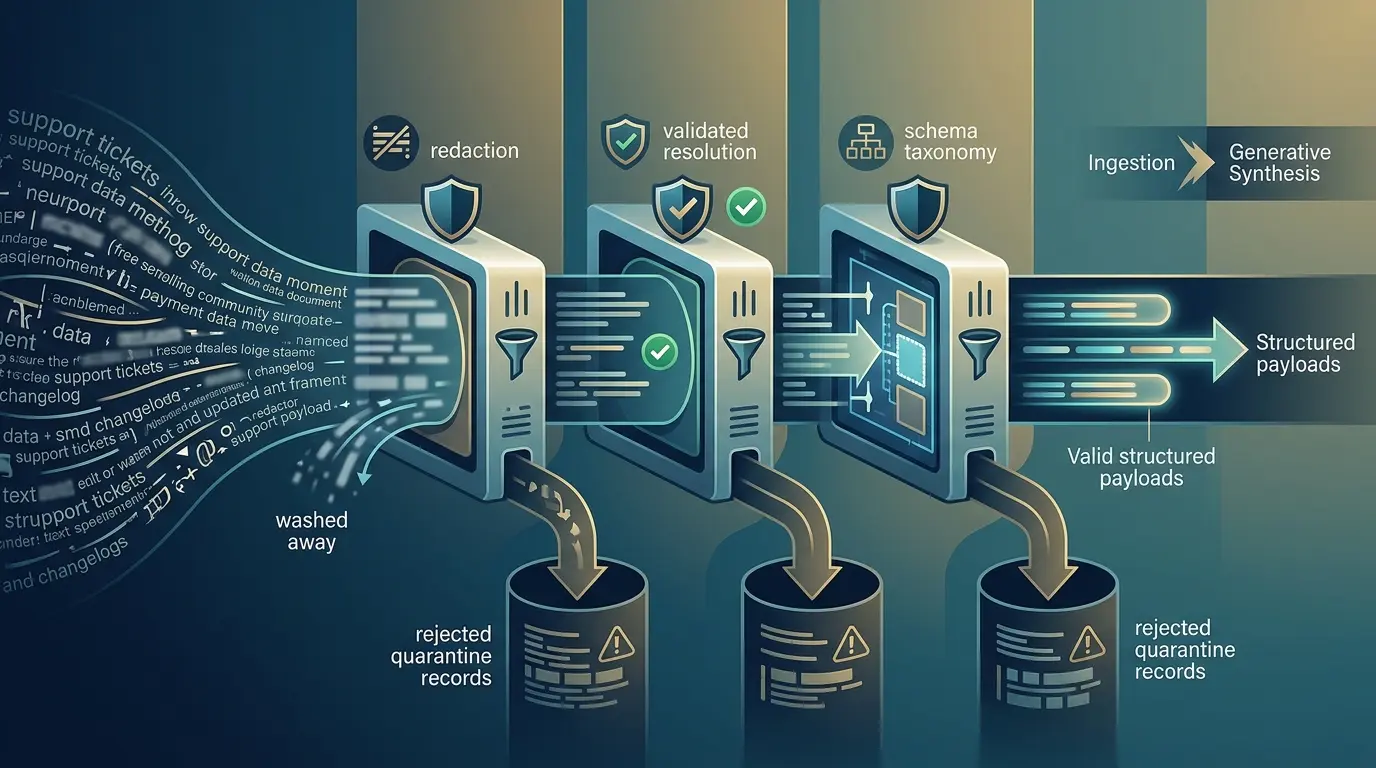
Only after raw incident data or engineering notes satisfy deterministic validation checks should the system pass the payload to a generation engine. This ensures that language models operate exclusively on sanitized, approved technical context rather than ambiguous operational logs.
Governance, Exception Handling, and the Human Gate
Generative synthesis of technical documentation cannot operate as an unmonitored broadcast loop. Product breaking changes, altered API parameters, and security policies require strict human oversight before publication.
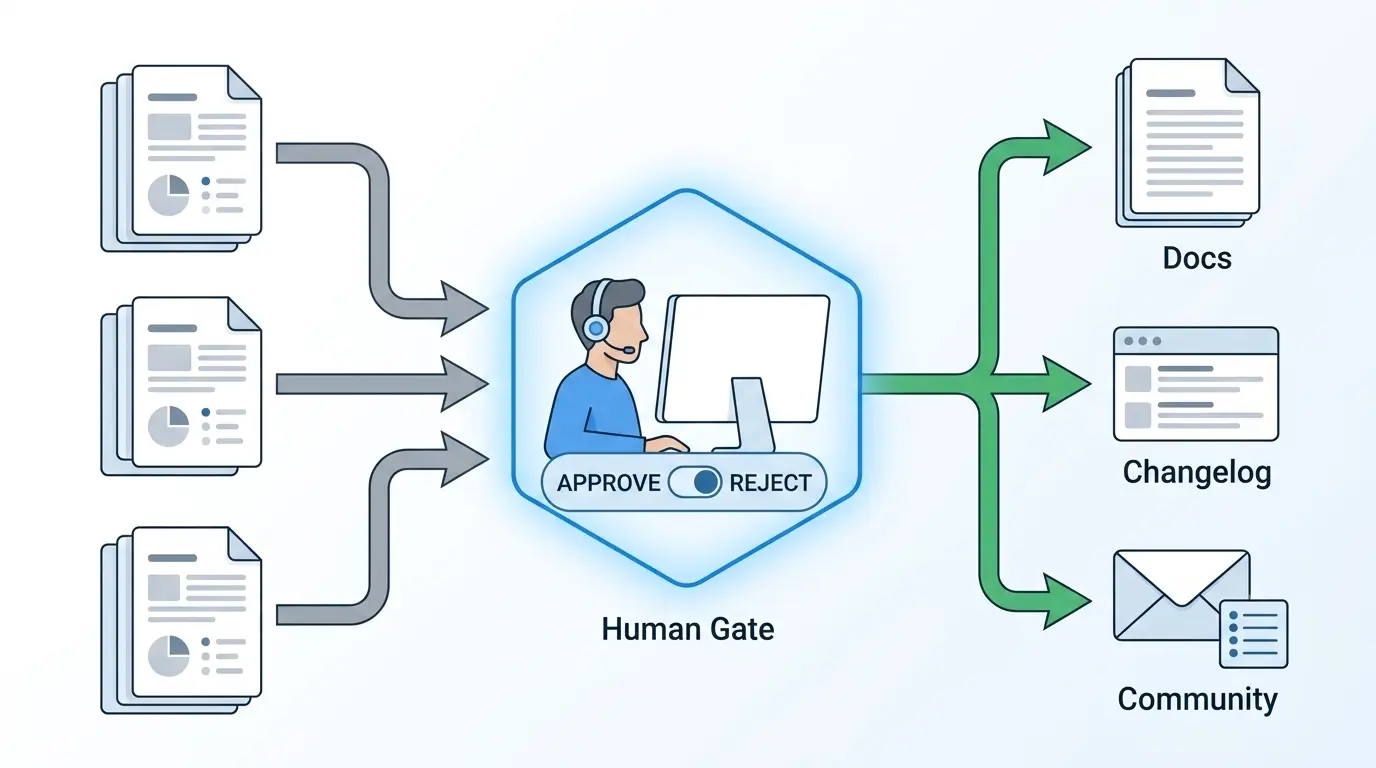
A proposed knowledge synthesis platform must incorporate deterministic exception routing. For example, if an ingested engineering note contains flags for deprecated endpoints or breaking schema changes, the workflow engine must conditionally route the draft to engineering leads and product managers rather than permitting direct publication to documentation portals.
The human gate serves as the decisive checkpoint. Authors, product specialists, and support engineers review the auto-generated drafts, verify technical fidelity against current product behavior, adjust language for tone, and formally authorize publication. The software provides speed in structuring inputs, while the specialist provides accountability for technical precision.
Evaluating custom software vs off-the-shelf SaaS allows enterprises to weigh platform flexibility and security against out-of-the-box vendor capabilities. custom software vs off-the-shelf SaaS.
Evaluating Custom Software Versus Packaged Knowledge Systems
Organizations seeking to modernize their knowledge capture workflows face architectural choices between general-purpose SaaS tools and custom internal workflow applications. Standard documentation platforms offer rich text editing, but they often lack deep, deterministic integrations with internal issue trackers and proprietary data models.
When assessing whether to build specialized internal software, teams must evaluate the total investment required. Reviewing the fundamental drivers of <a href="/blog/workflow-automation-cost/">workflow automation cost</a> helps leadership determine if custom software generates a positive return compared to standard software licenses.
Furthermore, deciding between off-the-shelf knowledge bases and purpose-built software requires careful analysis. Exploring <a href="/blog/custom-software-vs-off-the-shelf-saas/">custom software vs off-the-shelf SaaS</a> ensures that technical leaders choose an architecture aligned with their unique compliance, data isolation, and operational governance needs.
Organizations evaluating integration tools often compare n8n automation vs custom workflow software to determine how different architectures handle structured data extraction. n8n automation vs custom workflow software.
| Company | Advertised Role | Exact Advertised Task | Bounded Interpretation | Source and Date |
|---|---|---|---|---|
| Gusto | Marketing Programs Specialist, Symmetry | Distribute release notes and product updates to our developer persona across the channels developers actually use (in-product, email, docs, changelog, community). Use AI to translate engineering-written notes into developer-friendly communications and draft channel-specific variants. | The ad describes a workflow where engineering updates are adapted using AI and distributed across multiple specific developer communication channels. | Greenhouse Job Board (Accessed August 28, 2026) |
| Notion | Enterprise Technical Support Engineer | Collaborate on the creation and maintenance of both internal knowledge and customer-facing documentation, enhancing self-service support options for customers | The ad assigns responsibility for creating and maintaining dual-tier knowledge assets to support customer self-service. | Ashby Job Board (Accessed April 27, 2026) |
| Stripe | Product Support, Bridge | Create and refine documentation to empower users to resolve issues through self-service, reducing dependency on support teams. | The ad tasks support personnel with authoring and refining documentation aimed at deflecting repetitive inbound inquiries. | Stripe Careers (Accessed August 18, 2026) |
Diagnostic Checklist for Knowledge Management Workflows
- Audit support ticket resolution logs to measure what proportion contain structured, reusable technical solutions.
- Map the current pathway of release notes from engineering repository check-ins to customer-facing communication channels.
- Calculate the historical lead time between resolving complex customer issues and publishing corresponding self-service guides.
- Identify all required target publishing surfaces, including in-app tooltips, public documentation sites, email updates, and internal wikis.
- Review historical documentation revisions to identify recurring categories of human error, technical inaccuracies, or missing edge cases.
- Inspect existing incident and ticket data streams to confirm the presence of reliable deterministic metadata (tags, components, resolution codes).
- Assess data security and compliance requirements governing customer information redaction before content ingestion into drafting pipelines.
A job assignment confirms that an organization values knowledge translation, but the underlying system architecture determines how reliably and safely that knowledge moves from technical event to published documentation.
FAQ
Do these job advertisements prove that Gusto, Notion, or Stripe lack automated documentation tools?
No. The job advertisements prove only that these organizations assign documentation, translation, and communication responsibilities to specific roles. A job posting describes responsibilities and expectations; it does not document an organization's full internal software architecture, level of automation, or internal toolchain.
Why is deterministic filtering necessary before using generative AI for documentation?
Generative language models produce outputs based entirely on supplied context and model parameters. Without deterministic pre-filtering, raw incident tickets or engineering logs may introduce unredacted customer data, deprecated code snippets, or unresolved technical errors directly into draft content, creating compliance and accuracy risks.
How does custom workflow software differ from standard help desk knowledge bases?
Standard help desk tools provide static text editors and generic categorization hierarchies. Custom workflow software can implement bespoke data connectors to internal issue trackers, enforce strict compliance redaction pipelines, apply company-specific documentation schemas, and route drafts through custom multi-stage approval workflows tailored to an enterprise's exact operational requirements.
Can an automated system publish technical documentation without human review?
While technically possible, unmonitored publication introduces significant risks regarding technical accuracy, brand communication standards, and breaking product changes. A reliable production architecture utilizes automated pipelines to aggregate, clean, and draft content, while maintaining a strict human gate for subject matter experts to verify and approve all customer-facing releases.
What operational metrics indicate that an organization could benefit from a knowledge authoring system?
Key diagnostic metrics include significant lag between code deployments and published changelogs, low documentation coverage for high-volume support categories, substantial human hours spent reformatting technical notes into multi-channel copy, and recurring inaccuracies in published troubleshooting articles.