
Across multiple technology job postings, organizations assign customer operations specialists to monitor inbound queues, classify issue domains, and dispatch tickets across cross-functional boundaries. Analyzing these advertised tasks highlights a core software design challenge: how to structure intake mechanisms that separate routine deterministic routing from nuanced diagnostic reasoning.
What the Job Postings State About Ticket Triage
Recent job advertisements across several technology firms describe explicit operational duties centered on inbound queue management and ticket routing. In an opening for Support Operations at Stripe focusing on Privy, the posting notes that the candidate will own triage and routing for inbound support tickets from both Privy developers and end users of Privy applications, ensuring issues are assigned, tracked, and resolved promptly and efficiently across the Developer Success team.
Similarly, Gusto describes operational handoffs in two distinct roles. In an advertisement for a Relationship Manager in CX, the company lists the responsibility to triage, troubleshoot, and escalate technical bugs with clear documentation so our Engineering team can act quickly. In another listing for a People Process Transformation Lead, the posting describes leading the HR Service Center responsible for Tier 0/1 Gustie (employee) and People Empowerer (manager) support.
At Ramp, a posting for a Customer Experience Associate describes the cross-functional nature of escalation management. The job ad states that when an issue crosses team boundaries (such as risk, engineering, product, or partnerships), the associate routes it correctly, follows up, and makes sure the customer is not left waiting, working across Zendesk, internal tooling, and Slack-based escalation workflows.
- Stripe specifies routing inbound requests across both developer and end-user personas.
- Gusto outlines bug escalation pathways directly into engineering teams alongside internal HR service operations.
- Ramp identifies multi-boundary coordination spanning risk, product, engineering, and partner channels.
The Recurring Operational Responsibility Across Organizations
A fair inference from these job descriptions is that organizations frequently establish specialized roles or centralized hubs to mediate between raw inbound communication and downstream operational teams. Whether handling external customer software defects, internal employee queries, or cross-functional risk issues, incoming records must be categorized, enriched with contextual notes, and dispatched to the correct resolver group.
Job advertisements verify that these responsibilities exist, but they do not prove that an organization lacks automation or possesses inefficient tooling. An explicit job requirement can indicate standard governance, high-touch quality assurance, or high-volume edge cases requiring constant human oversight. However, the recurring pattern of reading unstructured messages, diagnosing the core problem domain, and updating secondary ticketing platforms highlights a classic system architecture boundary.
Establishing Internal Evidence of Routing Overhead
Before evaluating whether to build custom software to support ticket triage, an engineering team must gather baseline empirical metrics from its existing communication channels. The presence of a manual triage workflow in job documentation does not inherently justify an engineering initiative.
Teams should measure the volume of re-routed tickets, the distribution of routing latency across business hours, and the consistency of initial priority tagging. If an audit reveals that support personnel spend substantial time performing repetitive field mapping, structured payload normalization, or standard documentation gathering, software intervention may be evaluated against the operational requirements.
Comparing custom workflow software versus n8n automation for mission-critical routing pipelines. custom workflow software versus n8n automation.
Smallest Conditional Internal Product Design
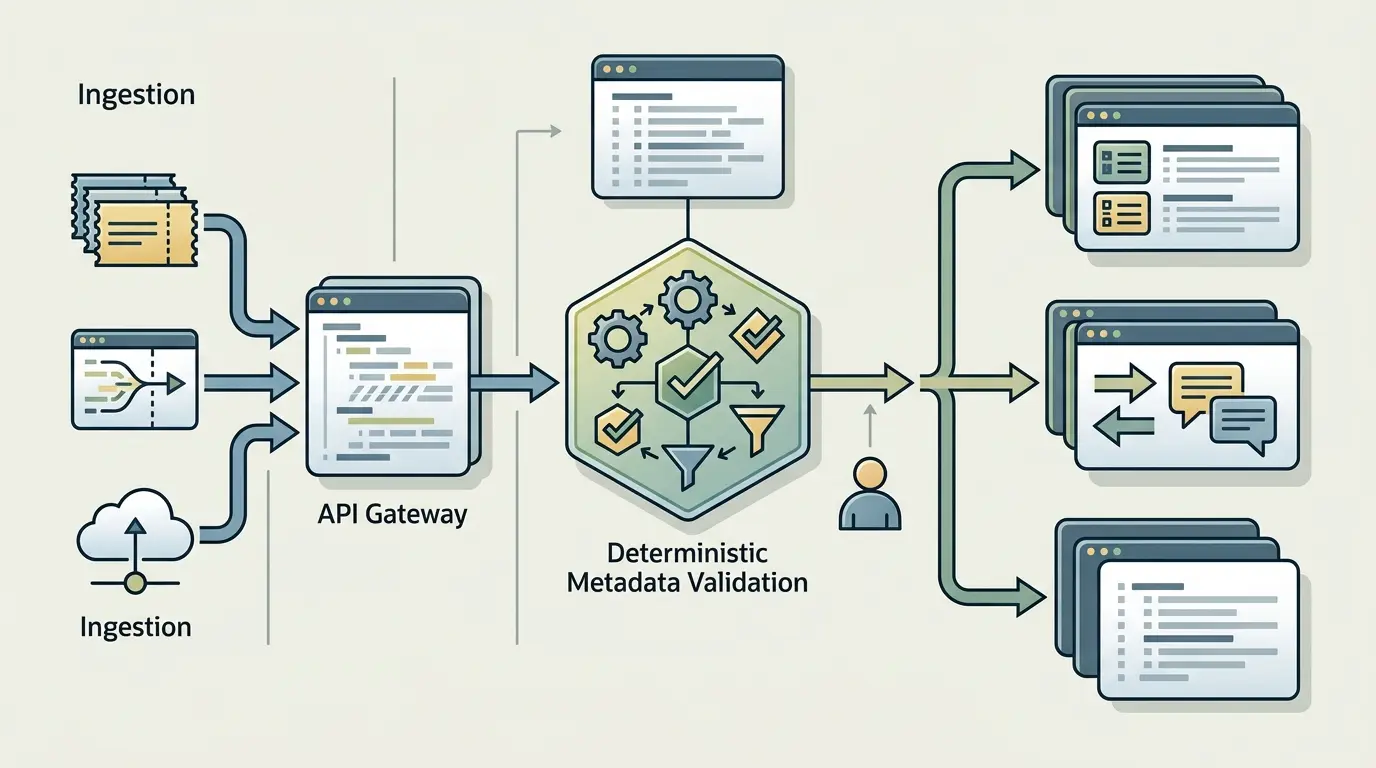
If an engineering team decides to build a dedicated intake and routing application, the smallest viable architecture is a pipeline that processes incoming ticket webhooks, standardizes payload schemas, executes deterministic validation, and presents high-ambiguity cases to a human operator before final dispatch.
A proposed intake engine would ingest messages from customer-facing touchpoints, extract structured fields, match metadata against internal account directories, and evaluate deterministic business rules. When high-confidence criteria are satisfied, the system can write the structured ticket into the target issue tracker or communication channel automatically.
Exploring custom software development for core internal operational engines. custom software development.
Deterministic Logic Before Generative AI Processing
Effective intake architectures enforce strict deterministic logic before passing unstructured payload content to statistical or generative language models. Routing engines should never rely on generative AI to resolve explicit metadata such as enterprise subscription tiers, regional jurisdictions, or active system incident flags.
In a robust pipeline, deterministic filters first inspect sender domain authentication, extract known account identifiers, query tenancy databases, and verify existing open ticket states. Only when structured metadata is fully parsed should a large language model be invoked to summarize narrative text, propose issue taxonomy classifications, or extract reproduction steps from user descriptions.
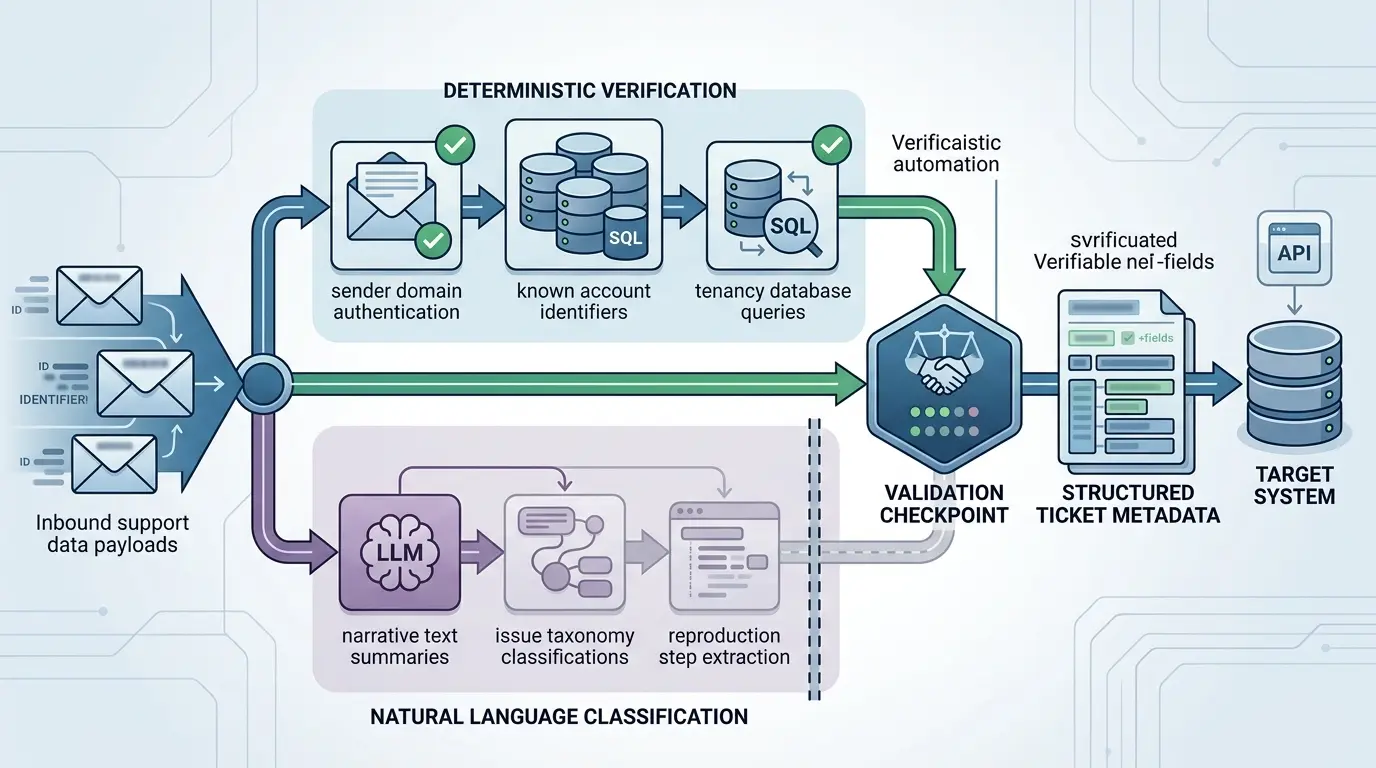
- Deterministic layer extracts verifiable identifiers, account status, and system incident states.
- Rule engines match known error strings or categorical selections against rigid routing tables.
- Language models process unstructured narrative transcripts only to extract summaries and taxonomy proposals.
Principles for scoping an MVP without waste when building initial routing prototypes. scoping an MVP without waste.
Handling Exception Routes and System Auditability
Every automated triage architecture requires defensive exception routing. If a payload contains corrupted metadata, fails signature verification, or yields low-confidence classifications from machine learning components, the pipeline must divert the event to an unassigned holding queue with full context preserved.
Audit logging must capture the complete lifecycle of each ticket: raw incoming payload timestamps, extracted deterministic variables, model confidence scores, assigned routing targets, and downstream API acknowledgments. This visibility ensures that operations leads can audit routing decisions and debug misclassifications without disrupting active queues.
Designing the Human Decision Gate
To balance operational velocity with high accuracy, the routing system should implement a structured human-in-the-loop decision interface for edge cases. Rather than forcing operations associates to manually re-enter data across multiple disjoint platforms, the system can present a unified staging queue displaying AI-suggested categories alongside deterministic account metrics.
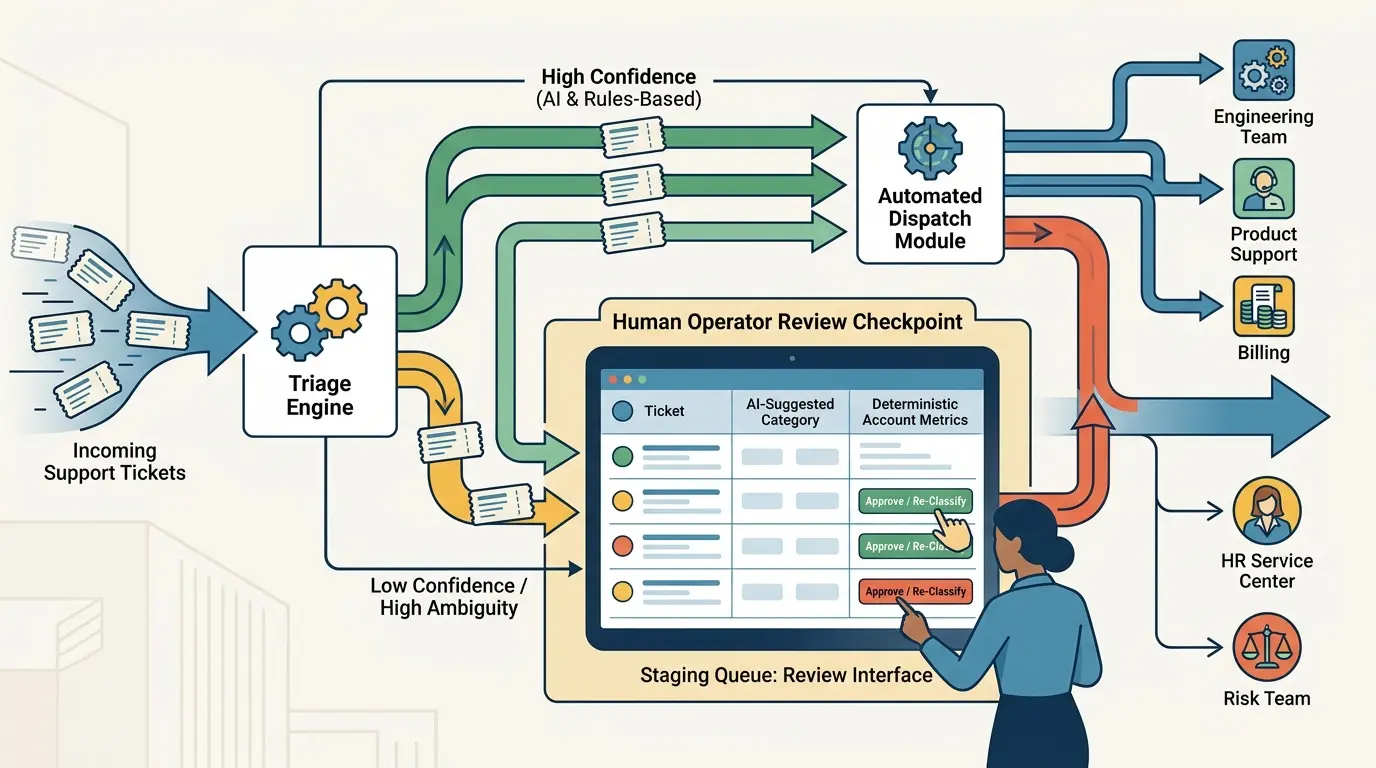
Within this interface, a specialist can confirm or modify the proposed routing tag, adjust urgency ratings, or approve generated technical documentation with a single action. Once approved, the system dispatches the updates via internal APIs, preserving operator authority while removing manual copy-paste overhead.
Assessing the Automation Opportunity in Your Organization
Organizations evaluating their own intake workflows should conduct a structured review of operational handoffs before committing engineering resources. Developing custom internal software requires ongoing maintenance and governance, meaning teams must verify that standard platform configuration cannot resolve their bottleneck.
When intake volume scales or cross-system workflows require complex multi-database lookups, bespoke routing software can offer reliability that generic workflow glue tools struggle to maintain. Understanding your exact payload structures, service level objectives, and exception frequencies is the critical first step in determining the right architectural approach.
Analyzing the engineering trade-offs and workflow automation cost across internal operational tools. workflow automation cost.
| Company | Role | Advertised Task | Bounded Interpretation | Source Access Date |
|---|---|---|---|---|
| Stripe | Support Operations, Privy | Own triage and routing for inbound support tickets from both Privy developers and end users of Privy applications, ensuring issues are assigned, tracked, and resolved promptly and efficiently across the Developer Success team. | The ad assigns responsibility for managing intake queues and dispatching tickets across developer and end-user cohorts. | 2026-08-27 |
| Gusto | Relationship Manager, CX | Triage, troubleshoot, and escalate technical bugs with clear documentation so our Engineering team can act quickly. | The ad describes evaluating customer bug reports, preparing documentation, and escalating cases to engineering. | 2026-08-20 |
| Gusto | People Process Transformation Lead | Lead the HR Service Center responsible for Tier 0/1 Gustie (employee) and People Empowerer (manager) support. | The ad outlines leadership of an operational hub handling frontline employee and manager inquiries. | 2026-08-24 |
| Ramp | Customer Experience Associate | When an issue crosses team boundaries — risk, engineering, product, partnerships — you route it correctly, follow up, and make sure the customer isn't left waiting. You'll work across Zendesk, internal tooling, and Slack-based escalation workflows. | The ad describes cross-boundary ticket routing and follow-up across ticketing and chat systems. | 2026-08-26 |
Diagnostic Checklist for Auditing Inbound Triage Operations
- Audit existing support and intake channels to document all entry points for customer and internal requests.
- Measure the distribution of incoming inquiries by category, tenant tier, and required downstream destination.
- Calculate the proportion of tickets that require manual re-assignment or field correction after initial receipt.
- Identify deterministic routing rules that can be executed purely on structured metadata without semantic interpretation.
- Define explicit confidence score thresholds for any machine learning components used in intent classification.
- Map required integration contracts between primary help desk platforms, engineering trackers, and internal databases.
- Establish clear fallback queues and alerting protocols for unclassified, high-severity, or malformed payloads.
- Prototype a centralized human review queue for low-confidence classifications before deploying direct automated dispatch.
A robust triage system enforces deterministic metadata extraction and rigid business logic before invoking generative models for text analysis.
FAQ
Do these job advertisements prove that the hiring companies lack internal triage automation?
No. The job postings verify only that human operators are assigned specific triage, routing, and escalation responsibilities. They do not document the presence, absence, or sophistication of internal software tools currently used by those teams.
Why should deterministic filtering precede AI classification in routing software?
Deterministic logic guarantees that rigid operational rules, such as account priority tiers, contractual SLAs, and security flags, are enforced predictably without relying on the statistical variability of natural language models.
When should an organization build a custom routing engine instead of configuring help desk settings?
Custom routing architectures are typically considered when ticket workflows require complex, bi-directional state synchronization across multiple disparate databases, proprietary telemetry services, and bespoke escalation queues.
What role does a human operator maintain in an automated triage architecture?
Human operators act as an essential quality gate for edge cases, ambiguous language, novel error types, and low-confidence classifications, ensuring operational precision while providing feedback to refine routing rules.
How can engineering teams measure baseline triage performance before building software?
Teams should quantify the volume of ticket reassignments, the time elapsed between initial receipt and correct queue placement, and the frequency of incomplete technical context provided to downstream engineering resolvers.