
To choose between an AI agent and workflow automation, look at your data predictability: build deterministic workflow automation for structured, rule-based tasks with zero tolerance for error, but build an AI agent when handling unstructured inputs, open-ended reasoning, and dynamic tool usage. While automation provides consistent execution of fixed steps, agents adaptively decide how to achieve a defined goal.
Understanding the Core Paradigm Shift
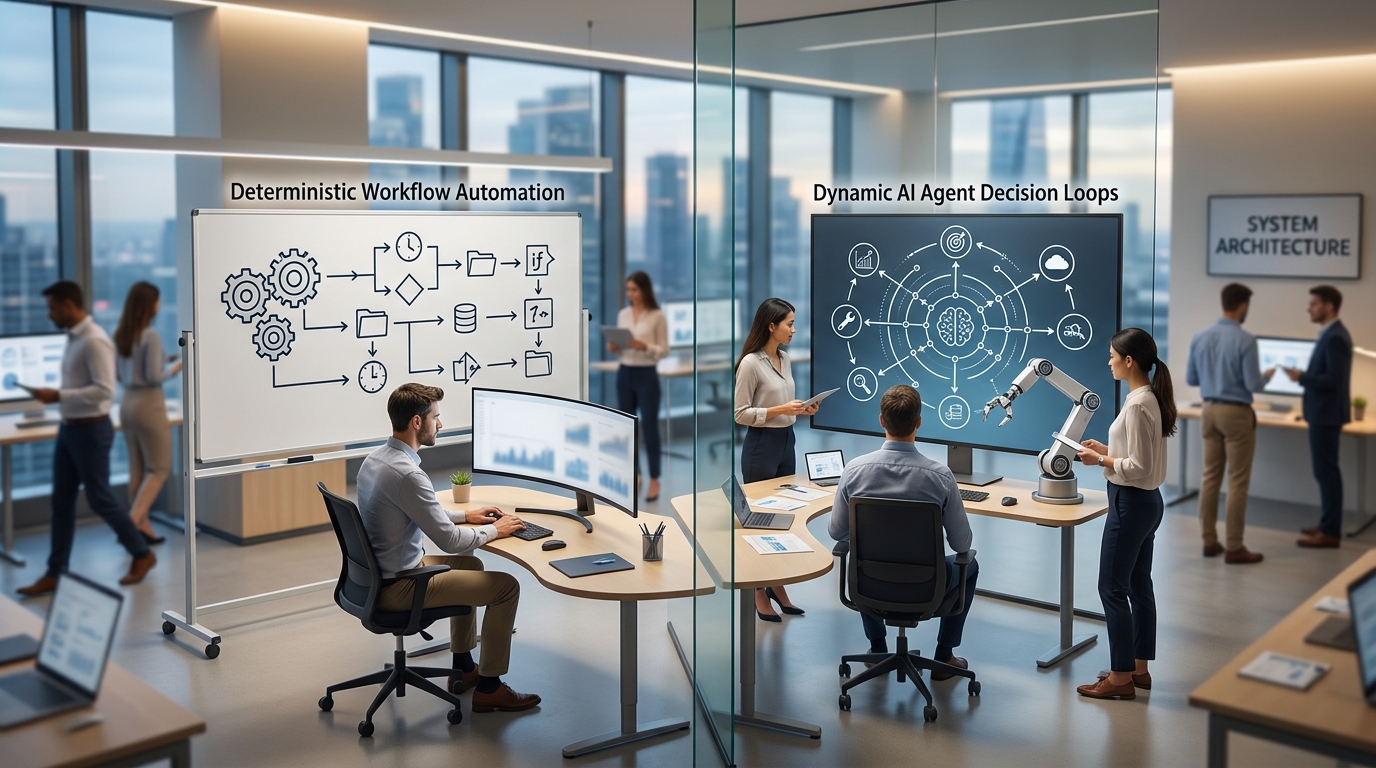
Traditional software development relies heavily on deterministic execution. In this model, developers write explicit code to handle specific inputs and map them to predictable outputs. A workflow automation system is a prime example of this paradigm. It operates on strict execution logic, where data moves through a predefined series of steps. If an external system triggers a webhook, the automation executes a sequence of actions—such as retrieving a record, formatting a string, and updating a database. This approach is reliable for tasks where the inputs, processing rules, and outputs are fully known and static.
AI agents represent a shift toward probabilistic execution. Instead of executing a fixed sequence of instructions, an AI agent leverages a large language model to determine its own path toward a defined goal. When given an objective, a set of tools (such as APIs or database access), and a starting context, the agent enters a reasoning loop. It analyzes the current state, selects an appropriate tool, evaluates the tool's output, and decides on the next step. This allows the system to navigate situations where the exact sequence of actions cannot be pre-programmed due to the high variability of the environment or the unstructured nature of the task.
For founders and operators, distinguishing between simple AI integrations and true agentic behavior is critical. Calling an LLM to perform a single, static task within a traditional workflow—such as translating a block of text or summarizing an email—is still deterministic workflow automation. The overall execution path remains rigid and controlled by the surrounding code. True agentic behavior occurs only when the AI model itself is granted the autonomy to decide which tools to use, when to use them, and how to proceed based on its own reasoning.
Input Complexity and State Management
The choice between these two architectures often depends on the nature of the input data. Deterministic workflow automation requires highly structured inputs, such as JSON payloads, CSV files, or database tables with rigid schemas. If an incoming payload deviates from the expected structure, the workflow will typically fail unless explicit error-handling paths have been pre-configured. This structural rigidity makes deterministic systems stable for standard business data transfers but fragile when forced to ingest unpredictable, real-world inputs.
AI agents are designed to handle unstructured inputs, including raw emails, conversational text, and document scans. Because the core engine is a language model capable of semantic understanding, it can parse messy data, extract key variables, and structure the information dynamically without requiring a rigid schema beforehand. This capability opens up opportunities to automate processes that begin with highly variable human communication, allowing systems to interpret intent and context before initiating any downstream actions.
However, managing state across these different models presents distinct technical challenges. Deterministic workflows maintain state through simple database flags, session variables, or step-by-step logs, which are highly efficient and reliable. In contrast, AI agents must maintain state by carrying their execution history within a context window. As the agent takes multiple steps, this history grows, increasing the computational load and introducing the risk of context drift. If the context window becomes overloaded or if the model misinterprets previous steps, the agent may lose track of its primary objective or enter repetitive loops.

Exception Handling and Operational Control
In deterministic workflow automation, exception handling must be explicitly designed and coded. Developers must anticipate potential failure points—such as network timeouts, rate limits, or missing data fields—and build specific fallback mechanisms, such as retry schedules or manual escalation queues. While this requires more upfront planning, it ensures that the system's behavior during a failure is entirely predictable and controlled, preventing unauthorized actions or corrupted data states.
AI agents handle exceptions through dynamic reasoning rather than pre-programmed rules. If an agent encounters an error while executing a tool, it can analyze the error message, adjust its prompt or parameters, and attempt an alternative approach. This self-correcting capability makes agents resilient when interacting with dynamic environments or APIs that occasionally change. However, this autonomy also introduces unpredictability, as the agent's self-correction path is not guaranteed to align with business policies.
To manage the risks associated with probabilistic decision-making, operators often implement human-in-the-loop controls. While an agent can autonomously research a customer query, draft a response, or prepare an inventory adjustment, a human operator can be introduced as an approval gate before the action is finalized. This hybrid approach allows businesses to leverage the speed and analytical capabilities of AI agents while maintaining strict control over critical operational outcomes, ensuring that autonomous errors do not directly impact customers or core databases.
Cost Structures and Maintenance Realities
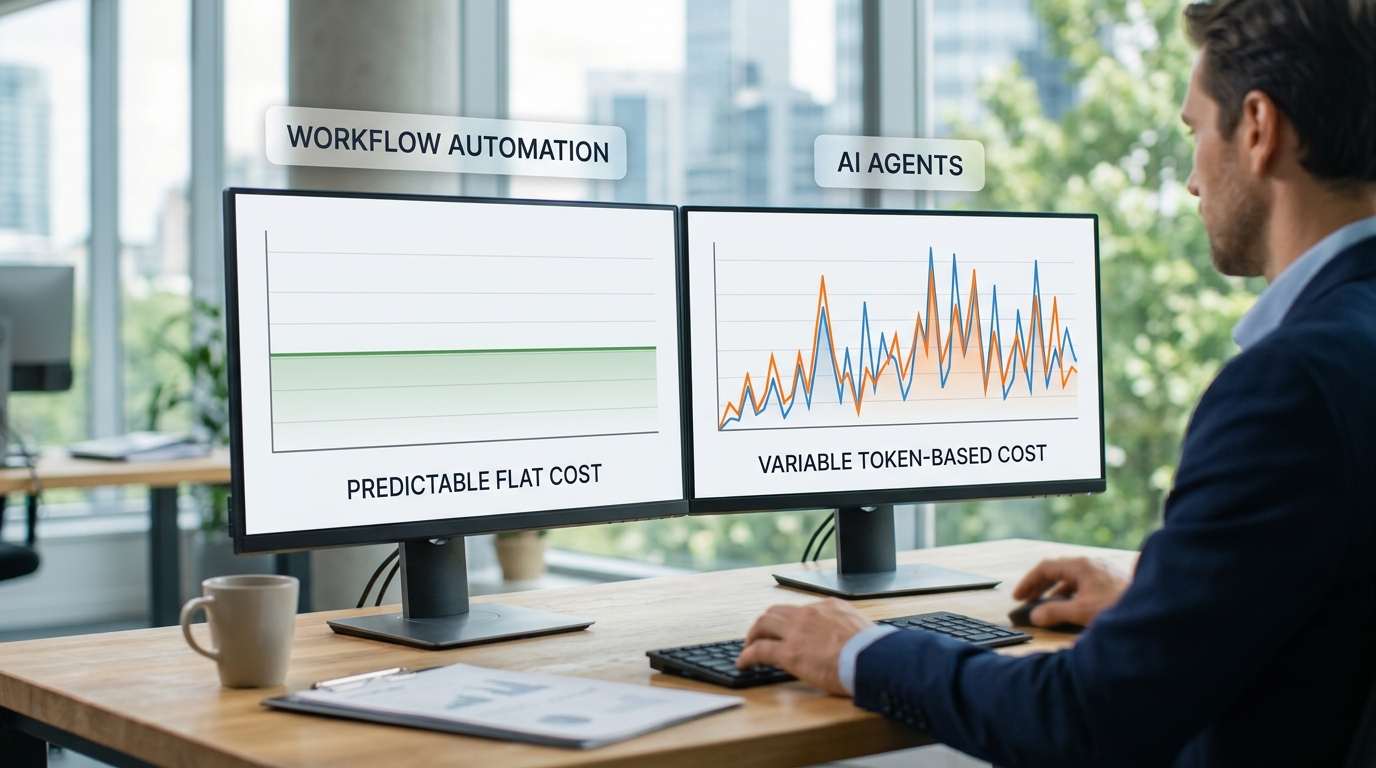
The financial models for these two architectures differ significantly. Deterministic workflow automation typically involves predictable upfront development costs and low, stable ongoing operational expenses. These systems run on standard cloud infrastructure, consuming minimal compute resources. Because the execution paths are fixed, the infrastructure costs scale linearly with transaction volume and are generally easy to forecast, making it simple to calculate the return on investment for specific automation projects.
AI agents operate on a highly variable cost structure driven by token consumption. Every step in an agent's reasoning loop—including reading prompts, invoking tools, analyzing outputs, and self-correcting—requires sending data to an LLM and receiving completions. For complex tasks that require multiple reasoning steps, token usage can accumulate rapidly. High transaction volumes can lead to substantial API expenses, meaning founders must carefully evaluate whether the cognitive flexibility of an agent justifies the ongoing operational cost compared to a simpler, deterministic alternative.
Maintenance requirements also diverge based on the chosen architecture. Deterministic workflows require maintenance primarily when external APIs change, when database schemas are updated, or when core business logic shifts. AI agents, however, require ongoing monitoring to guard against model drift, prompt injection, and changes in model behavior. Because LLM providers frequently update their underlying models, an agentic prompt that works reliably today may produce different decisions tomorrow, requiring continuous evaluation and prompt engineering to maintain consistent behavior.
Limitations and suitability
Understanding where each architecture is unsuitable is essential for making sound technical decisions. AI agents are not designed for tasks that require absolute mathematical precision, strict compliance, or zero variance. Operations such as financial reconciliation, payroll processing, and inventory accounting must remain deterministic. Relying on a probabilistic model for these tasks introduces the risk of hallucinations and logical inconsistencies, which can lead to severe operational errors and compliance issues.
Conversely, deterministic workflow automation is highly unsuitable for open-ended tasks that require subjective judgment, creative synthesis, or complex pattern recognition. Attempting to build a deterministic system to handle unstructured customer feedback triage or competitive market analysis often results in an overly complex web of rules that is difficult to maintain and breaks whenever human inputs deviate from the narrow expected path.
Operators must align their technical choices with the risk tolerance of the specific business process. A common pitfall is over-engineering a solution by building a complex AI agent when a simple, well-structured API integration would achieve the objective with reliability and lower cost. Before writing any code, founders should verify that the complexity of the task genuinely requires probabilistic reasoning rather than straightforward data mapping.
A Strategic Selection Framework for Founders
To determine the appropriate architecture, founders can utilize a structured decision-making framework. The first step is to evaluate the predictability of the process inputs and the rigidity of the required outputs. If the inputs are structured and the output must follow an exact, unyielding standard, deterministic workflow automation is the correct choice. If the inputs are unstructured and the process requires adapting to variable contexts to reach a goal, an AI agent is more appropriate.
When launching a new digital product or internal tool, learning how to scope an MVP without waste is critical. Founders should generally default to deterministic automation first to establish a baseline of operational efficiency. By starting with simple, rule-based workflows, you can identify the exact points where manual intervention or complex decision-making is required, introducing agentic components only when deterministic rules prove insufficient to handle the necessary variation.
This architectural decision also influences long-term product strategy. When evaluating custom software vs off-the-shelf SaaS, founders must consider whether their automation needs represent a core competitive advantage. Custom-built AI agents can provide unique proprietary value by capturing specific operational expertise, whereas standard data-syncing tasks are often best handled by existing, off-the-shelf workflow tools that require minimal custom development.
How YAS Engineers Intelligent Automation
At YAS, we help founders and operators navigate these complex technical choices through strategic product development. As a product and engineering studio focused on native-first Shopify development, AI automation, product development, and founder advisory, we design systems that align with your specific operational needs and business goals. We focus on practical, high-impact solutions rather than adopting technologies simply because they are trendy.
Whether your business requires a highly reliable, deterministic integration to sync data across platforms or a sophisticated AI agent designed to process unstructured customer interactions, our team ensures the architecture is secure, scalable, and cost-effective. We work closely with founders to scope and build MVPs that establish solid operational foundations, helping you avoid the pitfalls of over-engineering while maintaining the flexibility to scale.
By partnering with a studio that provides both technical execution and strategic founder advisory, you gain a partner dedicated to making practical technical and business decisions. We help you analyze your workflows, determine where to apply deterministic automation versus probabilistic AI agents, and build the custom software necessary to drive long-term operational efficiency.
| Feature | Workflow Automation | AI Agent |
|---|---|---|
| Input Type | Strictly structured (JSON, CSV, SQL) | Unstructured (Text, voice, images, PDFs) |
| Execution Path | Deterministic (Pre-defined rules) | Probabilistic (Dynamic reasoning) |
| Error Handling | Fails or triggers pre-set fallback | Attempts autonomous self-correction |
| Operational Cost | Low and highly predictable | Variable (Based on LLM token usage) |
| Primary Use Case | Data syncing, report generation, system syncs | Customer support, research, complex triage |
Step-by-Step Selection Process
- Map the entire business process from initial input to final output.
- Identify all decision points and classify them as rule-based or judgment-based.
- Analyze the input data format to see if it is highly structured or completely unstructured.
- Calculate the acceptable error tolerance for each step in the process.
- Estimate the ongoing API and token costs for run-time execution.
- Build a minimal prototype using deterministic workflows first to establish a baseline.
Do not use AI to solve a problem that can be resolved with a simple database query or a clean API integration.
FAQ
Can I combine workflow automation and AI agents?
Yes, the most robust systems use workflow automation as the backbone to handle structured data and API execution, while calling AI agents specifically for unstructured tasks like text analysis or dynamic decision-making.
Which is cheaper to build and maintain?
Workflow automation may cost less for stable, predictable tasks, but the result depends on integration depth, exception handling, monitoring, and maintenance responsibility. It requires less testing, has predictable hosting costs, and does not suffer from model drift or ongoing API token expenses.
How do I know if my business needs an AI agent?
You need an AI agent if your process requires analyzing unpredictable, unstructured data, making subjective decisions, or interacting with users in an open-ended conversational format.
What are the security risks of using AI agents?
AI agents are vulnerable to prompt injection, data leaks through LLM training, and unintended actions if given direct write access to critical databases without human-in-the-loop validation.
Can workflow automation handle API failures?
Yes, workflow automation handles API failures through pre-configured retry logic, error-routing paths, and alerts to human administrators, though it cannot dynamically invent new solutions to the failure.