
Public job advertisements from Notion, Stripe, and Gusto assign frontline personnel explicit responsibilities for diagnosing customer issues, reproducing defects, and packaging context for engineering teams. While these postings define role boundaries rather than internal software capabilities, this recurring handoff structure raises an important operational question: how can engineering organizations design internal products that assist technical triage without bypassing necessary human verification?
What the Job Postings Literally State
A survey of current technical hiring notices reveals explicit operational responsibilities assigned to frontline and relationship teams. In an advertisement for an Enterprise Technical Support Engineer, the job posting states that the hire will: 'Reproduce customer issues, perform initial codebase triage, and file bugs with Engineering'. The posting directly links issue reproduction, triage involving codebase navigation, and ticket creation.
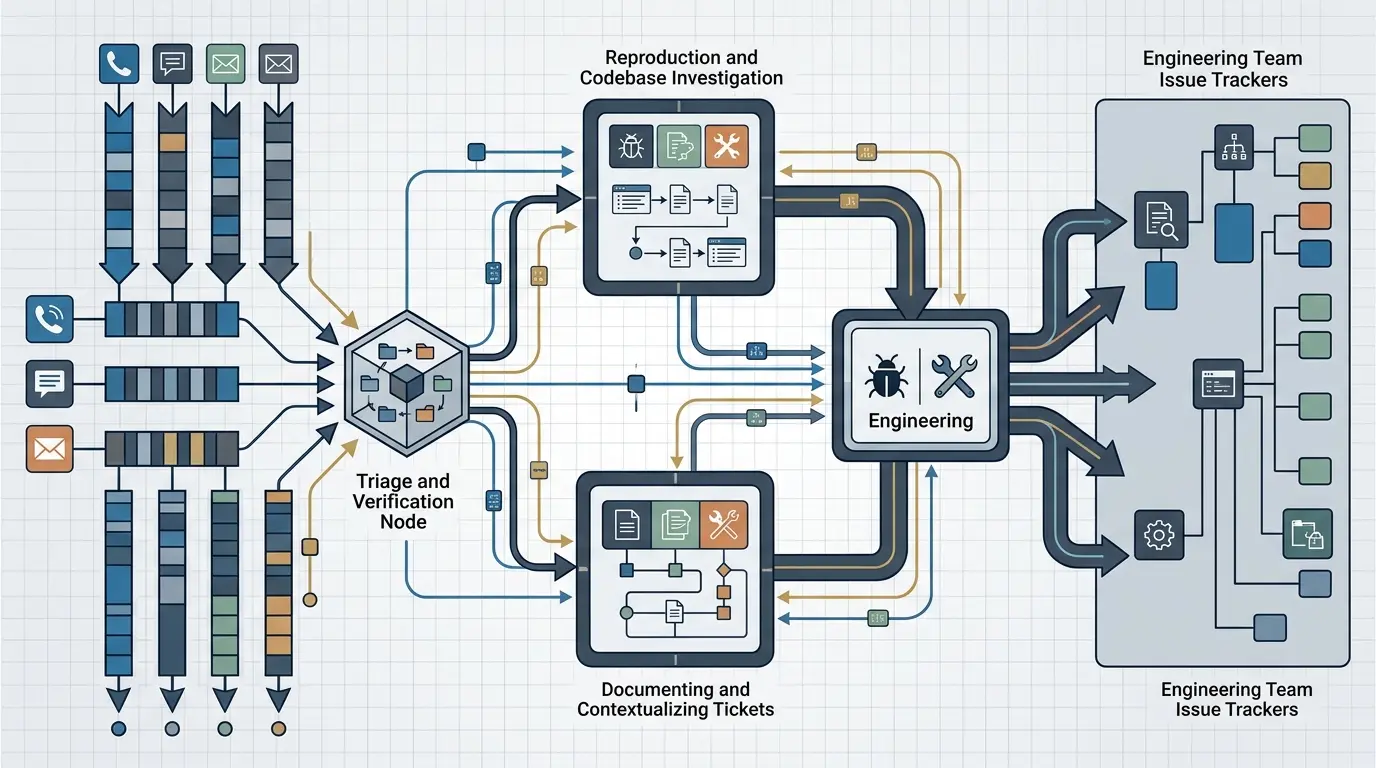
Similarly, a job notice from Stripe for a Technical Support Engineer (Metronome) defines the responsibility to: 'Troubleshoot any issues that arise from customers and diagnose any blockers. Escalate issues with customer context to the engineering team.' Here, diagnostic evaluation and the transfer of contextual findings form the primary escalation interface.
Furthermore, a posting from Gusto for a Retirement Client Relationship Manager specifies that the role must: 'Triage, troubleshoot, and resolve customer issues, escalating technical bugs to Engineering with clear, well-documented tickets and following through to resolution'. Across these three distinct industries, the published text assigns staff the duty of translating customer-reported symptoms into structured engineering artifacts.
- Notion: Reproducing issues, performing initial codebase triage, and filing bugs with Engineering.
- Stripe: Troubleshooting customer blockers and escalating issues accompanied by customer context.
- Gusto: Triaging and troubleshooting issues while escalating technical bugs using well-documented tickets.
The Recurring Operational Responsibility
Analyzing these hiring notices demonstrates a consistent operational pattern: the handoff boundary between customer communication channels and engineering issue trackers. The presence of these tasks in job descriptions confirms that organizations assign human specialists to interpret ambiguous customer reports, investigate underlying technical state, and synthesize findings for development teams.
However, an advertised responsibility does not indicate whether a company lacks internal software or possesses bespoke tooling. A job duty proves neither the absence nor the presence of custom triage applications, nor does it measure team size, ticket volume, error rates, or workflow cost. What it confirms is that human judgment remains the primary operational bridge between external client friction and internal engineering response.
To evaluate the economic trade-offs of building custom triage pipelines, explore our analysis of workflow automation cost structures. workflow automation cost factors.
Investigating Escalation Recurrence in Internal Operations
When an organization seeks to understand how this pattern operates inside its own boundaries, it must gather concrete empirical evidence rather than making assumptions. Understanding handoff efficiency requires examining the end-to-end lifecycle of technical escalations.
An internal review should evaluate whether support personnel must routinely gather diagnostic context across disparate interfaces before filing a bug. Teams should audit whether engineering teams frequently request clarification, additional telemetry, or reproduction steps after a ticket has been submitted. By measuring the distribution of touchpoints per escalated bug, leadership can determine whether their escalation pathway operates smoothly or presents opportunities for workflow consolidation.
Smallest Conditional Internal-Product Design
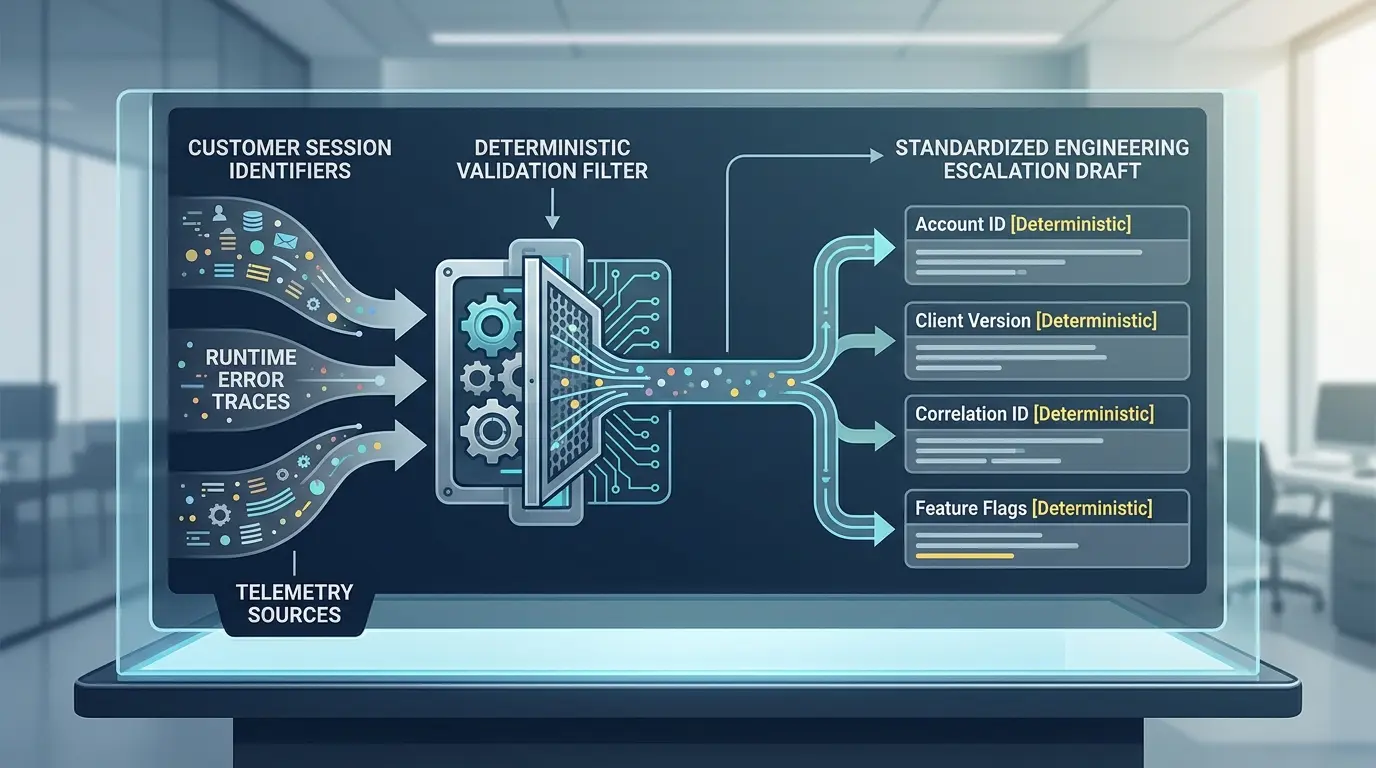
If an organization identifies measurable friction in its triage handoff, it can evaluate the design of a targeted internal product. A proposed escalation system could unify context aggregation, deterministic log parsing, and structured ticket formatting into a single triage workbench.
Rather than forcing specialists to manually query disconnected monitoring systems, a tailored internal application could ingest customer session identifiers, capture relevant runtime error traces if available, and populate a standardized engineering escalation draft. In organizations evaluating their development approach, deciding between generic workflow automation and tailored interfaces often defines long-term maintainability.
Organizations evaluating whether standard ticketing platforms fulfill their diagnostic needs can review our comparison of custom software versus off-the-shelf SaaS. custom software versus off-the-shelf SaaS.
Deterministic Data Pipelines Before Generative AI
A robust internal triage tool must prioritize deterministic data extraction before introducing generative summarization layers. When a customer escalation is initiated, the system should validate known fields deterministically, such as account identifiers, client application versions, active feature flags, and correlated timestamps.
Only after raw diagnostic artifacts are structured deterministically should a language model be employed conditionally to draft reproduction steps or synthesize verbose customer dialog. This separation prevents hallucinated reproduction steps and guarantees that core engineering fields reflect verified system telemetry rather than probabilistic text generation.
Balancing deterministic rules against language model generation is detailed in our guide on AI agent versus workflow automation architectures. AI agent versus workflow automation.
Exceptions, Auditability, and the Human Decision Gate
Automating context capture does not eliminate the necessity of human decision-making. Frontline engineers possess context regarding customer business impact and nuances that automated heuristics cannot assess. Therefore, an escalation platform must function as an assisted workbench with a mandatory human approval gate.
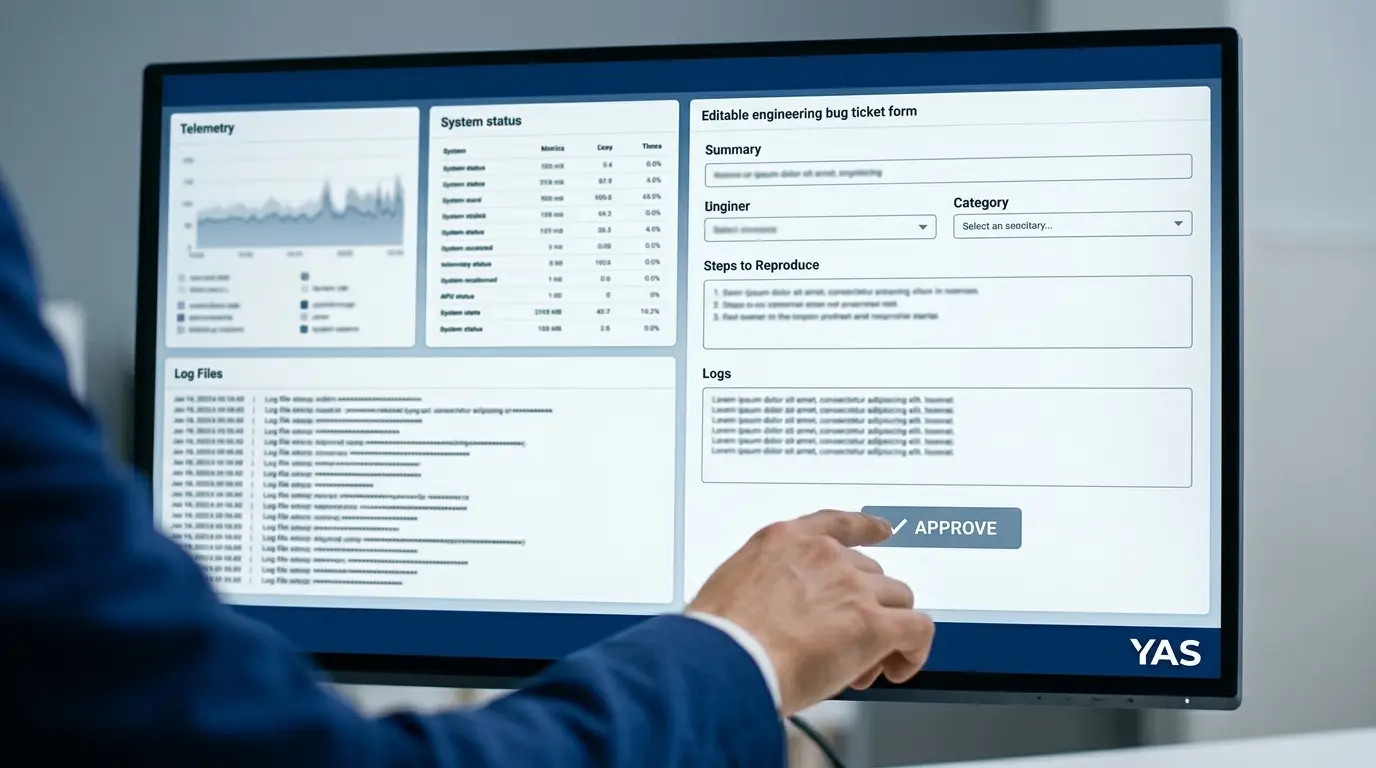
The support specialist must review the compiled telemetry, edit synthesized reproduction steps, assign appropriate severity levels, and confirm engineering routing. Furthermore, comprehensive auditability requires logging what data was deterministically extracted, what text was generated by AI assistance, and what edits were applied by the human specialist before submission.
Assessing the Opportunity in Your Own Operation
Before building custom internal tooling, an engineering organization must assess whether its escalation volume and technical complexity justify dedicated software development. If bug filing is infrequent or handled through standardized native integrations, off-the-shelf connectors may suffice.
Conversely, if customer-reported issues involve high domain complexity, specialized infrastructure logs, and frequent cross-team back-and-forth, engineering leadership may consider scoping a purpose-built triage tool. Auditing internal ticket lifecycles and reproduction accuracy provides the baseline metrics needed to make an informed architectural decision.
When structuring an internal triage workbench, engineering teams can reference principles for scoping an MVP without waste. scoping an MVP without waste.
| Company | Role | Exact Advertised Task | Bounded Interpretation | Source / Access Date |
|---|---|---|---|---|
| Notion | Enterprise Technical Support Engineer | Reproduce customer issues, perform initial codebase triage, and file bugs with Engineering | Assigns the role responsibility for issue reproduction, codebase triage, and bug creation. | 2026-04-27 (Ashby Job Board) |
| Stripe | Technical Support Engineer, Metronome | Troubleshoot any issues that arise from customers and diagnose any blockers. Escalate issues with customer context to the engineering team. | Assigns the role responsibility for troubleshooting customer blockers and escalating context to engineering. | 2026-08-18 (Stripe Careers) |
| Gusto | Future Opportunities: Retirement Client Relationship Manager | Triage, troubleshoot, and resolve customer issues, escalating technical bugs to Engineering with clear, well-documented tickets and following through to resolution | Assigns the role responsibility for troubleshooting, resolving customer issues, and documenting bug tickets for engineering. | 2026-08-14 (Greenhouse Job Board) |
Diagnostic Checklist for Operational Handoff Audits
- Audit the average number of back-and-forth clarification messages between support and engineering on filed bugs.
- Measure the percentage of customer escalation tickets that require manual log lookups across independent interfaces.
- Map the exact fields required by engineering teams to successfully reproduce a reported defect.
- Inspect current reproduction failure rates where engineering returns tickets to frontline staff due to incomplete context.
- Calculate the latency between initial customer report submission and verified bug ticket creation in the engineering tracker.
- Determine whether customer identifiers can be deterministically linked to diagnostic logs without manual copy-paste operations.
- Evaluate whether support specialists currently edit or author code-level triage hypotheses before filing tickets.
- Review internal compliance and privacy boundaries regarding customer log extraction during technical escalations.
Reproduce customer issues, perform initial codebase triage, and file bugs with Engineering
FAQ
Do these job advertisements prove that Notion, Stripe, or Gusto lack internal bug escalation software?
No. Job postings define duties, required skills, and operational responsibilities for individual roles. They do not document internal system architectures, tooling maturity, or the presence of proprietary escalation software.
What is the difference between deterministic data extraction and AI-assisted triage?
Deterministic extraction parses structured data such as error codes, tenant IDs, timestamps, and environment metadata through exact programmatic rules. AI-assisted triage processes unstructured conversation transcripts to draft narrative reproduction steps, which must then be verified by a human specialist.
Why should organizations maintain a human gate in technical escalation pipelines?
A human specialist provides critical evaluation of business impact, filters irrelevant telemetry, validates whether reproduction steps match customer reality, and ensures engineering teams receive vetted, actionable reports.
How can an engineering team determine if their escalation process requires custom software?
Teams should evaluate their escalation volume, the time spent gathering context across disparate tools, and the frequency with which engineering rejects tickets due to incomplete diagnostic details. If standardized integrations cannot bridge these operational gaps, custom software may be warranted.
Can commercial off-the-shelf ticketing systems handle this handoff pattern?
Off-the-shelf ticketing tools handle core ticket creation and routing well. However, when complex diagnostic data aggregation, custom codebase mapping, or deep telemetry correlation is required, organizations often evaluate custom internal software or purpose-built extension layers.