
Across modern security engineering job descriptions, organizations routinely assign engineers to ingest vulnerability reports, translate threat intelligence, and triage security incidents. When evaluating these advertised duties across companies, a core systems design question emerges: how should an engineering organization structure the intake, validation, and routing workflows that link external threat signals to internal remediation tracks without relying purely on unstructured human attention?
What the Job Postings Explicitly Describe
A review of verified job advertisements reveals recurring operational responsibilities centered on security triage, incident response, and threat translation. In a job posting for a Security Engineer, Detection and Response, Notion describes the role as requiring the engineer to "Translate threat intelligence and adversary TTPs into durable detections, telemetry requirements, and response improvements." The advertisement defines a direct link between incoming adversary tactics and detection engineering outputs.
Similarly, Figma's posting for a Security Engineer specifies that candidates will "participate in operational security responsibilities like security reviews, consulting, vulnerability triage, and security incident response." At Ramp, two distinct security postings outline related intake functions. An advertisement for a Detection & Response Lead lists the duty to "Respond and assist with security requests and incidents submitted by Ramp team members," while a posting for a Product Security Engineer assigns the responsibility to "Lead remediation of prioritized issues across our technology stack: collaborating with other engineers to triage and fix vulnerabilities discovered internally, through penetration testing, and through our bug bounty program."
These public listings establish that companies across SaaS and fintech explicitly allocate engineering capacity to the intake, classification, and assignment of security findings.
- Notion assigns detection engineers to translate threat intel and tactics into durable detections and telemetry requirements.
- Figma includes vulnerability triage and operational incident response within core security engineering duties.
- Ramp lists internal team request assistance, incident response, and bug bounty remediation coordination in dedicated security descriptions.
The Recurring Operational Triage Loop
When examined together, these responsibilities illustrate a common operational loop. Ingress signals arrive from diverse origins, including employee submissions, penetration testing reports, third-party bug bounty programs, and external threat intelligence feeds. The security function must process these varied inputs, evaluate the technical context, and output concrete tasks such as detection rules, telemetry specifications, or prioritized remediation assignments for product engineering teams.
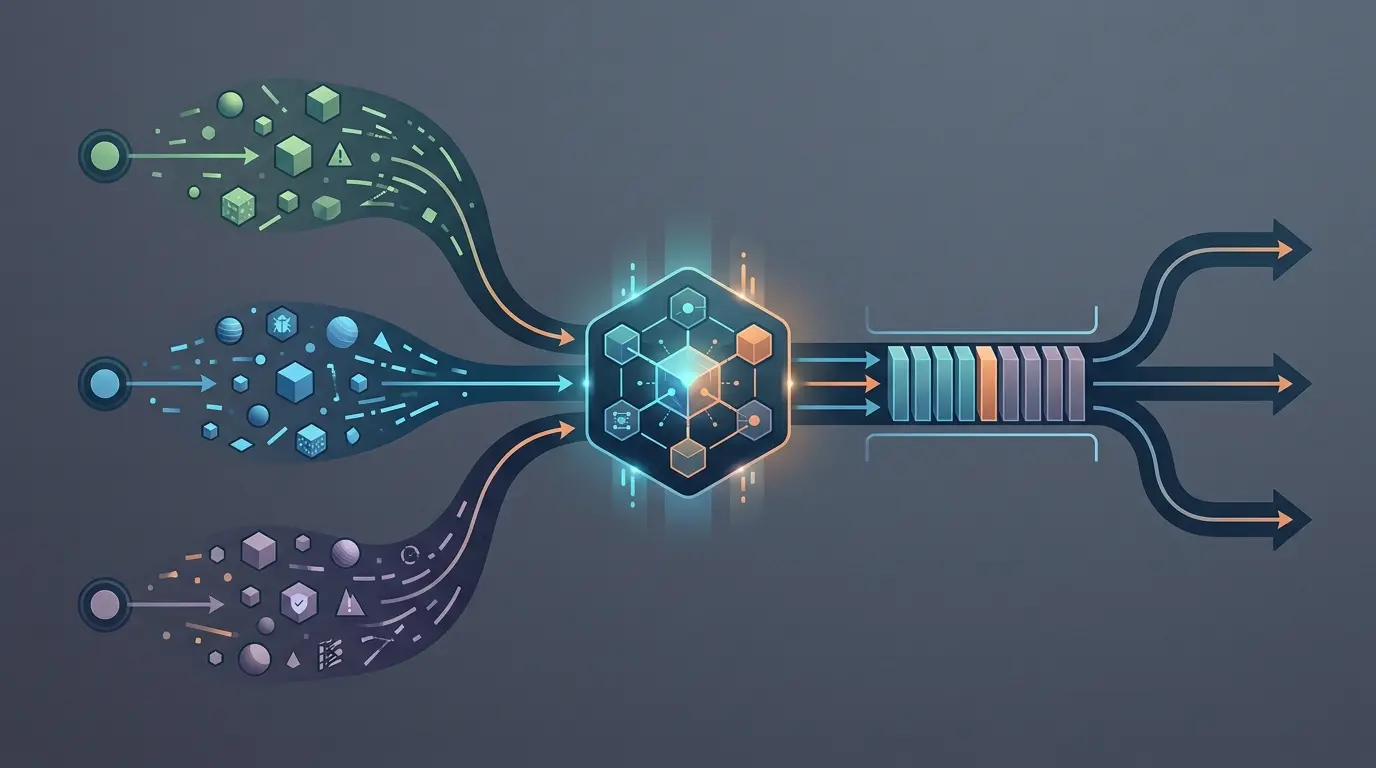
As a fair inference, organizations managing multiple reporting channels often require consistent mechanisms to validate incoming data against internal environments. When an incoming alert or finding lacks standardized metadata, an engineer must manually inspect the asset context, determine potential impact, and route work items to the relevant technical owners. This structural similarity across organizations makes the intake boundary a primary candidate for systems analysis.
- Ingestion from multiple channels: external intelligence, internal staff requests, penetration tests, and vulnerability disclosures.
- Evaluation stage: validating vulnerability scope, asset ownership, and exploitability against the organization's architecture.
- Output dispatch: creating detection logic, incident records, or engineering remediation tickets.
Diagnostic Evidence Required to Evaluate Internal Recurrence
A job advertisement describes a set of responsibilities, but it does not measure how often a task is performed, how many systems are touched, or what internal software already supports the staff. Before concluding that an operational pattern requires new software intervention, an engineering team must gather objective operational telemetry from its own workflows.
To establish whether vulnerability and alert triage constitutes an operational bottleneck, an organization must audit the lifecycle of its security findings. Relevant metrics include the volume of raw reports received per channel, the number of context switches required to identify an asset owner, the rate of duplicate submissions, and the elapsed time between initial ingestion and remediation dispatch. Collecting these data points separates routine operational overhead from systematic workflow fragmentation.
- Audit ingestion volume across bug bounty portals, scanner feeds, and internal reporting channels.
- Measure the frequency of duplicate reports and unmapped asset notifications.
- Track time elapsed between report intake and verified assignment to a service owner.
measuring the true investment required for workflow automation cost before building internal tools workflow automation cost.
The Smallest Conditional Internal Product Design
If an operational audit reveals substantial engineering time spent collecting context and routing tickets, a proposed internal platform could streamline the intake pipeline. Such a system would act as an operational workspace that centralizes disparate ingress streams into a unified review interface.
In a proposed design, the internal product would ingest notifications from bug bounty portals, penetration testing spreadsheets, and internal forms via structured APIs or webhooks. If asset metadata services exist within the enterprise, the workspace would automatically query internal inventories to append repository ownership, deployment environments, and service criticality to each incoming report before human review.
Rather than assembling disconnected point integrations, organizations often evaluate whether to implement custom workflow software that natively matches their internal schema and governance models.
- Unified ingestion service normalizing external disclosures and internal incident submissions.
- Automated context enrichment layer querying internal service catalogs for component ownership.
- Standardized ticket generation dispatching directly to engineering trackers with pre-populated metadata.
defining technical boundaries to scope an MVP without waste when addressing internal bottlenecks scope an MVP without waste.
Deterministic Steps Before Generative Integration
A robust triage architecture enforces strict deterministic rules before introducing any non-deterministic AI evaluation. In a structured pipeline, the system first normalizes incoming payloads into a standard JSON schema, extracts technical indicators such as Common Weakness Enumeration identifiers or target endpoints, and executes deduplication logic against active tickets.
Only after deterministic validation and context mapping are complete could an AI service assist the engineer. For example, a generative model could parse unstructured penetration test narratives to propose a draft vulnerability summary, suggest an initial severity rating based on established internal rubrics, or outline a remediation checklist for the receiving team.
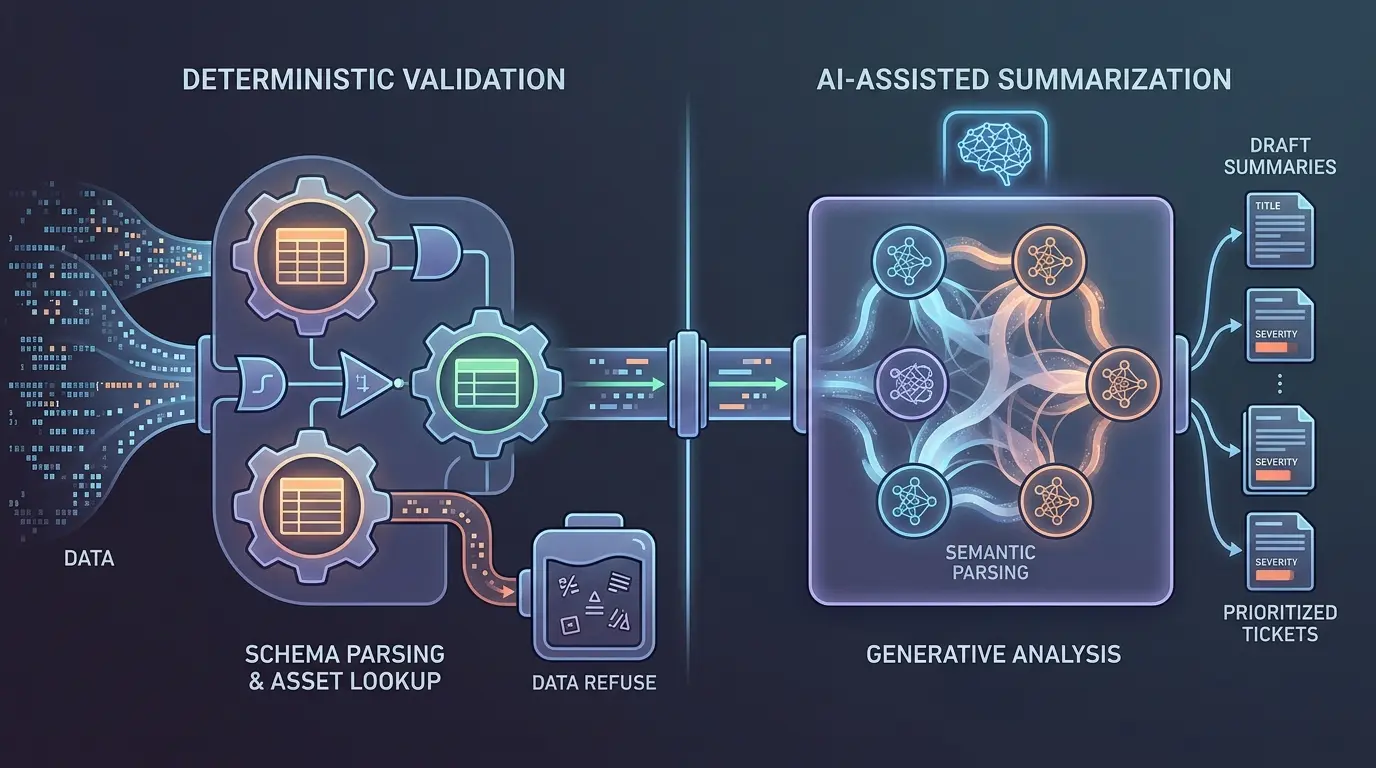
Maintaining a clean separation between deterministic data transformations and probabilistic language generation protects the pipeline from silent extraction failures.
- Deterministic payload parsing and schema validation.
- Automated deduplication against open vulnerability records.
- Static mapping of domain routes to responsible engineering teams.
- Generative drafting of issue summaries and initial remediation notes.
evaluating lightweight script platforms against resilient internal systems in n8n automation vs custom workflow software n8n automation vs custom workflow software.
Exceptions, Escalations, and Auditability
Security workflows require complete audit trails and predictable exception paths. In a proposed triage system, any report involving critical zero-day vulnerabilities or production infrastructure compromise must bypass standard batch review queues and trigger immediate on-call escalation.
Every automated action, from metadata enrichment to severity drafting, must be logged with immutable timestamps and versioned system states. If an incoming finding cannot be mapped to a known asset or contains contradictory diagnostic evidence, the pipeline must route the item to an unassigned review state rather than guessing an owner or dropping the alert.
Ensuring complete visibility into how a ticket moved from intake to resolution is vital for regulatory compliance and post-incident reviews.
- Immediate interrupt routing for critical severity thresholds.
- Explicit quarantine queues for unmapped assets and malformed payloads.
- Immutable audit logs capturing all state transitions and system enrichments.
The Human Decision Gate
Regardless of the level of automation in context gathering, final triage decisions require human engineering judgment. An automated system should never unilaterally adjust the security posture of an application, dismiss a vulnerability finding, or close an incident without explicit human sign-off.
In a well-designed operational workspace, the security engineer acts as the authoritative decision gate. The software presents the enriched finding, displays the suggested classification alongside relevant internal asset data, and provides one-click approval mechanisms for the engineer to confirm severity, adjust remediation deadlines, and dispatch tasks to engineering teams.
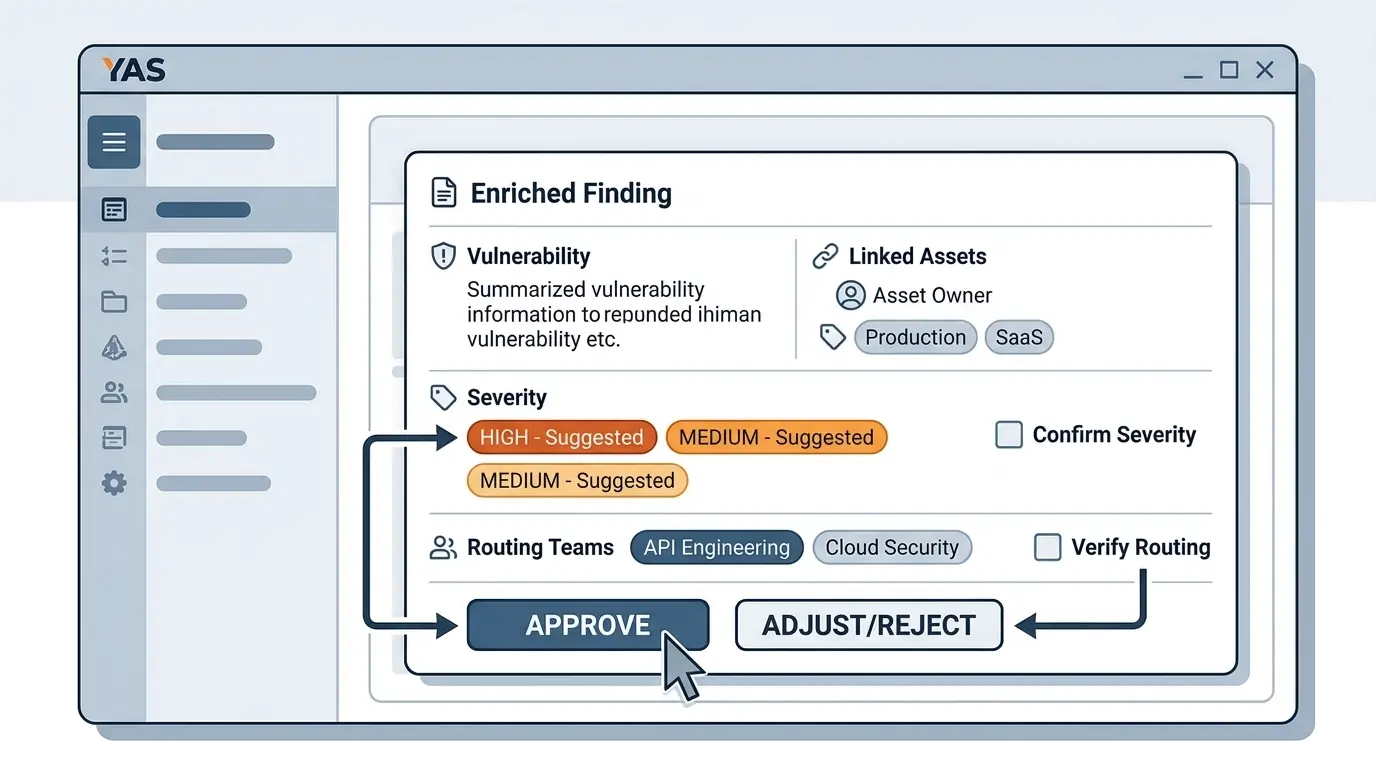
This boundary preserves security accountability while removing the repetitive burden of manual data assembly.
- Security engineer reviews and confirms vulnerability severity before ticket creation.
- Human verification of suggested asset ownership and blast radius calculations.
- Explicit engineer approval required to dismiss duplicate or invalid reports.
Assessing the Tooling Opportunity in Your Organization
Deciding whether to build internal triage tooling requires an objective assessment of operational scale and complexity. If an organization processes a low volume of security reports, standard issue trackers and manual assignments are entirely adequate.
By grounding systems development in empirical operational metrics, organizations ensure that engineering investments solve demonstrable operational friction.
- Quantify the engineering hours currently dedicated to context gathering and ticket routing.
- Evaluate whether existing off-the-shelf security tools accommodate internal asset models.
- Define concrete success metrics for intake latency and routing accuracy prior to development.
Teams evaluating this shift should consider how custom software vs off the shelf SaaS balances against long-term maintenance needs custom software vs off the shelf SaaS.
| Company | Role | Exact Advertised Task | Bounded Interpretation | Source / Access Date |
|---|---|---|---|---|
| Notion | Security Engineer, Detection and Response, Dublin | Translate threat intelligence and adversary TTPs into durable detections, telemetry requirements, and response improvements. | The role requires mapping external threat intelligence and adversary techniques into internal detection rules and logging specifications. | 2026-01-29 |
| Figma | Security Engineer | You will also participate in operational security responsibilities like security reviews, consulting, vulnerability triage, and security incident response. | The posting explicitly lists vulnerability triage and operational incident handling as standard engineering duties. | 2026-07-22 |
| Ramp | Detection & Response, Lead | Respond and assist with security requests and incidents submitted by Ramp team members | The position includes intake, evaluation, and response coordination for internal employee-submitted security reports. | 2026-03-05 |
| Ramp | Security Engineer, Product | Lead remediation of prioritized issues across our technology stack: collaborating with other engineers to triage and fix vulnerabilities discovered internally, through penetration testing, and through our bug bounty program | The role entails triaging findings across multiple distinct sources including bug bounty submissions and penetration tests, then coordinating fixes with product engineers. | 2026-01-20 |
Diagnostic Checklist: Auditing Internal Security Intake Pipelines
- Log every incoming security finding across all sources (scanners, bug bounties, employee forms, penetration tests) for four consecutive weeks.
- Measure the elapsed time spent by security engineers identifying asset owners and verifying service boundaries for each report.
- Calculate the proportion of incoming findings that represent duplicate issues or false positives requiring manual dismissal.
- Audit the number of disconnected tools an engineer must access to validate an average vulnerability report.
- Determine whether existing service catalogs provide machine-readable APIs for automated asset lookup.
- Assess whether ticket creation and SLA tracking across engineering teams follow consistent, deterministic rules.
- Formulate a minimal technical specification for a centralized intake and enrichment layer if manual routing overhead exceeds acceptable operational thresholds.
Lead remediation of prioritized issues across our technology stack: collaborating with other engineers to triage and fix vulnerabilities discovered internally, through penetration testing, and through our bug bounty program
FAQ
Do these job postings prove that the cited companies lack triage automation?
No. The verified job advertisements prove only that Notion, Figma, and Ramp assign specific triage, incident response, and detection translation duties to engineers. A job description does not document the existence, absence, or maturity of internal software tooling.
Why is deterministic validation required before applying AI models to security reports?
Deterministic steps verify schema structure, deduplicate records, and map asset IDs against authoritative databases with absolute predictability. Applying generative models only after these checks ensures that non-deterministic drafting operates on verified operational context.
What distinguishes an internal security triage product from an off-the-shelf ticketing system?
Standard ticketing platforms record tasks but rarely integrate deeply with an organization's internal asset registries, dynamic telemetry feeds, or custom deployment metadata. A dedicated internal product embeds contextual enrichment directly into the ingestion and routing pipeline.
How should an organization decide between custom triage software and commercial tools?
Organizations should audit the specificity of their internal systems, asset hierarchies, and governance requirements. When commercial tools cannot natively map to proprietary infrastructure without brittle workarounds, custom workflow software provides greater reliability.
What is the primary role of the security engineer in an automated triage system?
The security engineer serves as the critical validation gate. The software automates data aggregation, deduplication, and initial draft synthesis, while the engineer reviews exploitability, validates business risk, and authorizes downstream remediation assignments.