
Across published postings from Notion, Figma, and Ramp, hiring notices describe engineers actively transforming threat intelligence, penetration tests, and vulnerability queues into remediation items. When multiple organisations recruit for the same cross-boundary translation duty, it highlights an architectural question: how can teams design internal platforms to normalise intake, parse evidence, and assist human evaluators without bypassing necessary security controls?
What the Job Postings Explicitly Describe
A review of verified public job descriptions shows that growing software teams place vulnerability evaluation and threat translation directly within engineering responsibilities. In a posting for a Security Engineer in Detection and Response, Notion asks the role to "Translate threat intelligence and adversary TTPs into durable detections, telemetry requirements, and response improvements." The text explicitly details the conversion of external threat context into technical engineering outputs.
Similarly, Figma describes operational expectations in its Security Engineer posting, noting: "You will also participate in operational security responsibilities like security reviews, consulting, vulnerability triage, and security incident response." In the fintech sector, Ramp seeks a Product Security Engineer to "Lead remediation of prioritized issues across our technology stack: collaborating with other engineers to triage and fix vulnerabilities discovered internally, through penetration testing, and through our bug bounty program."
These listings establish as fact that security personnel are hired to handle incoming findings from varied channels, assess those findings against internal systems, and drive downstream technical remediation.
- Notion: Translating adversary tactics, techniques, and procedures into detection logic and telemetry requirements.
- Figma: Executing core operational security tasks including vulnerability triage and security reviews.
- Ramp: Triaging findings across bug bounty portals, internal assessments, and third-party penetration tests.
The Recurring Operational Responsibility Across Intake Streams
While each company operates within its own business domain, the duties described share a structural core: ingesting raw, external or disparate technical data, evaluating its relevance to the production environment, and routing structured remediation tasks to software teams.
A fair inference is that these tasks sit at the boundary between unstructured incoming intelligence and structured work queues. Whether the input is a prose vulnerability report, an external penetration testing matrix, or a generic threat signature, an engineer must extract the technical claims, evaluate their applicability, and initiate corresponding tracking records.
The recurrence of this operational requirement does not mean that existing tooling is broken or absent. Instead, it demonstrates that vulnerability intake is an enduring discipline requiring clear handoffs, consistent data translation, and rigorous engineering coordination.
Evaluating Workflow Recurrence and Friction Inside an Organisation
When an organisation identifies similar duties across its security staff, determining how much operational overhead exists requires an empirical audit. A job description proves that a duty exists, but it does not reveal the volume of incoming reports, the tools used to process them, or the latency between report receipt and fix deployment.
To evaluate whether an internal system opportunity exists, teams must inspect their operational audit trails. This involves measuring the total volume of findings across all reporting channels, recording the time required to gather context for each finding, and cataloguing the manual transformations performed between receiving an external payload and logging an actionable engineering issue.
Understanding these baseline metrics allows organisations to determine if building tailored infrastructure will provide meaningful governance and throughput improvements, as explored in our guide on how to scope an MVP without waste.
The Smallest Conditional Architecture for Intake Management
If an organisation chooses to build custom software to support this process, the proposed system could begin with a modular ingestion and normalisation layer. Rather than forcing engineers to query disparate reporting dashboards, an internal application can standardise payload schemas upon arrival.
Under this conditional design, incoming items from bug bounty platforms, automated scanning outputs, or penetration testing documents are ingested through dedicated connector modules. The system transforms these heterogenous schemas into a canonical internal record containing the core vulnerability classification, reported reproduction steps, and target identifiers.
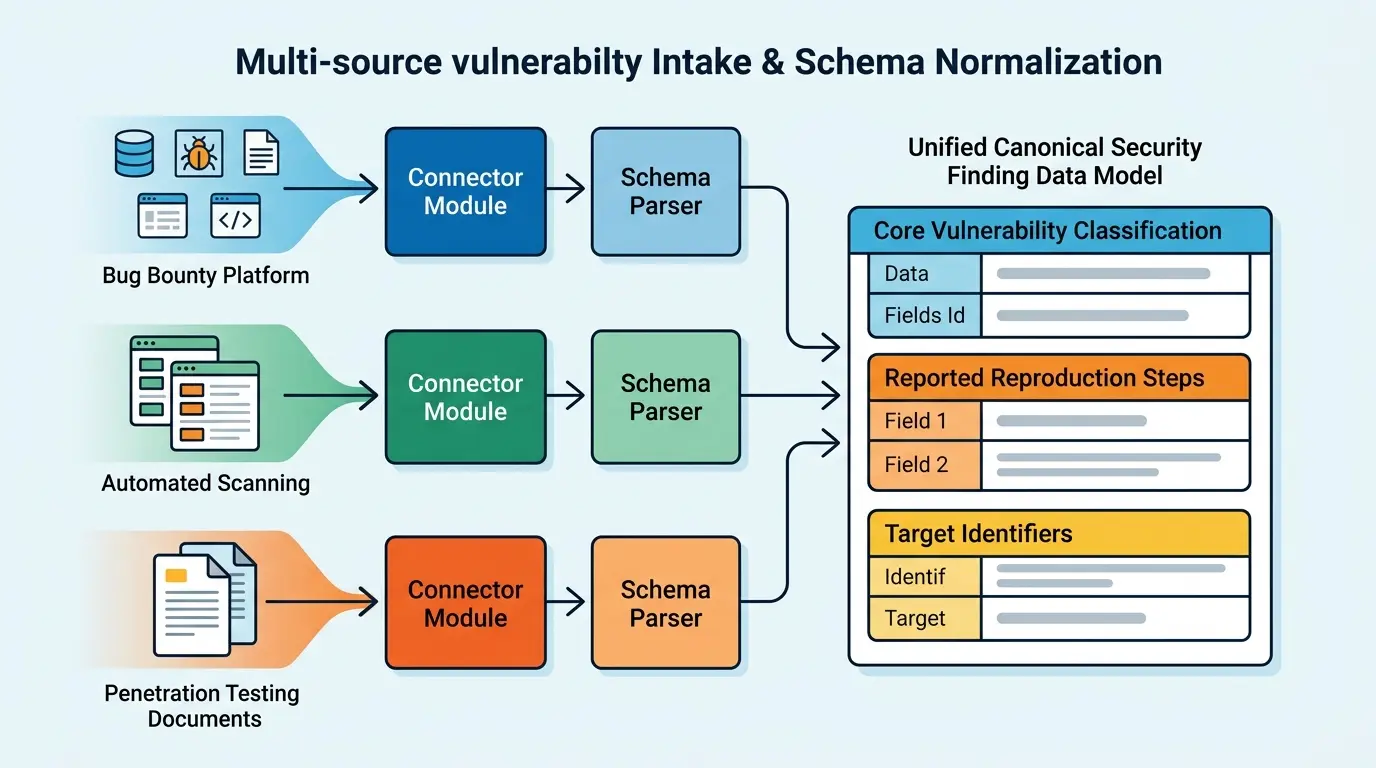
By consolidating these streams into a unified data structure, the architecture eliminates fragmented entry points. Choosing tailored system design over rigid integrations is often critical, as discussed in our analysis of custom software versus off the shelf SaaS.
Prioritising Deterministic Steps Before Generative Processing
A robust internal intake platform must enforce strict, deterministic validation steps before applying any artificial intelligence or natural language synthesis. Security operations require reliable traceability that cannot depend solely on probabilistic models.
Deterministic steps should first execute deduplication against active vulnerability databases, check that submitted endpoints match known asset inventories, and verify whether the reported component is active in production. If these checks fail, the system routes the record to an intake backlog without expending further processing resources.
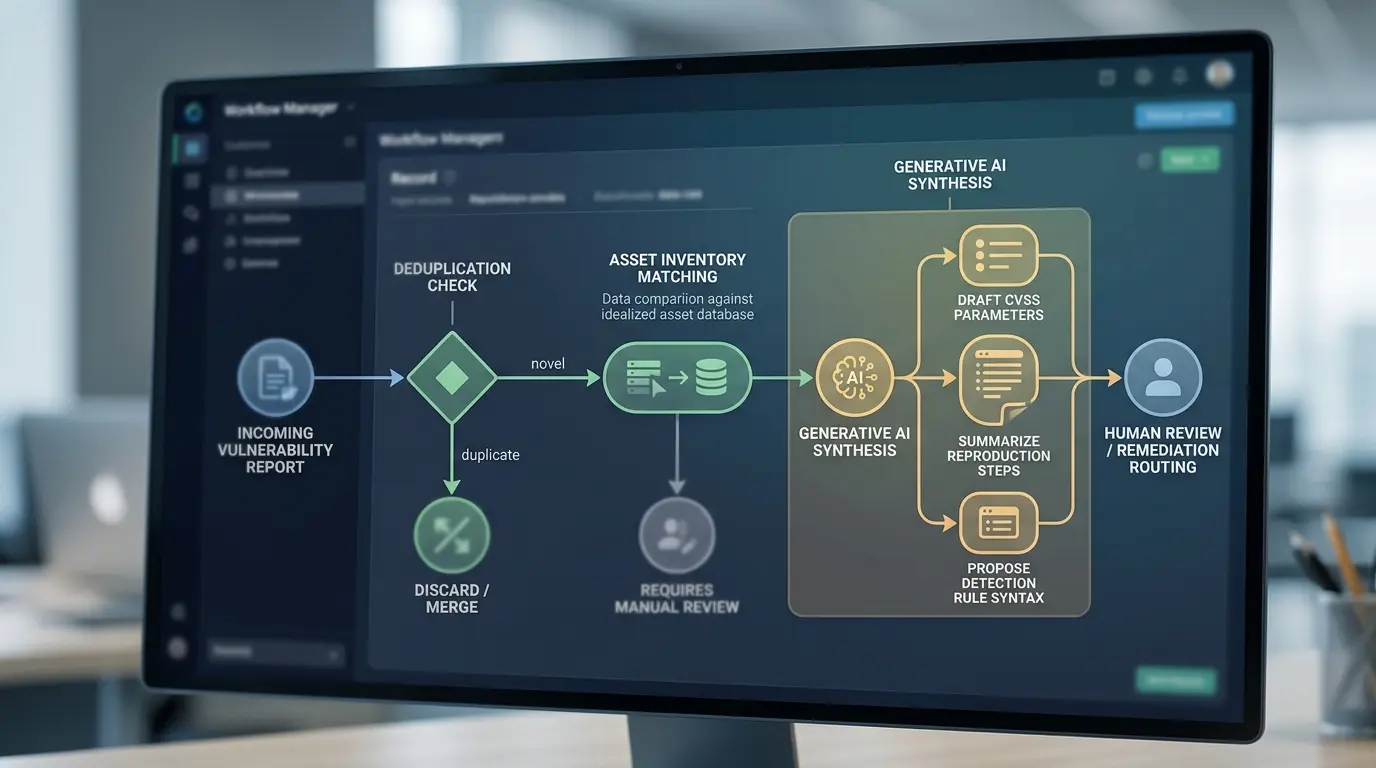
Structuring pipelines this way avoids the reliability pitfalls common when comparing n8n automation vs custom workflow software.
Handling Exceptions, Ambiguity, and Immutable Audit Trails
Operational security systems must accommodate edge cases gracefully. An effective architecture defines explicit fallback routes whenever incoming findings lack sufficient reproduction steps, mention unrecognised infrastructure, or contain critical zero-day indicators requiring emergency protocol.
When an ingested finding fails automated parsing or indicates immediate severe risk, the platform should bypass standard enrichment queues and alert on-call staff directly through designated high-priority notification channels. Every state change, parsing attempt, and automated validation must be recorded in an append-only audit log.
Understanding these architectural bounds helps leadership properly calculate custom workflow software cost.
Preserving the Human Decision Gate
Under no circumstances should an automated pipeline unilaterally publish security patches or dismiss incoming vulnerability disclosures without qualified human review. The core objective of internal tooling is to assist the engineer with contextual synthesis, not to remove expert oversight.
In a well-designed triage platform, the system acts as a workbench. It presents the engineer with a compiled dossier: the original report, matched source repository metadata, historical duplicates, and an AI-drafted severity assessment. The security engineer retains sole authority to confirm the risk level, modify remediation timelines, and approve the assignment of engineering tickets.
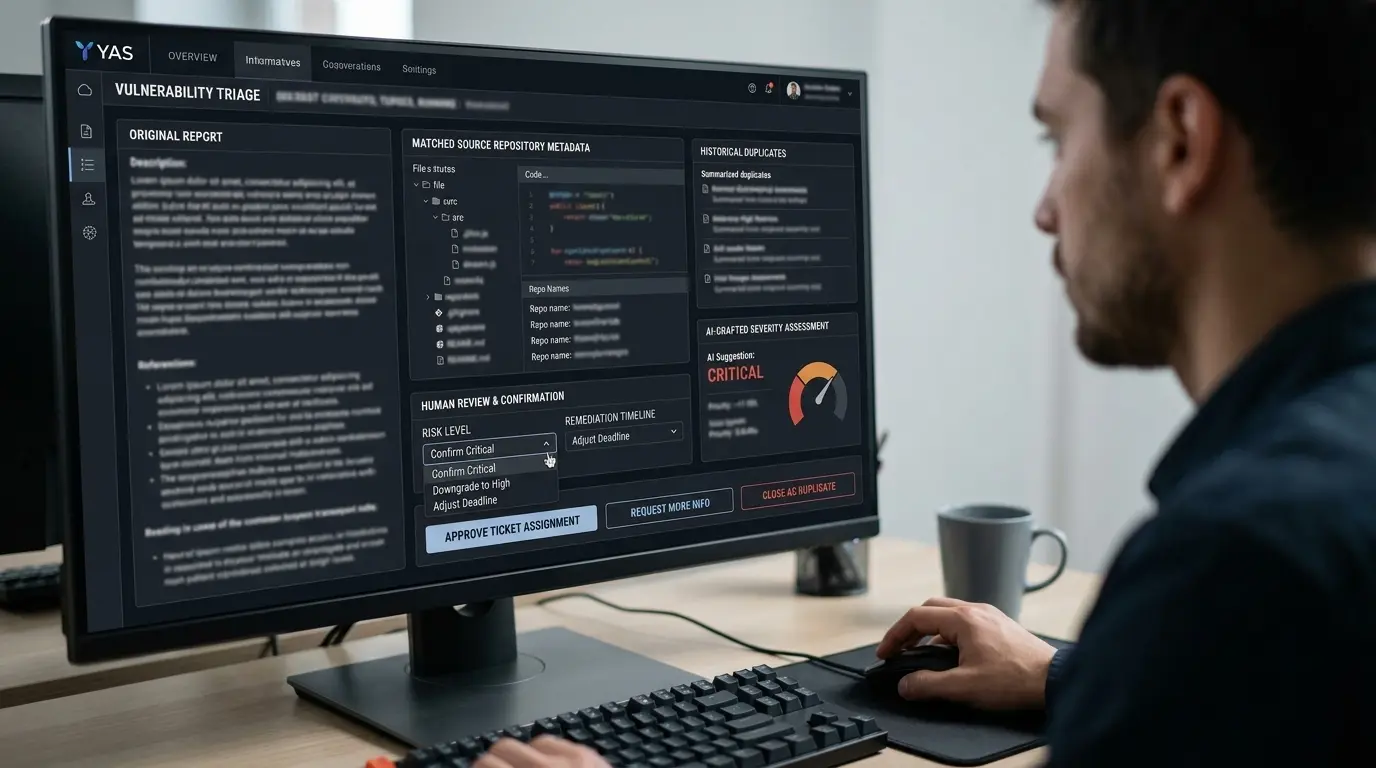
By keeping human judgement at the centre of critical security gates, organisations safeguard their environments against false negatives while giving engineers the structured context necessary to make rapid, defensible decisions. Building these high-assurance internal workbenches is a core capability when partnering with a custom software development company.
Assessing the Internal Product Opportunity in Your Team
To determine whether your security team would benefit from custom ingestion software, leadership should conduct a structured review of current operational bottlenecks. Rather than assuming that high hiring demand implies broken tooling, evaluate the quantifiable friction within your vulnerability handling processes.
Begin by documenting the lifecycle of recent vulnerability reports and threat intelligence memos. Identify where engineers spend time manually transcribing data between systems, searching for asset ownership details, or re-formatting reports into engineering tasks. If findings consistently stall during the context-gathering phase, investing in a unified triage application may yield significant operational resilience.
Building these high-assurance internal workbenches is a core capability when partnering with a custom software development company.
| Company | Role | Exact Advertised Task | Bounded Interpretation | Source / Access Date |
|---|---|---|---|---|
| Notion | Security Engineer, Detection and Response | "Translate threat intelligence and adversary TTPs into durable detections, telemetry requirements, and response improvements." | Role is tasked with converting external threat tactics and telemetry into operational detection rules and response enhancements. | June 10, 2026 |
| Figma | Security Engineer | "You will also participate in operational security responsibilities like security reviews, consulting, vulnerability triage, and security incident response." | Role includes standard operational security duties, specifically highlighting vulnerability triage alongside reviews and response. | July 22, 2026 |
| Ramp | Security Engineer, Product | "Lead remediation of prioritized issues across our technology stack: collaborating with other engineers to triage and fix vulnerabilities discovered internally, through penetration testing, and through our bug bounty program" | Role coordinates vulnerability triage and fix verification across internal discoveries, penetration tests, and bug bounty channels. | January 20, 2026 |
Diagnostic Audit Checklist for Internal Vulnerability Triage Workflows
- Audit all active ingestion channels (bug bounties, penetration tests, scanner feeds, threat intel feeds) and map their inbound data schemas.
- Measure the elapsed time between initial report ingestion and the assignment of a verified engineering remediation ticket.
- Calculate the proportion of incoming vulnerability reports that require manual asset ownership identification by an engineer.
- Review historical tickets to assess deduplication accuracy and identify how often duplicate reports are independently triaged.
- Inspect the current tooling boundary to determine where security engineers manually copy data between intake portals and development trackers.
- Identify whether existing detection rule updates follow an automated code promotion pipeline or rely on manual administrative configuration.
- Evaluate the audit log integrity across the vulnerability lifecycle to ensure all triage approvals, downgrades, and exceptions are permanently recorded.
Lead remediation of prioritized issues across our technology stack: collaborating with other engineers to triage and fix vulnerabilities discovered internally, through penetration testing, and through our bug bounty program
FAQ
Do these job advertisements prove that Notion, Figma, or Ramp lack internal security software?
No. The advertisements establish that these companies assign vulnerability triage, threat intelligence translation, and remediation coordination to security engineers. A job posting outlines responsibilities and requirements; it does not detail internal software architecture, level of automation, or internal tool maturity.
What is the primary difference between deterministic processing and AI assistance in triage systems?
Deterministic processing relies on rule-based logic to perform verifiable operations such as matching asset identifiers, deduplicating known records, and validating schemas against internal inventories. Generative AI assistance is probabilistic and is best applied to summarize natural language descriptions, draft preliminary detection queries, or suggest initial severity categorisations for human review.
Why should an automated security triage pipeline retain a human decision gate?
Human decision gates ensure that security engineers evaluate risk context, business impact, and exploitability before tasks are routed to product teams or before detection rules are pushed to production. Automated models can produce false positives or misjudge architectural context, making expert human sign-off essential.
How can an organisation determine if it needs custom triage software?
An organisation should audit its existing vulnerability lifecycle metrics. If security personnel spend substantial operational effort transcribing reports between systems, tracking down code ownership manually, or reconciling disparate reporting formats, building custom ingestion and orchestration tooling may reduce handoff friction.
What constitutes a fair inference versus a factual claim in job ad analysis?
A factual claim is strictly bounded by the verbatim text of the job posting, such as the specific duties described by the employer. A fair inference is a reasoned, cautious observation regarding the underlying operational nature of those duties, clearly marked as an analytical perspective without asserting unverified company facts.