
Job advertisements for accounting positions regularly describe responsibilities for balance sheet reconciliations, subledger schedules, and periodic flux analysis. When distinct organizations outline comparable closing routines across distinct business models, it prompts an architectural question about where deterministic data transformation ends and where human financial judgment must remain in control.
What the Job Postings Literally State
Public job postings for accounting and finance professionals across diverse sectors frequently outline specific closing routines. For instance, a posting by Gusto for a Revenue Accountant states that the role will "Prepare monthly journal entries, subledger reconciliations, and supporting schedules for retirement revenue streams." This text defines clear monthly deliverables tied to specialized revenue transactions.
Similarly, an advertisement from Figma for a Senior Accountant role lists the responsibility to "Own month-end and quarter-end close activities, including journal entries, accruals, account reconciliations, and financial reporting for your assigned areas." A second posting from Figma for a Senior Analyst, SEC Reporting & Technical Accounting, notes the duty to "Contribute to the monthly and quarterly close process, including balance sheet reconciliations and flux analyses."
In fintech, a job listing from Stripe for an Entity Controller specifies the requirement to "Manage the monthly close of US GAAP books and local books, including balance sheet reconciliations, supporting schedules, flux analysis, and reporting deliverables." Each of these statements establishes that accounting teams are assigned responsibility for matching ledger records, compiling period-end schedules, and evaluating variances.
Identifying the Shared Accounting Closing Responsibilities
Across these job advertisements, several core tasks appear repeatedly: extracting transaction details, reconciling subledgers against general ledger balances, posting balanced entries, and preparing variance analyses. These duties recur on monthly and quarterly cadences regardless of whether the business operates in human resources software, design tooling, or payments infrastructure.
A job description confirms what an organization expects an employee to do, but it does not reveal the underlying technical stack, the degree of existing automation, or the internal software tools already available to the team. The mention of balance sheet reconciliations or flux analyses demonstrates that these accounting controls are essential to the business, not that the workflow is unassisted.
When organizations hire skilled professionals to oversee these reconciliation and flux cycles, the operational objective is ensuring accurate financial reporting under applicable accounting standards. Evaluating this pattern allows system architects to explore how software can best support accountants in performing balance validations without displacing human oversight.
- Subledger matching against general ledger trial balances.
- Accrual calculations and recurring journal entry preparation.
- Balance sheet reconciliation package compilation.
- Period-over-period variance calculation and flux analysis reporting.
Organizations seeking comprehensive product development can explore how YAS builds custom software to deliver tailored internal operational systems. YAS builds custom software.
Determining Internal Recurrence and Workflow Boundaries
To establish whether a reconciliation or flux process represents a candidate for dedicated software tooling, an organization must look beyond the generic responsibilities listed in a job ad. A business needs to measure its own operational parameters, such as the number of data repositories involved, the volume of monthly line items, and the structure of variance reviews.
A fair inference is that complex transactional businesses maintain multiple streams of revenue, partner payouts, and accrual schedules. If an accounting team must pull raw transactional exports across disconnected databases to verify ERP general ledger accounts, the workflow presents high operational coordination requirements.
Understanding these requirements involves examining where data flows deterministically and where subjective human judgment is required. Evaluating whether to invest in bespoke internal software or rely on existing tooling depends on the specific complexity of the company's ledger structures, as detailed in our guide on custom software vs off-the-shelf SaaS.
When designing internal workflows, teams often weigh off-the-shelf integration platforms against tailored software; analyzing n8n automation vs custom workflow software can clarify when specialized business logic warrants dedicated application code. n8n automation vs custom workflow software.
Minimal Internal Software Architecture for Reconciliation
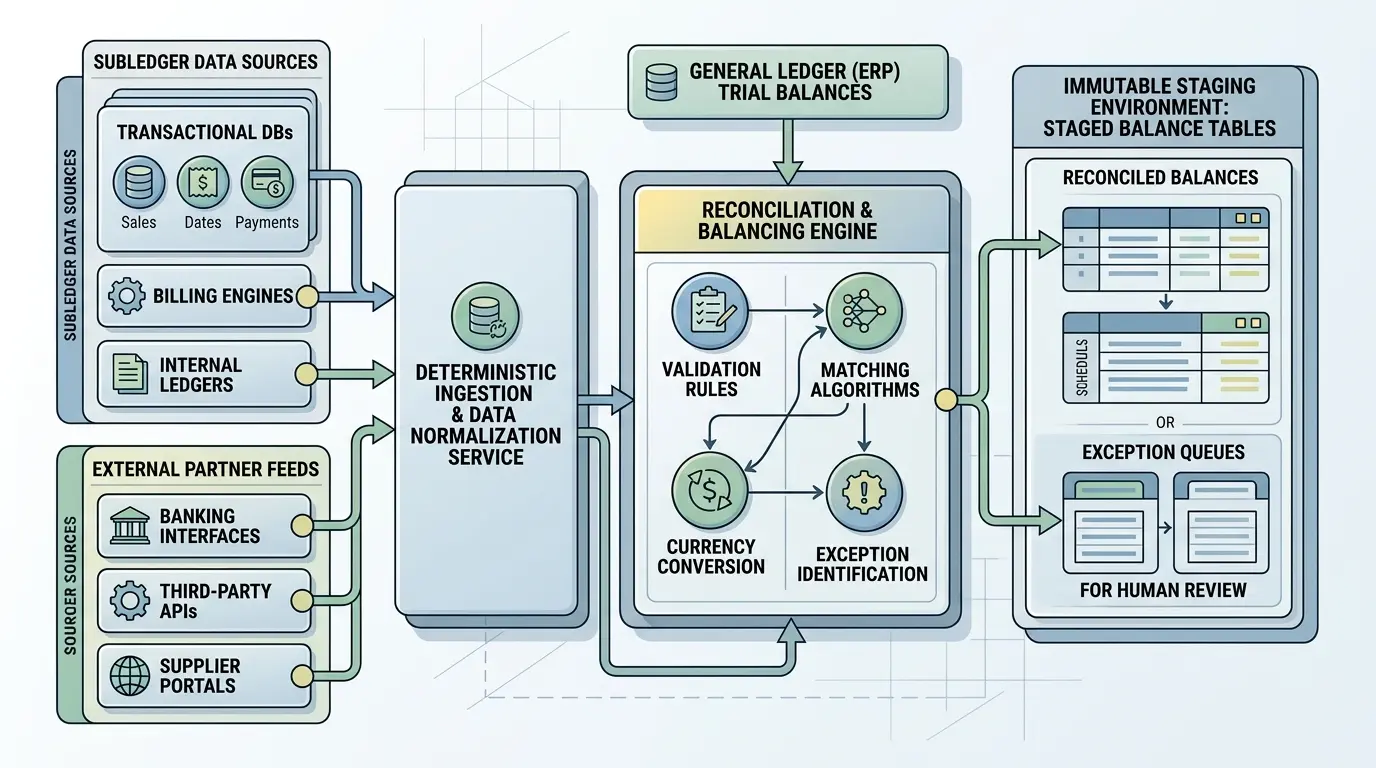
If an engineering team sets out to build internal tooling for financial close workflows, the smallest viable architecture focuses on deterministic data ingestion and reconciliation orchestration. Rather than attempting to automate whole accounting roles, a proposed system could ingest subledger feeds, normalize transaction schemas, and run verifiable mathematical balance comparisons.
The architecture begins with scheduled extraction connectors that pull source records from transactional databases, billing engines, and banking interfaces. These records are loaded into an immutable staging environment where ledger balancing rules are applied deterministically against general ledger balances pulled from the core ERP.
When designing internal workflows, teams often weigh off-the-shelf integration platforms against tailored software; analyzing n8n automation vs custom workflow software can clarify when specialized business logic warrants dedicated application code.
Evaluating whether to invest in bespoke internal software or rely on existing tooling depends on the specific complexity of the company's ledger structures, as detailed in our guide on custom software vs off-the-shelf SaaS. custom software vs off-the-shelf SaaS.
Deterministic Pipeline Design Before Generative Commentary
In financial operations, mathematical precision and strict traceability are non-negotiable. Therefore, any product design must implement deterministic calculations before introducing probabilistic features such as AI-assisted variance explanations. The system must verify that balances reconcile down to the cent prior to any commentary generation.
A proposed pipeline calculates period-over-period variance percentages and absolute dollar shifts deterministically. When an account variance exceeds a predefined materiality threshold, the system flags the line item for human review. Only after deterministic variance detection occurs could a language model conditionally inspect underlying transaction metadata to draft preliminary explanatory notes.
Such language generation must remain strictly bounded: it should read structured transaction tags and metadata to propose a draft explanation, leaving the factual verification and editing entirely to the accounting analyst.
Scoping such internal tools requires discipline around boundaries. As explored in our framework to scope an MVP without waste, starting with the core deterministic comparison prevents over-engineering and keeps audit controls clear. scope an MVP without waste.
Exception Routing, Traceability, and Audit Trails
A critical component of financial close software is exception handling. When subledgers fail to match general ledger balances, or when unmapped transaction codes appear, the proposed system should isolate the discrepancy without stalling the entire close schedule. Unmatched records must be routed to designated queues based on account ownership and materiality thresholds.
Auditability is central to internal accounting controls. Every automated ingestion run, mathematical comparison, draft journal entry, and user edit must produce an immutable audit log. This record should capture the source dataset timestamp, the rule version applied, the user identity, and the exact ledger state at the time of execution.
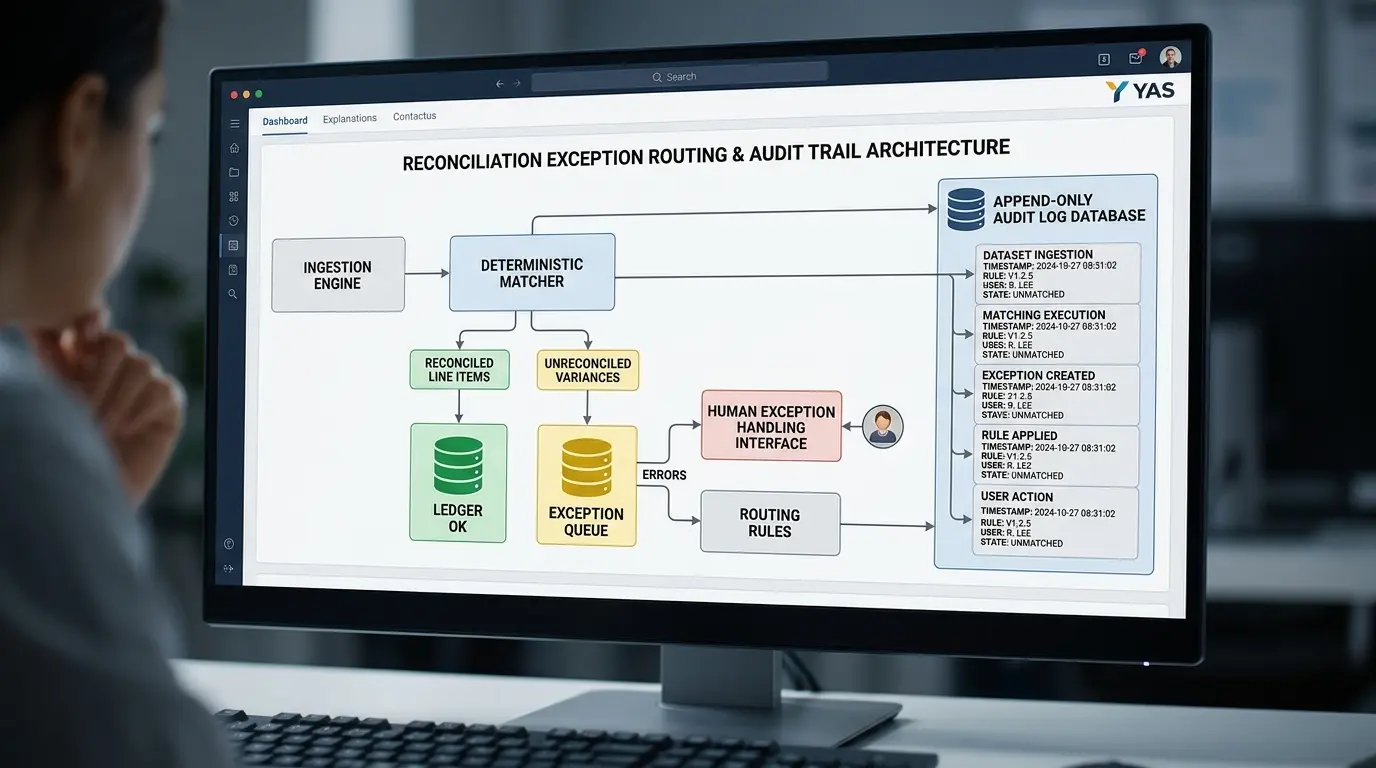
By enforcing strict audit logging, internal software ensures that internal and external auditors can trace every balance sheet figure back to its source records. This architectural structure protects the integrity of financial controls while providing clear visibility into operational adjustments.
Human Review Gates and Accounting Sign-Offs
Internal software designed for financial close processes must never post directly to general ledgers without an explicit human sign-off gate. Accounting principles require human professionals to evaluate revenue recognition standards, assess accrual adequacy, and approve adjustments.
The interface should present the preparer and reviewer with clear side-by-side reconciliation summaries, highlighted exception items, and generated flux drafts. A Senior Accountant or Controller reviews the supporting schedules, adjusts journal entries as necessary, and records a cryptographically verifiable approval before data is transmitted to the ERP.
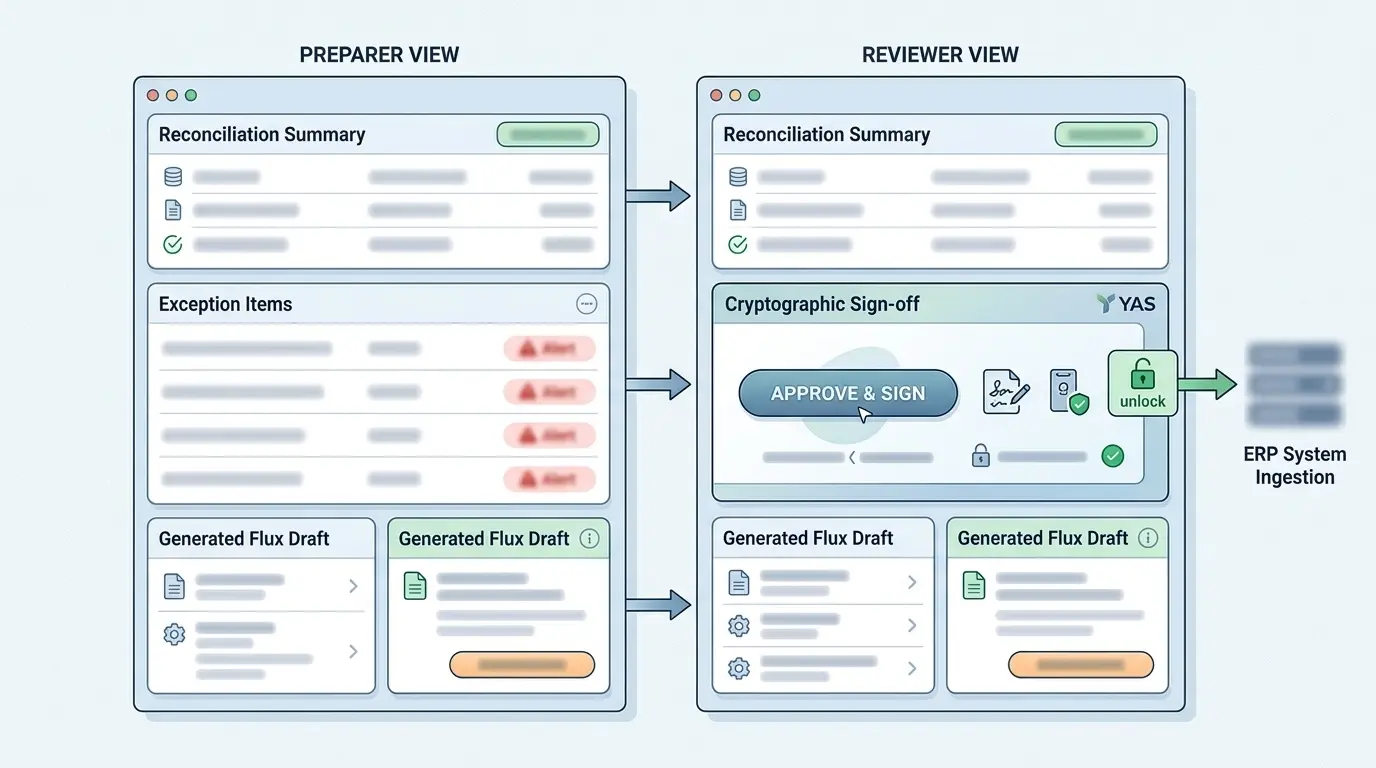
Maintaining clear human gates ensures that professional accountability remains intact. The software serves as an operational assistant that prepares structured data packages, while certified accounting personnel retain full authority over accounting treatments and financial disclosures.
Diagnostic Steps for Internal Finance Operations
Organizations evaluating their own closing operations should conduct an objective diagnostic before initiating software development. This analysis involves mapping data dependencies, timing requirements, and reviewer workload across monthly and quarterly cycles.
Organizations seeking comprehensive product development can explore how YAS builds custom software to deliver tailored internal operational systems.
Understanding these factors helps leadership evaluate whether operational bottlenecks stem from complex data transformation requirements, fragmented tooling, or routine manual verification steps. For teams assessing development budgets, our breakdown of workflow automation cost provides an analysis of internal engineering expenditures. workflow automation cost.
| Company | Role | Exact Advertised Task | Bounded Interpretation | Source and Date |
|---|---|---|---|---|
| Gusto | Revenue Accountant | Prepare monthly journal entries, subledger reconciliations, and supporting schedules for retirement revenue streams | The role is responsible for monthly journal entries, reconciliation of subledgers, and supporting schedules for retirement revenue. | Greenhouse Job Board (Accessed August 14, 2026) |
| Figma | Senior Accountant | Own month-end and quarter-end close activities, including journal entries, accruals, account reconciliations, and financial reporting for your assigned areas | The role manages periodic close tasks encompassing journal entries, accruals, reconciliations, and reporting for assigned business areas. | Greenhouse Job Board (Accessed July 22, 2026) |
| Stripe | Entity Controller | Manage the monthly close of US GAAP books and local books, including balance sheet reconciliations, supporting schedules, flux analysis, and reporting deliverables. | The role oversees monthly close procedures under US GAAP and local standards, including balance sheet reconciliations and flux analysis. | Stripe Careers (Accessed August 18, 2026) |
| Figma | Senior Analyst, SEC Reporting & Technical Accounting | Contribute to the monthly and quarterly close process, including balance sheet reconciliations and flux analyses | The role participates in periodic close workflows specifically involving balance sheet reconciliation and flux analysis. | Greenhouse Job Board (Accessed July 22, 2026) |
Diagnostic Checklist for Financial Close Operations
- Audit all data sources feeding the general ledger, listing the exact format, connection type, and extraction schedule for each subledger.
- Map every manual data transformation step currently performed in spreadsheets between raw transactional exports and ERP journal entry templates.
- Measure the total elapsed time and personnel hours dedicated to balance sheet reconciliation and flux compilation during each closing cycle.
- Catalog the standard variance thresholds used by finance leadership to trigger mandatory flux analysis explanations.
- Document the exception categories and discrepancy rates encountered during subledger-to-general-ledger balance matching.
- Inspect the existing audit trail to verify whether data changes, manual adjustments, and supervisory sign-offs are logged systematically.
- Review internal compliance and control requirements to ensure automated pipelines preserve necessary separation of duties.
- Assess whether building a dedicated internal ingestion and reconciliation tool provides sufficient operational value relative to software engineering costs.
A job duty proves neither the absence nor the presence of internal software, but repeated close responsibilities highlight the engineering boundary where deterministic data pipelines must support human accounting judgment.
FAQ
Do these job advertisements prove that the hiring companies lack automated financial tools?
No. Job descriptions specify the tasks and responsibilities assigned to an individual role. They do not document internal software infrastructure, backend pipelines, or the degree of automation already deployed across the company's accounting systems.
Why is flux analysis consistently listed alongside balance sheet reconciliation?
Balance sheet reconciliations verify that detailed subledger records align with general ledger accounts. Flux analysis examines period-over-period variance percentages and absolute dollar changes across those balances to identify unusual trends and ensure financial reporting integrity.
Where should deterministic software end and human judgment begin in closing workflows?
Deterministic software is suited for data ingestion, mathematical matching, balance reconciliation, variance threshold calculation, and audit trail recording. Human judgment is essential for evaluating accounting treatments under GAAP, interpreting complex contract terms, and approving journal entries.
Can generative AI replace human accountants in month-end variance analysis?
No. Generative language models can conditionally assist by drafting preliminary explanatory commentary based on structured transaction metadata. However, certified accounting professionals must review, verify, and take responsibility for all financial explanations and reporting disclosures.
What is the primary risk of attempting to automate journal entry posting entirely?
Direct automated posting without human review risks introducing unverified accruals, misclassified transactions, or standard non-compliance into the general ledger. Regulated financial controls require segregation of duties, review thresholds, and formal management sign-offs.