
Ecommerce teams scale catalog updates, customer operations, and inventory reconciliation by combining deterministic workflow software with controlled AI agents. Relying solely on raw language models creates data drift and unpredictable errors across complex product catalogs. Bespoke automation pairs structured validation rules with human review queues, keeping high-volume retail operations accurate, auditable, and resilient as order volume grows.
Operational Bottlenecks in Modern Ecommerce Workflows
Ecommerce businesses operating across multi-channel marketplaces face substantial manual friction in back-office routines. Product onboarding requires translating supplier manifests into marketplace-compliant schemas, standardizing attributes, and validating pricing rules. When done manually, these tasks slow time-to-market and introduce attribute mismatches that affect search visibility.
Customer service and returns processing present parallel operational strains. Support teams spend considerable time matching incoming return requests against shipping carrier events, ERP records, and inventory disposition rules. Unifying these disparate data sources manually leads to delayed refund decisions and elevated support costs.
Inventory reconciliation across warehouse management systems and external retail channels introduces further risk. Stock discrepancies between physical inventory and multi-channel listings can trigger stockouts or unfulfillable orders. Solving these challenges requires robust integration architecture rather than ad hoc manual data entry.
Plan engineering investment using our breakdown of workflow automation cost factors.
Deterministic Logic Versus Controlled AI Agents
Automating ecommerce workflows requires a clear division between deterministic code and probabilistic AI models. Deterministic workflow software executes rigid tasks such as calculating sales tax, verifying stock thresholds, and syncing tracking numbers across APIs. These operations require exact mathematical precision and unambiguous logic that should never be delegated to language models.
Conversely, controlled AI agents excel at unstructured data extraction, semantic categorization, and natural language synthesis. An AI agent can parse unstructured supplier specification sheets, identify missing product attributes, or classify incoming customer inquiries based on sentiment and intent.
Reliable retail architectures place deterministic guards around every AI agent. The AI outputs structured JSON that passes through schema validation before reaching live production databases or inventory ledgers.
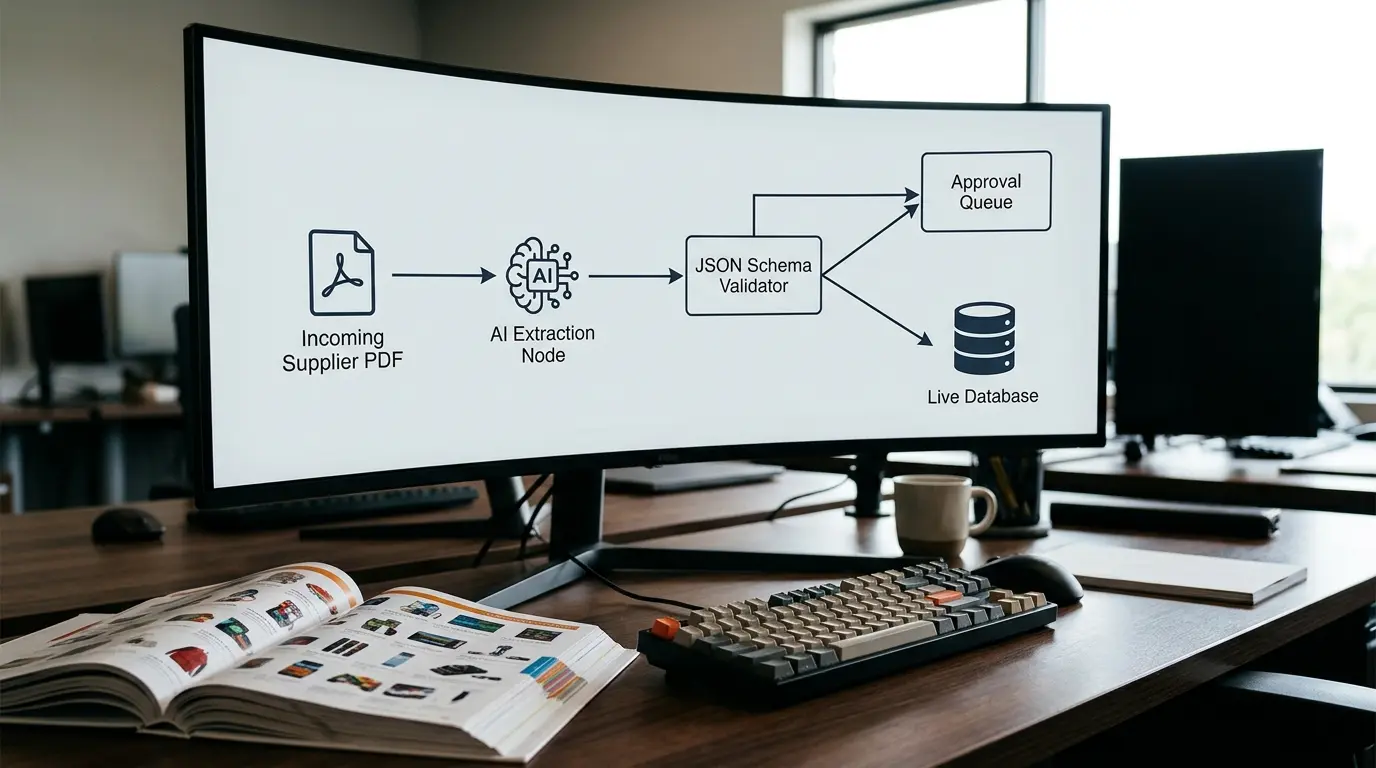
For a deeper technical comparison, read our guide to AI agent architectures versus workflow automation.
High-Impact Ecommerce Automation Domains
Catalog enrichment represents one of the highest-leverage applications for AI automation. Specialized agents extract technical specifications from supplier PDFs, generate SEO-aligned product descriptions, and normalize size, color, and compatibility fields across thousands of SKUs.
Support triage is a candidate when a team repeatedly identifies the same request types and retrieves the same order context. An assistant can prepare a response for review. Any automated dispatch needs explicit policy rules and representative evaluation; a model-generated confidence score alone should not authorize it.
Supplier invoice processing and purchase order matching automate multi-way reconciliation. System integrations ingest supplier invoices, match line items against warehouse receipt records, flag cost variances, and route discrepancies directly to procurement specialists.
To prioritize the first workflow, use our framework for identifying candidate automation processes.

Worked Example: One Supplier File to a Reviewed Catalog Update
This is an illustrative design scenario, not a YAS client result. Imagine a team receiving a spreadsheet and a PDF from one supplier. The useful first scope is one product family and a small approved set of attributes. Prices, stock quantities, and publication permissions remain outside this example. The objective is to prepare a reviewable change set, not to let a model rewrite the live catalog.
Keep a traceable input
Store a reference to the supplier file and its version, then match each row to the internal product identifier. Preserve the original value beside the proposed normalized value. If the same supplier code maps to two products, stop that row and show the ambiguity. Do not ask the language model to choose whichever match looks most plausible. A missing identifier is a data problem, not a prompt problem.
Separate preparation from permission to write
The extraction step proposes an attribute, its source location, and whether the source actually contains the value. Validation then checks allowed units, required fields, taxonomy membership, and contradictions with existing approved data. A model describing itself as confident is not an acceptance criterion. The reviewer needs the source excerpt, the proposed difference, and the reason a row was flagged, so correcting it does not require reopening several systems.
Test recovery, not only the happy path
Before enabling writes, process sample records into a staging change set and compare them with an operator-reviewed answer set. Include an empty cell, a changed unit, an ambiguous product match, a duplicate file, and an update made by a person after extraction. Define whether each case must be rejected, held for review, or safely retried. Successful field validation alone must not authorize a publication.
For an event-driven integration, duplicate deliveries and recovery need explicit handling; Shopify documents these concerns in its webhook guidance. Track the intended operation and source version, check the current destination state, and avoid repeating an already-applied change after a timeout. Where the platform cannot safely resolve an uncertain outcome, hold it for reconciliation instead of assuming failure and writing again.
The handover should include the field mapping, sample acceptance cases, access boundaries, a named exception owner, and instructions for stopping further writes. Record which updates were applied and which were held. Recovery may mean a compensating change reviewed against the current catalog, not blindly restoring an old value over a newer legitimate edit.
A related public example is the product-photo input and generated-asset review flow in My UGC Studio. It illustrates a different ecommerce task: preparing visual material for review. It is not evidence that this catalog integration exists, and it does not establish a sales uplift. See the distinctions between public product workflows and proposed pilots in the YAS automation examples.

Human-in-the-Loop Architecture and Exception Handling
Autonomous execution without human oversight poses substantial operational risks to retail brands. A robust human-in-the-loop framework routes ambiguous data, low-confidence agent inferences, and anomalous transactions into dedicated review interfaces.
Exception handling systems capture edge cases before they affect customer experience or financial integrity. For example, if an AI agent proposes a product price change that deviates beyond a preset tolerance, the system halts execution and alerts an operations manager.
Review interfaces should present operators with the complete operational context, including raw supplier data, the agent proposed output, and the specific validation rule that triggered the review. Operator corrections can then be logged to refine system prompts and validation logic over time.

Data Quality, Validation Rules, and System Integration
Custom workflow automation connects enterprise resource planning systems, warehouse management platforms, payment gateways, and marketplace channels into a coherent pipeline. An API integration can reduce repeated exports and uploads when permissions, data coverage, rate limits, and recovery behavior fit the workflow. A scheduled file exchange may still be appropriate for systems without a suitable API.
Data validation layers enforce strict schema definitions at every boundary. Type checks and reference validation catch specified structural problems. They do not prove that a supplier value is factually correct; units, source provenance, approved taxonomies, and cross-field consistency need separate checks.
Maintaining centralized audit logs ensures end-to-end traceability for every automated action. The audit trail should connect the source version, transformation, validation result, approval, and destination update. Retain only the data needed for diagnosis, with appropriate access controls and retention limits rather than indiscriminately logging customer data.

For implementation scope and operating responsibilities, explore YAS custom AI automation services.
Limitations and suitability
AI automation is not suitable for highly volatile processes lacking defined business rules or baseline operational stability. If an organization has not documented its core catalog taxonomies or return policies, introducing automated agents will amplify existing process flaws rather than resolve them.
Standalone AI agents without integration middleware cannot guarantee data consistency across distributed ecommerce systems. Teams must verify that their underlying software platforms provide accessible APIs or database webhooks to support reliable event-driven automation.
Organizations must establish clear operational ownership for automated systems. Ongoing monitoring, prompt adjustments, schema updates, and exception queue management require dedicated operational oversight to maintain long-term reliability.
Choose the First Process and Prepare a Useful Brief
I would start with the process whose input, owner, and acceptable output can be demonstrated today. A bounded catalog preparation task is a better starting point than a promise to automate all retail operations. If most work consists of resolving undocumented policy disputes, clarify those decisions first. If the process is already fast and stable, the maintenance cost may outweigh the benefit of adding AI.
For a useful first discussion, describe the trigger, the tools involved, the repeated manual step, and what happens when the normal path fails. Include approximate volume and the person who handles exceptions. You do not need to choose an AI model or prepare a technical specification. Use anonymized examples or a simple process description; do not send customer records, credentials, or unrestricted production access in an initial inquiry.
Agree how the first implementation will be accepted before estimating a wider rollout. Compare operator handling time on a representative sample, the share of records requiring correction, the age of unresolved exceptions, and the ongoing costs of APIs, review, and support. Keep sample composition comparable. A faster extraction step is not a saving if operators spend more time repairing its output downstream.
A turnkey scope should make ownership after launch explicit: which integrations and environments are included, how changes are approved, where failures appear, who can pause processing, and what support covers. Ask for exclusions as well as deliverables. Broader rollout follows evidence from the first working path, not an assumed percentage improvement.
If you can describe one recurring task and its desired outcome, bring that to a discussion of AI automation implementation. The next useful decision is whether the task is ready for a bounded implementation, needs process clarification, or is better served by existing software.
Engineering Custom Automation with YAS
YAS designs and builds bespoke end-to-end automation solutions tailored to unique business operations. The implementation may combine existing connectors, workflow tools, and custom components. The choice depends on the process, reliability requirements, available integrations, and who will maintain it.
Our engineering approach focuses on process redesign, strict data validation, human review queues, and resilient exception handling. The aim is to reduce defined repetitive work while preserving accountable review of important decisions. The acceptance test must show what actually changed; a demonstration alone is not evidence of time saved.
By structuring back-office data flows and automating manual data transformations, YAS helps ecommerce operations achieve scalable, auditable, and resilient business processes.
Compare implementation options in our guide to bespoke workflow software development.
| Ecommerce Process | Automation Mechanism | Primary Control Guard | Human Review Trigger |
|---|---|---|---|
| Supplier Catalog Ingestion | Controlled AI Attribute Extraction | Schema and Type Validation | Unmatched Taxonomy or Missing Fields |
| Customer Return Triage | NLP Intent Classification & API Lookup | Policy checks and human approval | Policy Mismatch or Return Value Exceeds Limit |
| Order Tracking Updates | Deterministic Webhook & Carrier Sync | Idempotency & Status Check | Carrier Delivery Exception or Lost Package |
| Supplier Invoice Reconciliation | Multi-Way Document Matching | Price Variance Tolerance | Discrepancy Between PO and Warehouse Receipt |
| Inventory Level Balancing | Deterministic ERP & Channel Sync | Safety Stock Floor Limits | Negative Inventory or Rapid Stock Drift |
Step-by-Step Implementation Framework for Retail Automation
- Map existing catalog, fulfillment, and customer support workflows to identify manual data entry bottlenecks.
- Define clear boundaries separating deterministic mathematical tasks from probabilistic natural language tasks.
- Establish structured JSON schemas and data validation rules for all external data inputs.
- Implement dedicated review queues and user interfaces for human-in-the-loop exception handling.
- Build direct API integrations between ERP, WMS, and ecommerce storefront platforms.
- Deploy controlled AI agents with constrained system prompts and strict confidence scoring.
- Establish automated audit logging and real-time alerts for failed execution steps.
- Monitor exception queue resolution times and continuously refine validation logic based on operator inputs.
Bespoke automation succeeds in retail when probabilistic language models are bound by deterministic validation rules and visible human review controls.
FAQ
What is the difference between AI agents and deterministic workflow software in ecommerce?
Deterministic workflow software executes fixed, rule-based operations like tax calculation and inventory sync with exact precision. AI agents process unstructured information such as supplier specifications or customer emails, converting qualitative input into structured data for downstream execution.
How do human-in-the-loop controls protect ecommerce operations?
Validation rules can route specified anomalies and policy exceptions into review queues before an update is authorized. This reduces exposure but does not catch every incorrect inference. Test false acceptance as well as false rejection, and define who can approve a change or resolve an uncertain result.
How should automation handle inconsistent supplier data?
Start with representative files, including incomplete and conflicting examples. Extraction may help prepare attributes, but validation, source references, and an exception queue are still required. Missing values should remain unknown until confirmed rather than being invented to satisfy a schema.
When is an ecommerce process unsuited for AI automation?
Processes without documented business rules, established taxonomies, or stable underlying systems are unsuited for automation. Automating an unstable or undefined workflow amplifies errors rather than resolving operational friction.
When do we need a custom integration instead of an existing connector?
Use an existing connector when it supports the required data, permissions, throughput, recovery, and operational ownership. Add custom code for a specific unsupported requirement, such as a domain validation rule or exception interface. Custom integrations still face upstream API limits and require maintenance; they are not automatically more reliable.