Choose a startup portal when a shared interface, specific permissions or a cross-tool workflow justifies owning custom software. Choose an existing no-code stack when it can deliver the required job with acceptable cost and controls. A hybrid is often worth testing: keep proven tools and build only the missing workflow. The decision is about operating requirements, not whether custom code is inherently better.
Core Architectural Differences in Operational Systems
Start by describing one complete job: who submits information, who checks it, which system owns the record and what confirms completion. A portal is an interface and application boundary; it can still depend on external services. No-code describes how parts are configured, not whether their design is reliable. Either approach can be well governed or poorly maintained.
A stack of tools introduces several data models, permission systems and service limits. That can be manageable when each record has a clear owner and integrations have monitored failure paths. Problems arise when the same field is edited in several places without a conflict rule, or nobody knows whether a handoff completed. Count those specific gaps rather than treating every connector as fragile.
A custom portal can provide a shared view and enforce rules at its API boundary. It does not automatically create a single source of truth, safe permissions or reliable performance. Those properties require explicit implementation and testing. Before building, decide which records belong in the portal and which should remain authoritative in the existing CRM, accounting or document system.
Data Integrity and Cross-System Synchronization Overhead
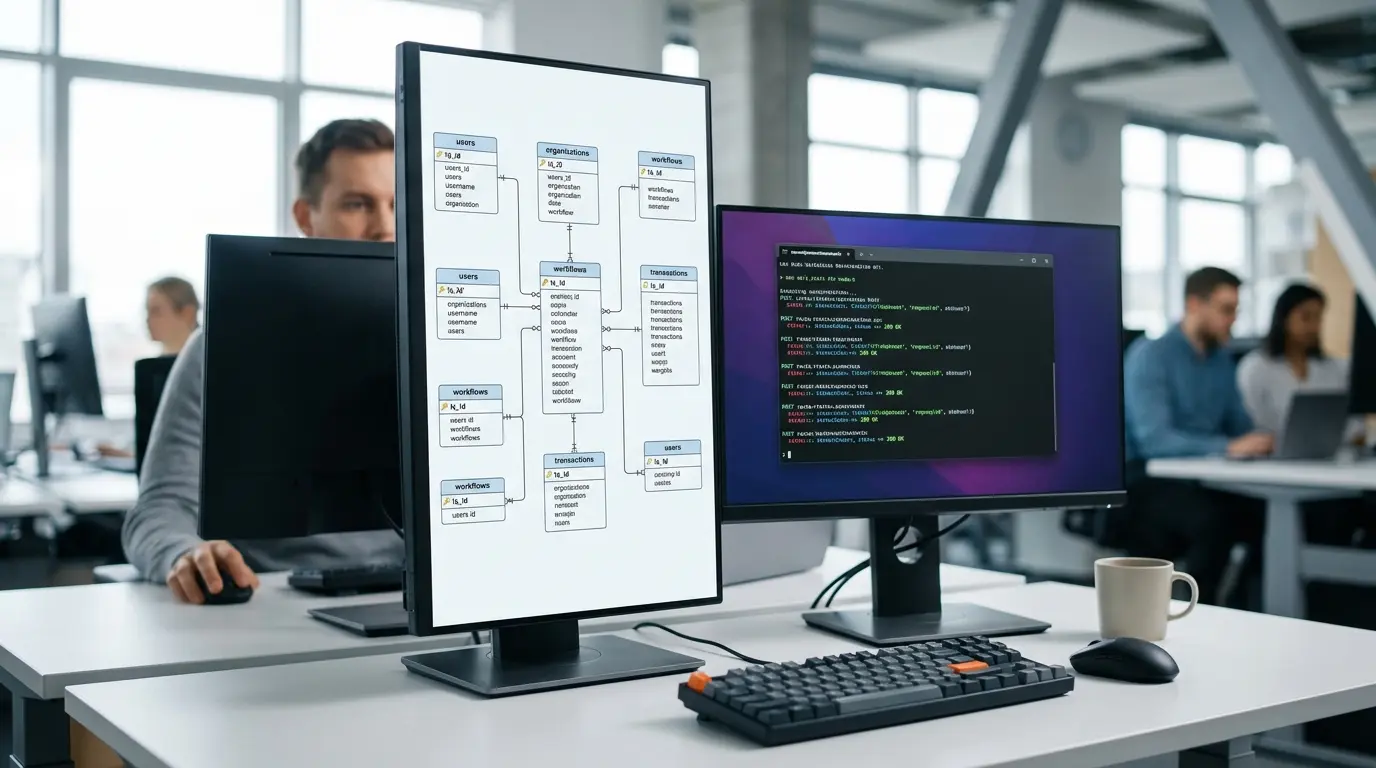
Both options need a plan for partial completion. A form may accept a request while the CRM is unavailable, or an external write may succeed before its response is lost. Give the operation a durable identifier, retain its status and assign unresolved work to an owner. A success message should describe what has actually been confirmed, not imply that every downstream step has finished.
A database transaction covers the operations inside its transaction boundary, not arbitrary external SaaS calls. AWS describes saga patterns as sequences of local transactions with continuation or compensation. For a portal that uses several services, recovery must be designed across those boundaries; an external email or payment is not undone by rolling back a local row.
For every external action, check the destination's status lookup, idempotency behavior and recovery options. Decide when a retry is safe, when a compensating action is permitted and when a person must reconcile the outcome. If an integration cannot confirm delivery, keep that uncertainty visible. These are requirements to test in a no-code setup and a custom implementation alike.
The support-ticket intake guide offers a related example of keeping request context across tools. Use it to list the handoffs your own process needs; it is not proof that a particular connector or portal already meets your requirements.
Exception Handling and Human-in-the-Loop Controls
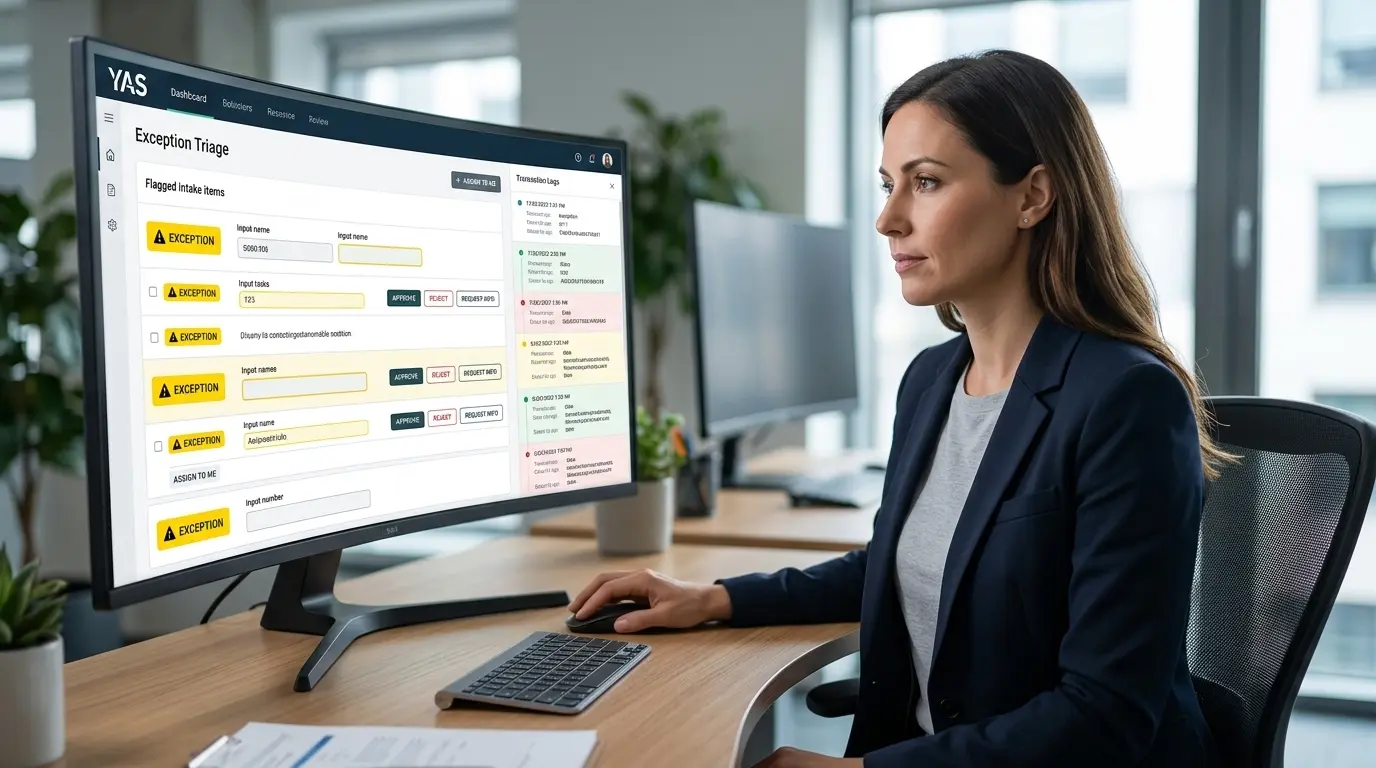
Ask what happens outside the normal path: a duplicate request, a missing document, a disputed change or an absent reviewer. Define the information a reviewer needs and the actions they can take. An alert alone may be insufficient, but a dedicated dashboard is unnecessary if an existing queue already supports the job clearly.
Automation platforms can support explicit error handling. For example, n8n documents error workflows that respond to failed executions and provide error context. The useful comparison is whether the configured workflow handles your failure cases, not a blanket claim that no-code tools only fail silently. Test the actual setup and the relevant plan limits.
A portal becomes attractive when reviewers need a coherent task view that existing tools cannot supply economically: source material, proposed changes, permissions, ownership and a clear next action. Specify who can correct, approve, reject or defer the record. Also specify what happens when a case waits too long. A custom interface still needs an operator and an escalation path.
Permission Boundaries and Regulatory Compliance
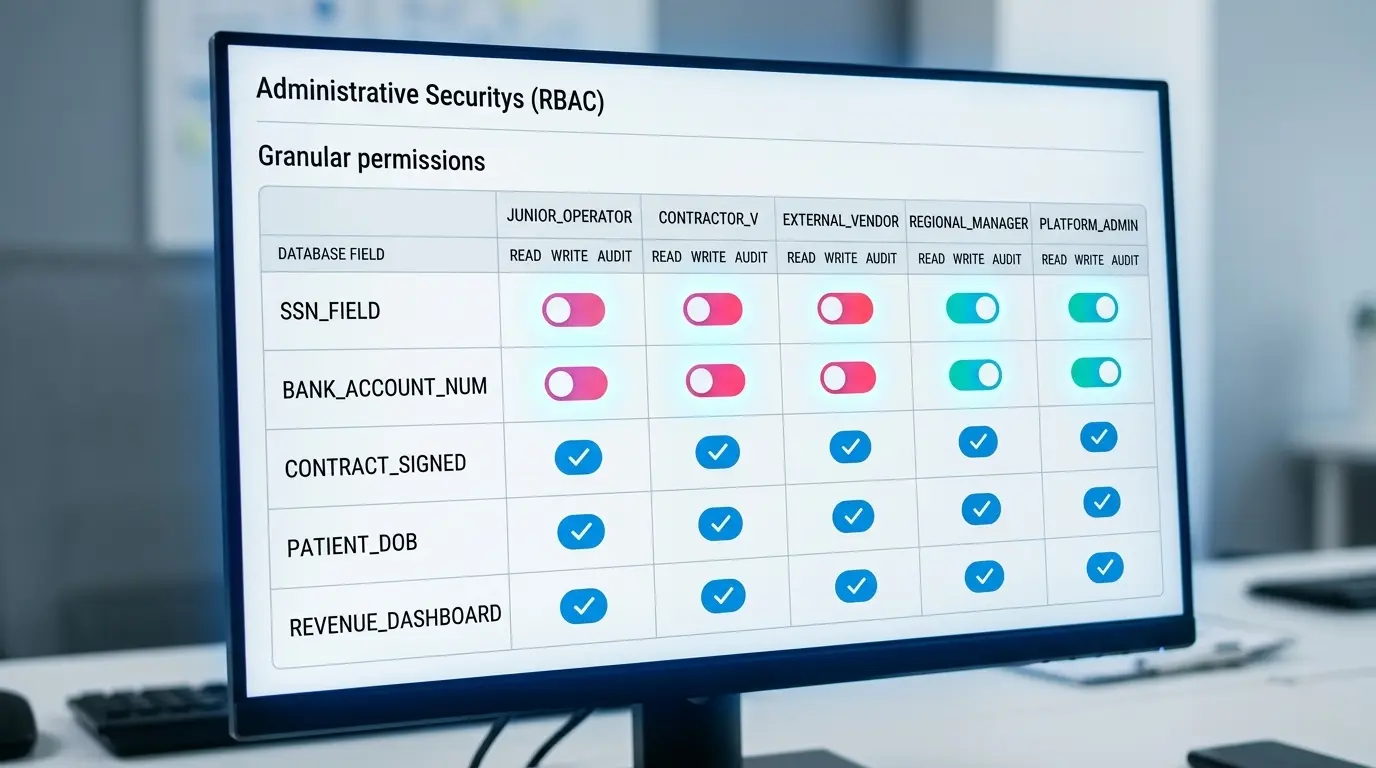
Create a permission matrix before comparing products: which roles may view, edit, approve, export or delete which records? Include contractors, external customers, automation accounts and administrators. Then test access through the API as well as the interface. Hiding a button is not an authorization boundary, and a broad integration credential can bypass a carefully designed screen.
Check each candidate platform's current role model, service-account permissions, audit history and plan restrictions. Do not assume granular access is unavailable in no-code, or available in every paid tier. Conversely, custom development does not remove the work of implementing tenant isolation, access revocation and safe defaults. Compare demonstrated capabilities against the same matrix.
For sensitive information, define what data is necessary, where it will be stored, who can access it and how retention and deletion work across all copies. Neither a custom portal nor a hosted builder is automatically suitable for a regulated workflow. Assess the particular requirements with the responsible security and legal specialists rather than treating an architecture label as compliance evidence.
If the missing piece is a repeatable cross-tool task rather than a whole customer interface, consider a scoped AI automation implementation. AI may assist interpretation or preparation where appropriate; predictable copying and routing may need only ordinary rules. The portal and the automation do not have to be the same project.
Maintenance Realities and Long-Term Engineering Costs
Compare total ownership cost over a realistic planning period: setup, subscriptions, hosting, integrations, operator effort, maintenance and the cost of unresolved work. Use your expected users, workload and storage rather than a generic claim that one architecture becomes cheaper at scale. Include who will diagnose a failure and how quickly normal operations can resume.
A configured stack depends on platform changes, API behavior and plan limits. A custom system adds responsibility for application code, dependency updates, deployments, backups and recovery. Both can still depend on the same external services. Ask for a representative change estimate and a recovery demonstration, not only the initial build price.
Clarify ownership in the agreement: repository and deployment access, environment responsibilities, operating documentation, export formats and the support arrangement. Paying for a custom build does not itself establish those terms. For a hosted tool, test whether your actual records and attachments can be exported in a usable form before relying on a future migration.
Our speed versus structural engineering guide discusses staged decisions. A short-lived prototype can be intentionally limited, but document its boundaries and the conditions that would require replacement. Avoid making the team dependent on a prototype whose responsibilities nobody has agreed to own.
How Custom Engineering Addresses Bespoke Workflow Demands
A custom workflow is worth evaluating when a specific requirement is repeatedly expensive or impossible to meet in the current setup. That could be a customer-facing approval journey, a task interface across several systems or a permission boundary the available tools cannot enforce. It is not a way to remove external API limits or eliminate all operational risk.
YAS can scope and implement a portal, an integration or a controlled AI workflow around that missing capability. Start with one process, the current tools, approximate volume and the practical blocker. We can compare configuration, a small custom layer and a broader build before defining an implementation scope. No credentials or customer records are needed for the initial inquiry.
A proposal should state the supported roles, data ownership, integrations, exception handling, acceptance tests and handover responsibilities. Agree which existing tools stay, what migrates and what is excluded. Maintenance and ongoing support need an explicit arrangement. A working first version should solve a bounded problem before it becomes a replacement for the entire stack.
If interpretation is part of the gap, the agent versus workflow comparison helps separate model suggestions from controlled execution. Do not add an agent simply to make a portal sound more advanced. A stable status rule or a better reviewer screen may be the useful improvement.

Worked example: a client approval journey
This is an illustrative decision scenario, not a delivered client case or a claim of savings. Imagine a service team collecting customer documents, checking completeness and requesting approval before work starts. The current stack has a form, shared storage and a CRM. Customers repeatedly ask which version is approved, while staff copy statuses between tools.
Keep and configure: first test whether existing customer views and permission settings can show the correct document version and approval status. Add an explicit owner and an exception queue. If customers and staff can complete the task without hidden manual copying, a new portal may not be necessary.
Add a narrow portal: if the customer journey remains fragmented, build only authenticated access to the relevant case, versioned document review and an approval record. Keep billing in the existing system. Define which status the CRM owns and which approval evidence the portal owns; do not allow both to overwrite the same field independently.
Test before expanding: try a normal approval, a revised document after approval, a duplicate submission, an unauthorized customer, an absent reviewer and a timeout after the CRM update. Confirm that a customer cannot see another customer's material and that an earlier approval cannot authorize a changed version. Do not migrate every historical attachment until this bounded journey meets its agreed criteria.
A useful first deliverable is an approved workflow and a demonstrated critical path, followed by an implementation proposal where needed. Compare the setup effort, customer effort, operator review and maintenance obligations. The decision may be configuration, a hybrid or a portal; the scenario does not establish a universal winner.
Decision framework: choose the minimum sufficient architecture
Decide whether a no-code stack is sufficient or a portal deserves evaluation. These questions define a review boundary, not an automatic recommendation to build.

- Source of truth. If several teams rely on one current record, include synchronization and reconciliation in the design; temporary single-team intake may not need a portal.
- Permissions and consequences. Standard low-risk approvals can fit configured tools; field-level access, consequential actions or complex exceptions need a stronger authorization model.
- Change rate and repeat volume. When policy changes weekly, keep the system easy to alter. Evaluate custom engineering only after the core job is stable enough to test and recurring enough to operate.
- Ownership and recovery. Name who handles exceptions, access, support and failed writes. If nobody can own the operating system, a custom portal does not remove that gap.
Choose the smallest architecture that preserves the required record, permissions and recovery path. Revisit it when those facts change.
Limitations and suitability
Do not start a full portal build while the core process changes every week, required access is unresolved or nobody owns the result. Test the offer and operating model first. A configured stack can also remain a durable solution after validation if its controls, costs and usability continue to fit; it is not limited to disposable prototypes.
Consider a hybrid when a small part of the journey causes most of the friction. Keep the working CRM or billing service, add an appropriate interface or integration and limit duplicated data. This still creates an integration boundary, so define synchronization and recovery. A smaller build is useful only if it closes the actual gap, not if it adds another place to check.
Before choosing, gather a sample of normal and exceptional jobs, verify access constraints and compare the same acceptance cases in each option. A preferred design that cannot demonstrate its critical permission or recovery behavior is not ready. Use the evidence to narrow the first release and keep a documented exit or rollback plan.
| Decision | Custom portal | Existing stack | Acceptance question |
|---|---|---|---|
| Data ownership | Choose authoritative records and implement conflict rules | Check each tool's record ownership and integration behavior | Can the team reconcile a partial update? |
| Review | Build or integrate the required operator view | Configure and test the available queue and failure paths | Can an owner resolve an exception with its context? |
| Permissions | Implement and test server-side access boundaries | Verify current product and plan capabilities | Can unauthorized roles access records through any route? |
| Cost and capacity | Include development, infrastructure, support and API limits | Include users, usage limits, configuration and operator effort | Does the expected workload fit the total budget? |
| Change and exit | Agree code access, data export and maintenance ownership | Test exports and document platform dependencies | Who can make the next change or migrate the records? |
Evaluation Checklist for System Architecture Decisions
- Map all current operational steps, data inputs, external software endpoints, and human review touchpoints.
- Quantify your monthly transaction volume and evaluate third-party API rate limits and recurring connector costs.
- Audit data governance and regulatory requirements regarding customer privacy, access control, and record retention.
- Identify common edge cases and quantify the operational cost of manual error reconciliation across existing tools.
- Evaluate whether your core business workflow requires proprietary logic that off-the-shelf software cannot execute.
- Determine internal technical capacity to maintain third-party connector dependencies versus dedicated code repositories.
- Develop a staged implementation roadmap that isolates high-risk operational steps prior to full portal migration.
Sustainable operational scale depends on whether your software architecture treats exceptions as routine business events or unexpected technical failures.
FAQ
When is a modular assembled tool stack preferable over a custom portal?
Use an existing stack when its configured workflow satisfies the job, access boundaries, recovery needs and ongoing budget. This can apply during validation or later operation. Keep it under review as requirements change, without assuming that higher volume alone requires custom software.
What is the primary operational risk of scaling with third-party connectors?
The risk is unobserved partial completion across systems, especially when ownership, status checks and recovery rules are missing. This also affects custom portals using external APIs. Check destination acknowledgements, safe retries, reconciliation and a responsible owner for unresolved jobs.
How does a custom startup portal handle human review for edge cases?
It can provide a review view with evidence, proposed changes and authorized actions, but those features must be specified, implemented and tested. An existing queue may already be sufficient. Compare what the operator can actually do, including corrections, escalation and absence coverage.
How should permissions be compared across a portal and several SaaS apps?
Several apps can have different roles and credential scopes, so the same business rule needs checking at each boundary. Some platforms offer granular controls; some plans may not fit. A custom portal also needs server-side authorization, isolation tests and timely access revocation.
How does technical debt accumulate in stitched automation workflows?
Undocumented rules, unnecessary duplication, weak tests and unowned dependencies create technical debt in configured and custom systems. Keep a map of important data and actions, record change ownership and test recovery. Choose an architecture your team can operate rather than assuming that code or no-code prevents debt.